
Blitz Bureau
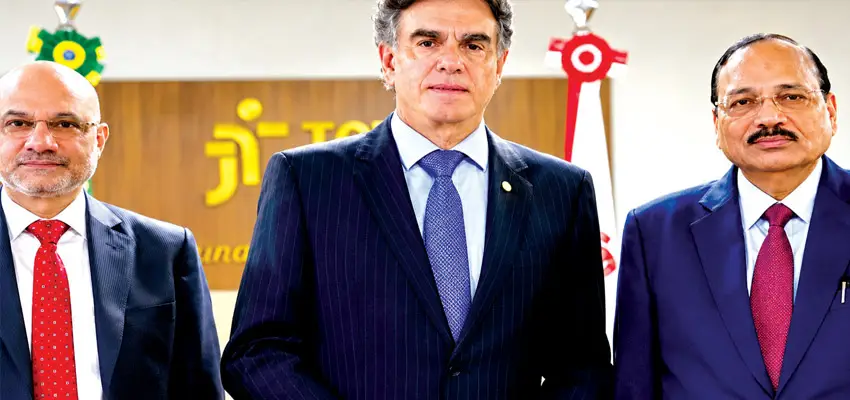
Justice Edson Fachin, President of Brazil’s Supreme Federal Court (STF), met Chief Justice of India Surya Kant, in Brasília recently to discuss expanding judicial cooperation between the two countries, including the possibility of establishing a joint commercial mediation platform within BRICS.
The meeting brought together representatives of both judicial institutions and the Indian Embassy in Brazil, including Indian Ambassador Dinesh Bhatia.
The discussions covered judicial independence, constitutional democracy, digital transformation, mediation, arbitration and the regulation of digital platforms. The two judicial leaders exchanged experiences regarding their respective legal systems and explored opportunities for closer institutional cooperation, particularly in resolving commercial disputes among BRICS member countries.
Shared mechanism
The proposed mediation platform would provide a shared mechanism for addressing commercial disagreements within the bloc. The initiative was among several possibilities examined during the meeting, although no formal agreement or implementation timetable was announced.
Fachin emphasised the importance of exchanging institutional experiences between Brazil and India, particularly in protecting judicial independence and strengthening democratic institutions. He described India as the world’s largest democracy and highlighted the value of learning from its judicial experience.
The Brazilian Justice stressed that judicial independence should be understood as a guarantee for citizens rather than a privilege granted to judges. He presented the principle as essential to protecting fundamental rights, limiting the exercise of political power and preserving constitutional autonomy.
Technological transformation was another central topic. The discussions addressed the growing use of digital tools in judicial proceedings, the challenges of regulating online platforms and the need to balance digital governance with freedom of expression.
Later, the Indian Supreme Court delegation met Rodrigo Badaró, a member of Brazil’s National Council of Justice (CNJ), in Brasília.
Technological knowledge
Badaró presented the council’s efforts to become a centre for technological knowledge and development, emphasising that Artificial Intelligence in the judiciary should advance alongside technological sovereignty and cybersecurity.
He identified data protection as a priority and argued that control over judicial information should not remain exclusively in the hands of private companies. His proposals included establishing a national cloud infrastructure, developing Brazilian AI capabilities and increasing investment in technological infrastructure.
As president of the CNJ’s National Committee on Artificial Intelligence in the Judiciary (CNIAJ), Badaró suggested sending a Brazilian specialist to India for a short training programme aimed at strengthening bilateral cooperation. He also asked Ambassador Bhatia to assist in formalising the initiative.
The Brazilian strategy involves developing proprietary software and technological modules supported by high-capacity data storage servers. It also includes a programme allowing judges and court employees to use Artificial Intelligence tools under controlled conditions.
The objective is to reduce risks associated with AI-generated errors, including fabricated judicial decisions, while limiting dependence on privately developed corporate technologies.
The Indian delegation, whose Supreme Court also maintains a committee dedicated to Artificial Intelligence, acknowledged that the two countries face similar challenges in integrating emerging technologies into their judicial systems.
Human understanding
During his exchange with Badaró, Chief Justice Surya Kant emphasised that technology should assist judicial authorities rather than assume control over the administration of justice. He argued that AI could be authorised to support courts but should never replace judges or dominate judicial decision-making.
According to the Indian Chief Justice, the interpretation of human circumstances and the assessment of mitigating factors remain responsibilities that must be exercised by judges. He emphasised that Artificial Intelligence, as software, lacks the human understanding required for judicial reasoning and the administration of justice.
The discussions reflected a shared interest in technological modernisation while maintaining human oversight of judicial decisions.
The Indian delegation also included Nawab Singh, Chairman of the Supreme Court’s High-Level Committee; Registrars Rakesh Kumar and Kuntal Sharma Pathak; Deputy Chief of Mission Sandip Kumar Kujur; and Executive Assistant Bruno Eduardo da Silva Balestrini Godoy.
The discussions covered judicial independence, constitutional democracy, digital transformation, mediation, arbitration and the regulation of digital platforms

Judicial AI conference next year
During the discussions with Chief Justice of India Surya Kant, Brazil’s National Council of Justice member Rodrigo Badaró announced the CNJ’s plans to organise its second conference on Artificial Intelligence in justice system, in early 2027.
The previous edition of the conference brought together representatives of all 91 courts in Brazil, covering state, federal, labour and military jurisdictions.
The CNJ representative formally invited the Indian Supreme Court’s Artificial Intelligence Committee and Ambassador Bhatia to participate in the upcoming conference. He also expressed interest in organising a reciprocal institutional visit to India.
The meeting included a presentation by Camila Salmoria, an auxiliary judge at Brazil’s National Justice Inspectorate, and CNJ official Daniel Castro. They outlined the activities of the CNIAJ and provided an overview of Brazil’s judicial system.
According to the Justice in Numbers 2026 report, Brazilian courts currently have approximately 75 million pending cases, highlighting the scale of the country’s judicial workload and the potential relevance of technological solutions.