01 Governance & the Union Cabinet
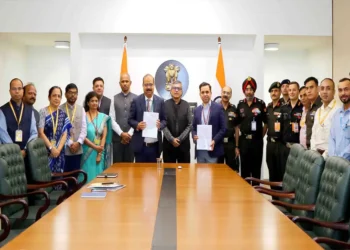
• 1 September — Ministry of Electronics and Information Technology. The government notified Semicon 2.0, the next phase of the India Semiconductor Mission, with a fiscal outlay of ₹1,27,500 crore across six pillars, and a support framework that runs beyond ordinary subsidy into seed funding, equity co-investment, royalty financing and deployment-linked incentives.
• 5 September — Rashtrapati Bhavan and the Ministry of Education. The President conferred the National Teachers Awards on forty-eight school teachers at Vigyan Bhawan, selected through a three-stage district, State and national scrutiny, and said a Viksit Bharat will be possible only on quality education.
• 4 September — Parliament. A joint committee was constituted on the Bill governing foreign contributions, taking the measure into detailed scrutiny rather than to an immediate vote.
02 Economy, GDP & public finance
• 31 August — National Statistics Office. Real GDP grew 7.8 per cent in Q1 of FY 2026-27 against 6.9 per cent a year earlier; nominal GDP grew 10.3 per cent, which places the implied whole-economy deflator at about 2.3 per cent — the calmest price reading inside a fast quarter that the series has carried in some time.
• 31 August — National Statistics Office. The tertiary sector grew 10.0 per cent, led by financial, real estate, IT and professional services at 12.1 per cent; the secondary sector 8.6 per cent with manufacturing at 9.2 per cent; the primary sector 2.9 per cent, agriculture and allied at 3.6 per cent, mining and quarrying contracting 2.4 per cent.
• 31 August — National Statistics Office. The new series with base year 2022-23 now applies double deflation to manufacturing, deflating output and intermediate consumption separately — a change that makes the manufacturing number harder to read in a quarter of moving input prices, and which the press note says so in as many words.
• 1 September — Ministry of Finance. Gross GST for August stood at ₹1,99,853 crore, up 14.8 per cent; refunds rose 67.9 per cent to ₹31,795 crore, so net revenue grew a slower 8.3 per cent — a gap worth reading as faster refunding rather than as slower business.
03 Markets, banking & insurance
• 4 September — Reserve Bank of India. Foreign exchange reserves reached a record $740.8 billion for the week ended 28 August, up $11.48 billion — foreign currency assets $600.670 billion, gold $116.409 billion, Special Drawing Rights $18.810 billion and the reserve position in the IMF $4.914 billion.
• 3 September — Japan Credit Rating Agency. India’s sovereign rating was lifted one notch to ‘A−’, with the country ceiling at ‘A’. A ceiling matters more than the rating itself to an Indian borrower, because it caps what any Indian company can be rated whatever its own books look like.
• Week to 4 September — BSE and NSE. The Sensex closed the week at 76,515.43 and the Nifty 50 at 23,897.70, both down about one per cent, with Friday’s 362-point rise snapping a four-session decline.
• 5 September — National Financial Reporting Authority. An audit-quality advisory committee was constituted, putting the regulator’s quality review work on a standing footing rather than a case-by-case one.
04 Industry, manufacturing & MSME
• 31 August — National Statistics Office. Manufacturing GVA grew 9.2 per cent in real terms in Q1 FY 2026-27, and within the fast indicators the Index of Industrial Production for electrical equipment rose 27.0 per cent, capital goods 15.2 per cent and other transport equipment 19.5 per cent year on year.
• 1 September — Office of the Economic Adviser, DPIIT. The Index of Core Industries was rebased and widened from eight core industries to nine, iron ore joining the list and steel now counted gross; the old series stands discontinued, and the bridge factor between the two is 1.47.
• 1 September — India Semiconductor Mission. All six pillars of Semicon 2.0 stood notified, giving equipment and materials suppliers — the part of the chip business India has least of — a scheme of their own for the first time.
05 Trade, exports & FTAs
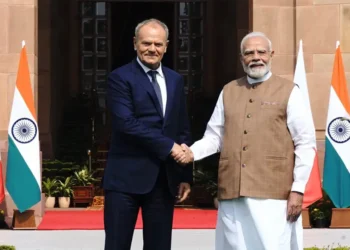
• 2 to 4 September — Ministry of External Affairs and Ministry of Commerce and Industry. Belgian Prime Minister Bart De Wever visited India with his defence minister and fifteen companies, the first such visit in twenty years, with diamonds, ports, logistics, clean energy and maritime cooperation on the table, and the India–European Union trade agreement as the frame around all of it.
• 31 August — National Statistics Office. Exports of goods and services grew 25.8 per cent in nominal terms in Q1 FY 2026-27 and imports 30.9 per cent; within that, exports of transport goods rose 52.2 per cent and imports of machinery and equipment 51.5 per cent — a trade account being pulled by capital goods on both legs.
• 4 September — Ministry of Commerce and Industry. India posted a commercial attaché to Brussels, putting a permanent trade presence next to the European Union’s institutions rather than routing the work through the bilateral mission alone.
06 Infrastructure, transport & urban development
• 31 August — National Statistics Office. Construction GVA grew 7.7 per cent in real terms and 16.5 per cent in nominal terms in Q1; the cement production index rose 8.9 per cent, finished steel consumption 8.3 per cent and the IIP for infrastructure and construction goods 7.2 per cent.
• 31 August — National Statistics Office. Railway passenger kilometres grew 8.3 per cent and cargo handled at major ports 6.2 per cent, while railway net tonne kilometres slipped 0.7 per cent — passengers moving faster than freight, which is the reverse of the usual Indian pattern and worth watching.
• 4 September — Ministry of Civil Aviation. An order for forty turboprop aircraft for regional routes was reported, the aircraft class that decides whether a small-town airport has a schedule or only a runway.
07 Energy, renewables & climate
• 31 August — National Statistics Office. The IIP for electricity rose 9.3 per cent year on year in Q1 FY 2026-27 against a fall of 1.5 per cent a year earlier, and GVA for electricity, gas, water supply and other utilities grew 8.9 per cent against a contraction of 1.8 per cent.
• 1 September — Petroleum and Natural Gas Regulatory Board and Energy Efficiency Services Limited. The two signed a memorandum on smart metering for piped natural gas, the unglamorous instrument that decides whether a city gas network can bill accurately enough to expand.
• 5 September — Comptroller and Auditor General, tabled report. The audit of the Solar Energy Corporation of India recorded an enterprise resource planning system running beside the business rather than inside it — and the corporation’s reply is on the same record.
08 Agriculture, rural development & cooperatives
• 31 August — National Statistics Office. Agriculture and allied activities grew 3.6 per cent in real terms in Q1 FY 2026-27, with total foodgrain output up 4.8 per cent and rice 6.2 per cent; fertiliser subsidy — urea and nutrient-based together — rose 57.6 per cent year on year.
• 3 September — Department of Consumer Affairs. The onion buffer was moved out of Nashik by rail, the stock leaving the warehouse for the consuming markets before the price signal rather than after it.
• 4 September — ICAR and the Assam Agricultural University record. Work was reported on an indigenous pig line showing resistance to a disease that kills others of its kind — a livestock story that matters most in the North East, where the animal is a household’s savings account.
09 Health & pharmaceuticals
• 2 September — Indian Council of Medical Research. Three diagnostic technologies were opened for transfer to industry, the Council inviting manufacturers to licence and make them rather than keeping them at the bench.
• 3 September — Ministry of External Affairs. Relief consignments to flood-hit Nepal included forensic kits and medical supplies, carried on successive Indian Air Force C-130J flights.
• Week of 31 August — Department of Pharmaceuticals. India Pharma 2026 opened in New Delhi alongside the India Medical Device edition, with the Department’s Secretary setting the target of India as a global hub for quality medical devices rather than a supplier of volume alone.
10 Education, skilling & youth
• 5 September — Rashtrapati Bhavan. The President conferred the National Teachers Awards on forty-eight teachers — 26 men, 22 women, 27 States, seven Union Territories and six central organisations, Uttar Pradesh with three awardees and Bihar, Madhya Pradesh, Maharashtra, Rajasthan and West Bengal with two each.
• 5 September — Ministry of Corporate Affairs. The Corporate Mitra programme opened its first batch with 2,879 learners, a training line aimed at the compliance work small companies cannot afford to buy in.
• 5 September — Prime Minister’s Office. The Prime Minister addressed the centenary of Shri Ram College of Commerce, Delhi — a hundred years of one college being an argument about what commerce education is for.
• 4 September — International Earth Science Olympiad. Indian students returned with nine medals, an event in which the country has not historically been a fixture.
11 Science, space & technology
• 4 September — Indian Space Research Organisation. GSLV-F17 lifted off from the second launch pad at Satish Dhawan Space Centre at 2:55 AM and placed EOS-05 into a sub-geosynchronous transfer orbit about nineteen minutes later, the vehicle performing better than the mission profile required.
• 4 September — ISRO. EOS-05 is India’s first imaging satellite intended to work from geostationary orbit — continuous observation from a fixed point rather than repeat passes — and is the successor to the GISAT-1/EOS-03 mission lost in flight.
• 5 September — Council of Scientific and Industrial Research. Seven CSIR technologies were licensed to industry, and the Council’s own reference-material work — the Bharatiya Nirdeshak Dravya standards India used to import — was set out with five glass cells of certified atoms behind it.
• 4 September — CSIR-National Aerospace Laboratories, Bengaluru. Micro gas turbine engines were unveiled, a small-engine class India has largely bought abroad; and IIT Roorkee reported a multi-axial test rig built to shake buildings the way an earthquake does.
12 Defence & internal security
• 3 September — Department of Defence Production. Registrations opened for Aero India 2027, the sixteenth edition, to be held at Air Force Station Yelahanka, Bengaluru, from 8 to 12 February 2027.
• 2 to 4 September — Ministry of Defence. Belgium’s defence minister travelled with the Belgian Prime Minister, taking defence and maritime cooperation into the bilateral conversation alongside trade.
• Week to 5 September — Indian Air Force and Ministry of External Affairs. Successive C-130J sorties carried relief into Nepal, the transport fleet doing the work that a strategic airlift capacity exists to do.
13 Law, justice & Parliament
• 4 September — Supreme Court of India, New Delhi. Delhi hosted the BRICS Chief Justices’ Forum, bringing the senior judiciary of the member economies to one table — a strand of BRICS cooperation that rarely gets reported and quietly shapes commercial dispute practice.
• 4 September — Parliament. A joint committee was constituted on the Bill governing foreign contributions.
• Week to 5 September — Comptroller and Auditor General. Reports tabled in the week covered the Green India Mission across 2015-16 to 2024-25, a State fiscal report on Haryana, and central public sector enterprise accounts — in each case with the audited body’s reply carried on the same record.
14 Social welfare, women & child, tribal affairs
• 4 September — Ministry of Social Justice and Empowerment. Ten crore people were reported to have taken the drug-free pledge under the Nasha Mukt Bharat Abhiyaan, a campaign whose measure is participation rather than prosecution.
• 4 September — Ministry of Labour and Employment. A special drive was reported to have freed more than 3,800 children from work, with rehabilitation and schooling the stated next step rather than the rescue count alone.
• 4 September — Ministry of Housing and Urban Affairs. NAMASTE cards were distributed to waste pickers in Najafgarh, Delhi — identity being the first thing a sanitation worker needs before any entitlement can reach them.
15 The States & the North East
• 4 September — India Meteorological Department. An orange warning was issued for Madhya Pradesh, the monsoon making its late-season demand on the State’s districts.
• 3 September — Comptroller and Auditor General, Report No. 1 of 2026 (Haryana). The State finance audit was tabled, setting out Haryana’s fiscal position in ratios rather than in adjectives — and the reply of the State government is carried in the same report.
• 1 September — Ministry of Panchayati Raj. 2.19 lakh panchayats were reported service-ready on the common service delivery framework, with BharatNet’s scope widened to 6.4 lakh villages — the gap between fibre laid and signal used remaining the live question.
• 1 September — Sports Authority of India and the Government of Assam. A National Centre of Excellence for swimming was reported for Assam, a discipline in which the North East has water and has lacked pools.
16 Culture, heritage & tourism
• 4 September — across India. Janmashtami was observed nationally, the festival that fills Mathura and Dwarka and, increasingly, the domestic tourism calendar around them.
• 4 September — Mumbai. The Belgian Prime Minister’s Mumbai leg took in the diamond trade, the craft economy that links Antwerp’s cutting rooms to Surat’s polishing floors and employs, in Gujarat alone, a workforce that runs to the hundreds of thousands.
• 5 September — New Delhi. The centenary of Shri Ram College of Commerce was marked with an address by the Prime Minister — institutional heritage of a kind India rarely counts as heritage at all.
17 Sport
• 3 September — Dubai, Women’s T20 Asia Cup. India secured a semi-final place with a 137-run win over Hong Kong China, having opened the campaign against Thailand on 30 August; the fixture against Pakistan followed on 5 September. The tournament runs in the United Arab Emirates from 28 August to 13 September 2026.
• 4 September — China Masters badminton. Kidambi Srikanth reached the quarter-finals, a stage of a Super 750 draw that Indian men’s singles has found hard to reach with any regularity this season.
• 1 September — Sports Authority of India. A National Centre of Excellence for swimming was announced for Assam, addressing a discipline where India’s talent identification has been thinnest.
18 India & the world
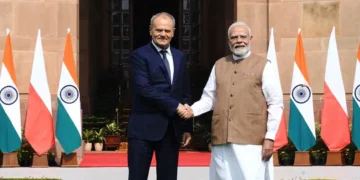
• 2 to 4 September — Ministry of External Affairs. Belgian Prime Minister Bart De Wever made the first visit by a Belgian head of government to India in two decades, accompanied by the defence minister and fifteen companies, with a long bilateral meeting in Delhi on 3 September and a Mumbai industry leg on 4 September.
• Week to 5 September — Ministry of External Affairs. India’s relief operation for flood-hit Nepal continued through the week, with successive Indian Air Force C-130J flights carrying medical supplies and forensic kits and the total consignment passing 68 tonnes.
• 4 September — New Delhi. The BRICS Chief Justices’ Forum met in Delhi, ahead of the wider BRICS calendar India is hosting this year.
• 5 September — Ministry of Commerce and Industry. The first working meeting under the India–European Union trade agreement framework was reported, with four questions placed on the table and a commercial attaché now posted to Brussels.