Blitz Bureau
NEW DELHI: Every discussion of Indian water begins with rivers and should begin with wells. Groundwater supplies about 62% of the country’s irrigation, 85% of rural drinking water and 50% of urban supply. No other single resource carries that combination of loads, and no other is as invisible: a river running low is a photograph, while an aquifer falling three metres a year is a number in a table that almost nobody reads. This year’s monsoon forecast sharpens the point — the IMD expects July rainfall below 94% of the long period average, against a 1971–2020 monthly normal of 280.4 mm, with northwest, northeast and parts of east-central India the exceptions and much of the rest of the country below normal.
The demand side explains the structure of the problem. Agriculture accounts for roughly 89% of India’s groundwater use, and within agriculture the pressure is concentrated in water-intensive crops — paddy and sugarcane — grown in semi-arid regions where the rainfall does not support them and the aquifer does. The regional data follows exactly that logic: monitored wells show a decline of 42.16% in Punjab and 38.27% in Haryana, the two states that did most to secure India’s food supply and that have paid for it in water. This is not a story of failure. It is a story of a policy that succeeded so completely at its original objective that its side effects became the next generation’s central problem.
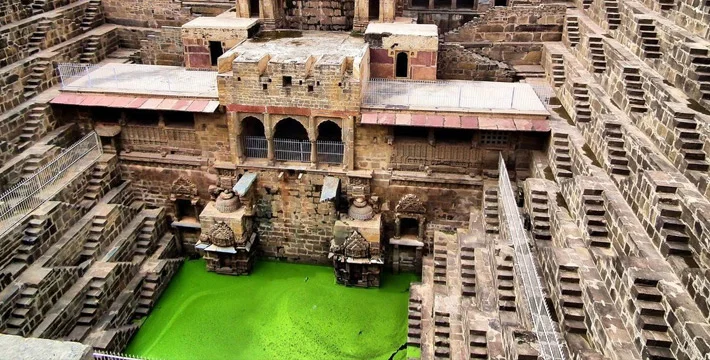
India solved this once before: the stepwell was a technology for storing monsoon water through a dry year. The modern equivalent is recharge structures and cropping choices that put water back as fast as pumps take it out.
Surface water is politics. Groundwater is arithmetic. India has spent decades arguing about the first while the second quietly decided the outcome.
At a Glance
• Dependence: groundwater supplies ~62% of irrigation, 85% of rural and 50% of urban water
• Demand: agriculture accounts for about 89% of groundwater use
• Regional stress: monitored-well declines of 42.16% in Punjab and 38.27% in Haryana
• Recent gain: 73% of monitored wells nationwide showed a rise in levels after the 2025 monsoon
• Institutions: 712 Jal Shakti Kendras operational as of December 30, 2025
• Recharge works: 39,60,333 artificial recharge structures completed under Jal Sanchay Jan Bhagidari as of January 2026
• This July: IMD forecasts rainfall below 94% of the long period average (normal 280.4 mm)
What makes this a solvable problem rather than a bleak one is that the recovery mechanism has been demonstrated. After the 2025 monsoon, 73% of monitored wells across the country recorded a rise in groundwater levels — aquifers refill when rainfall is good and when the water is helped to get underground rather than running off. That “helped” is the operative word, and it is where the institutional build-out matters: 39,60,333 artificial recharge works completed under Jal Sanchay Jan Bhagidari as of January 2026, and 712 Jal Shakti Kendras operational at the end of December 2025, are the physical and administrative infrastructure of putting water back. Recharge is the one intervention that works on the supply side of an aquifer, and India is now doing it at a scale visible in the national data.
The harder half is demand, and the constructive framing is that it is a pricing and cropping question rather than a moral one. Farmers in Punjab and Haryana are responding rationally to the incentives they face: assured procurement for paddy, near-zero marginal cost of pumping, and no signal anywhere in the system about the depth of the water table. Change any one of those and behaviour changes with it. The instruments that have worked in Indian conditions are known — direct-seeded rice and alternate wetting and drying, which cut water use substantially without cutting yields; micro-irrigation subsidies tied to measured extraction rather than area; procurement diversification towards millets, pulses and oilseeds so that a farmer switching crops is not switching into an uncertain market; and metered or paid-for power that compensates farmers in cash for saved electricity rather than penalising them. Each of these has run successfully somewhere in India already. The task of the next decade is not invention. It is making the successful pilot the default, aquifer block by aquifer block, and publishing the water table alongside the rainfall so that the country can see the resource it has been spending.