Blitz Bureau
NEW DELHI: India is the world’s largest consumer of groundwater, and for three decades the story of that consumption was a straight line downwards. The most recent official assessment tells a different one. The country’s total annual groundwater recharge rose from 432 billion cubic metres in 2017 to 448.52 billion cubic metres in 2025. After the 2025 monsoon, 73% of monitored wells across the country showed a rise in water level, and average levels now sit above the mean of the previous decade. Measured against the trajectory India was on, that is one of the more consequential reversals in the country’s development record — and one of the least discussed.
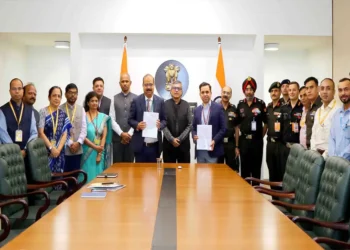
The reversal was engineered rather than gifted. A network of 43,228 groundwater monitoring stations, operated largely by the Central Ground Water Board, replaced guesswork with data. Some 712 Jal Shakti Kendras are now operational as district-level water resource centres. And under the Jal Sanchay Jan Bhagidari programme, 39,60,333 artificial recharge works had been completed as of January 2026 — check dams, percolation tanks, recharge shafts and revived traditional structures, built at a scale that only makes sense when the unit of intervention is the village rather than the state.
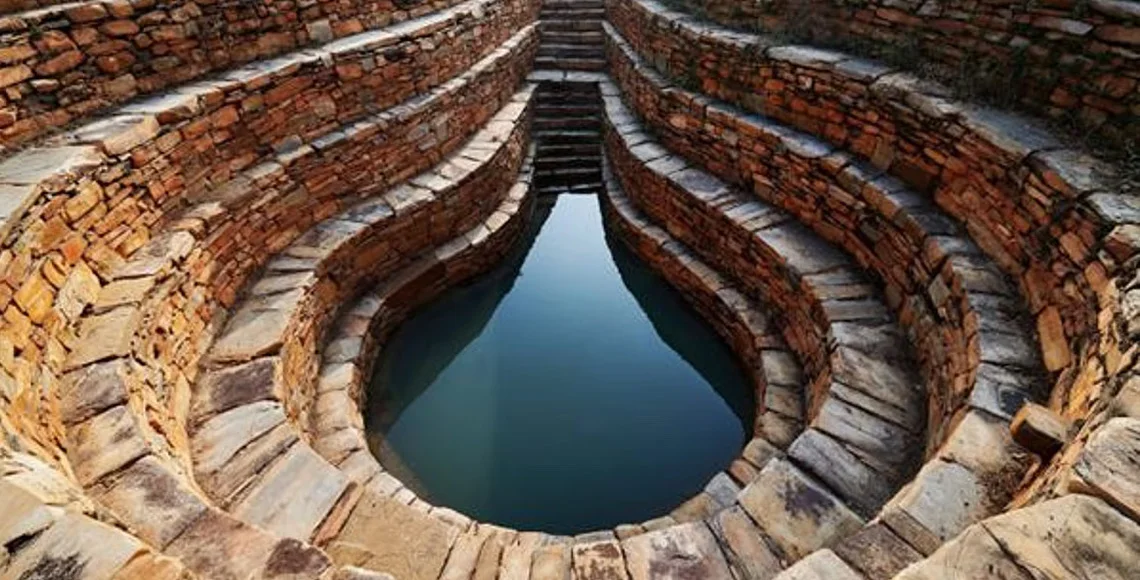
An old idea, industrialised: the stepwell was a recharge and storage structure. Nearly four million modern artificial recharge works apply the same logic at national scale.
Recharge is rising nationally and falling where the food is grown. A country-level average is the one number that cannot describe an aquifer.
At a Glance
• Annual groundwater recharge: 432 bcm in 2017, rising to 448.52 bcm in 2025
• After the 2025 monsoon: 73% of monitored wells showed a rise in level
• Monitoring network: 43,228 groundwater level monitoring stations
• Jal Shakti Kendras: 712 operational as of end-December 2025
• Recharge works: 39,60,333 completed under Jal Sanchay Jan Bhagidari as of January 2026
• Still declining: agriculture-intensive districts of Punjab and Haryana, parts of Meghalaya, and rapidly urbanising districts
• Principal driver of extraction: irrigation, particularly of water-intensive cereals
The honest qualification is geographic. Levels continue to decline in exactly the districts that matter most to national food security — the intensively irrigated belts of Punjab and Haryana, parts of Meghalaya, hilly districts where recharge geology is unfavourable, and the peri-urban districts where concrete is replacing farmland faster than recharge structures are being built. A national average that improves while the grain bowl depletes is not a contradiction; it is a signal that the recharge programme is succeeding in the places where it was easiest to build and has the hardest work still ahead.
What closes that gap is largely agronomic rather than hydrological, and the levers are well identified. The single largest one is crop choice: shifting a share of the paddy area in the north-west to maize, pulses, oilseeds and millets would cut extraction more than any structure could replace, and it becomes attractive to a farmer only when procurement, storage and price assurance follow the alternative crop as reliably as they follow rice. Alongside that: direct-seeded rice and alternate wetting and drying, which cut water use per tonne without changing the crop; metered or feeder-separated agricultural power with the savings returned to the farmer rather than withdrawn from him, which converts free electricity from an incentive to over-pump into an incentive to conserve; mandatory recharge in urban building codes, so that new construction adds to the aquifer it sits on; and publication of block-level extraction and recharge data in a form a panchayat can read, since community management works only when the community can see the balance sheet. India has already proved the difficult half of this problem is solvable. The remaining half is a matter of putting the same effort where the water is actually being used.