Freight corridor complete, ports move closer to factories
NEW DELHI: A container leaving a factory in Sanand has spent the past decade waiting its turn. It waited behind the Rajdhani, behind the local passenger service, behind whatever the section controller judged more urgent, because on Indian Railways a goods train has always been the last thing to move. From this afternoon it no longer waits. Prime Minister Narendra Modi will at around noon dedicate to the nation three sections of the Western Dedicated Freight Corridor — New Sanand (North) to New Makarpura, New Umbergaon to New Saphale, and New Saphale to New JNPT — covering 326 route kilometres built at a cost of more than ₹20,700 crore, according to the Prime Minister’s Office announcement of 7 September 2026.
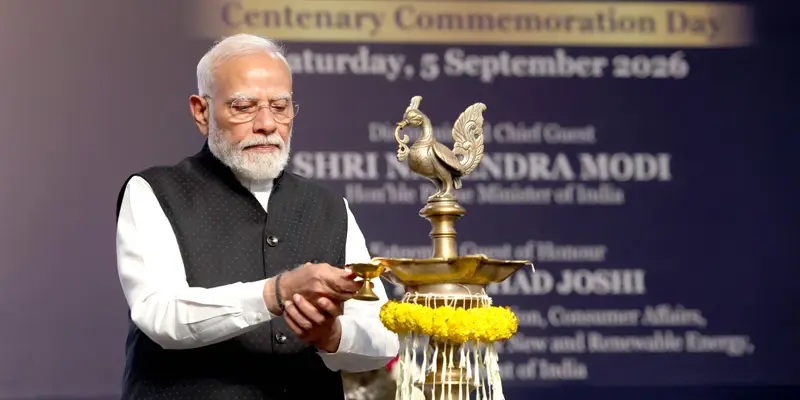
With that, the announcement says, the Dedicated Freight Corridor network stands fully operational across its entire length. Union Railway Minister Ashwini Vaishnaw, speaking to reporters at Ahmedabad airport on 7 September said both the Eastern and the Western corridors are now complete.
What a separate track actually buys
The engineering answer and the economic answer are different, and the second is the interesting one. A dedicated freight line is not merely a faster line; it is a line on which a goods train has a right of way it has never had. The three sections dedicated today give Jawaharlal Nehru Port Authority a direct rail connection, which the announcement says will speed the movement of export and import cargo, link industrial centres to ports, cut logistics costs and decongest Mumbai’s suburban railway network.
That last item is worth pausing on. Every freight train pulled off the Mumbai network is a path released for a passenger service on the most crowded commuter railway on earth. The corridor was built to move cargo; one of the things it will actually move is people.
The corridor is the largest item but not the only one. The Prime Minister will lay foundation stones for three railway projects spanning 329 kilometres at more than ₹9,700 crore — the third and fourth lines between Vadodara and Ratlam, the Miyagam Karjan–Choranda–Malsar gauge conversion, and the doubling of the Vishwamitri–Dabhoi section. Three National Highway projects worth about ₹1,780 crore follow, among them the six-laning of the Kamrej–Chalthan stretch of NH-48 and new major bridges over the Tapi and the Narmada. Gujarat’s own projects, worth about ₹2,600 crore, include the second phase of the Vadodara ring road and a 110 MW floating solar plant at Kadana dam.
He will also dedicate the Jobat–Tanda Road rail line, part of the Chhota Udepur–Dhar project, which brings the remote and tribal blocks of Alirajpur onto the national rail map for the first time. For a household in Alirajpur that is not an infrastructure statistic. It is the difference between a day’s journey and a train.
What India gains
India spends more of every rupee of output on moving goods than its competitors do, and almost every serious plan to change that has ended at the same bottleneck: a railway on which freight is a guest. That bottleneck is now gone on the two corridors that carry the country’s heaviest traffic. An exporter in Gujarat can put a container on a train and know when it will reach the quay at Nhava Sheva. Certainty of that kind does not show up in a growth figure for some years, but it is the thing every logistics manager in the country has been asking for, and from today it exists.
BLITZ DATA CARD :THE RECORD
Western Dedicated Freight Corridor, final sections dedicated: 326 route km
Cost of those sections: more than ₹20,700 crore
Sections: New Sanand (N)–New Makarpura · New Umbergaon–New Saphale · New Saphale–New JNPT
New railway projects, foundation stone: 329 km, more than ₹9,700 crore
New National Highway projects: about ₹1,780 crore
Government of Gujarat projects: about ₹2,600 crore
Total announced for Vadodara: more than ₹35,000 crore
Floating solar plant at Kadana dam: 110 MW
THE COMPARISON — cost per kilometre of the two rail packages
Freight corridor sections █████████████████████ ₹63.50 crore/km
New line and doubling works █████████▌ ₹29.48 crore/km
BLITZ CALCULATION — derived here, absent from the announcement
₹20,700 crore ÷ 326 km = ₹63.50 crore per kilometre for the freight corridor sections. ₹9,700 crore ÷ 329 km = ₹29.48 crore per kilometre for the new lines and doubling — a difference of 115 per cent, which is what a fully electrified, heavy-axle-load freight alignment costs over a conventional one.
Leg-sum check: 20,700 + 9,700 + 1,780 + 2,600 = ₹34,780 crore. The announcement puts the day’s total at more than ₹35,000 crore, so the balance sits in the Jobat–Tanda Road line and the services flagged off, which are not separately costed.
WHAT INDIA GAINS
A goods train that no longer waits its turn — an export container from Gujarat reaching Nhava Sheva on a schedule an exporter can quote to a buyer abroad, and a Mumbai suburban network with freight paths handed back to it.
Defence Council clears ₹1.10 lakh crore
The Defence Acquisition Council, chaired by Raksha Mantri Rajnath Singh, granted Acceptance of Necessity on 7 September 2026 to proposals costing about ₹1,10,000 crore, according to the Ministry of Defence release of the same date. The single figure that matters sits at the foot of that release: approximately 98 per cent of the procurements will be made from Indian industry.
The Army’s list is a list of the unglamorous things that decide whether a formation can move: vehicles that detect and mark chemical, biological, radiological and nuclear contamination; high-mobility vehicles for difficult ground; self-propelled mechanical mine layers; Advanced Light Helicopters; trawl tanks and the Sarvatra bridge system for crossing water under fire. The Navy gets Arudhra radars to replace the air route surveillance radars at its air stations, and — the item with the longest reach — the design, development and subsequent purchase of marine gas turbines, the propulsion system of a warship, which the ministry says will reduce dependence on foreign vendors. The Air Force gets a ground-based multi-purpose jammer and a secure access card system that retires paper identity passes for radio-frequency smart cards.
What India gains
A marine gas turbine is the sort of thing a country either makes or asks permission to buy. Designing one at home changes the terms on which every future Indian warship is powered. And of ₹1,10,000 crore approved, about ₹1,07,800 crore is set to be placed with Indian firms — a domestic order book roughly fifty times the size of the balance.
BLITZ DATA CARD :THE RECORD
Acceptance of Necessity accorded, 7 September 2026: about ₹1,10,000 crore
Share to be procured from Indian industry: approximately 98 per cent
Army: CBRN Recce Vehicles · High Mobility Vehicles · Self-Propelled Mechanical Mine Layers · Advanced Light · Helicopters · Trawl Tanks · Sarvatra Bridge System
Navy: Arudhra Radars · Marine Gas Turbines (design, development and procurement)
Air Force: fighter, transport and helicopter capability · Ground-Based Multi-Purpose Jammer · DEFSAC secure access cards
THE COMPARISON — where the ₹1,10,000 crore is to be spent
Indian industry ███████████████████████████████████████ 98%
Balance ▌ 2%
BLITZ CALCULATION — derived here, absent from the release
₹1,10,000 crore × 98 per cent = about ₹1,07,800 crore to Indian industry, leaving about ₹2,200 crore outside it. The domestic share is therefore 49 times the rest.
WHAT INDIA GAINS
Order books for Indian defence firms and their suppliers, and a warship propulsion system designed in India rather than sought from abroad.
Exporters get a direct line into DGFT
An exporter in Tiruppur has, until now, typed the same consignment details twice: once into the firm’s own accounting software, and again into the government’s certificate-of-origin portal. From 7 September onwards the second typing is optional. The Directorate General of Foreign Trade has opened an application programming interface on the Trade Connect e-Platform that lets a company’s own software talk directly to the certificate-of-origin system, according to Trade Notice No. 25/2026-27 of 7 September 2026.
The Blitz Data Card below.
Where to look before this is settled again: https://www.trade.gov.in/pages/certificate-of-origin for a screen of the interface, which may be run as a screen capture with the department’s credit; the Ministry of Commerce and Industry pages on pib.gov.in.
Three interfaces have been published: one for authentication, one for filing an application and receiving the certificate, and one for verifying a certificate already issued. Each access token lasts sixty minutes, requests and responses are signed with SHA-256 RSA signatures on 2048-bit certificates, and a firm must register the internet addresses from which it will connect. A ledger against every application shows whether it is in draft, in process, approved, issued or rejected.
Why fifteen agreements matter
The framework covers preferential certificates under India–Japan and India–Korea CEPA, SAFTA, SAPTA, the ASEAN–India FTA, India–Singapore CECA, India–Malaysia CECA, India–Chile PTA, India–Mercosur PTA, India–UAE CEPA, India–Australia ECTA, India–Oman CEPA, India–EFTA TEPA and India–UK CETA, along with the Generalized System of Preferences and the non-preferential scheme. The system applies each agreement’s own origin criteria and validation rules automatically once the exporter selects it.
What India gains
A preferential certificate of origin is the document that converts a signed trade agreement into a lower duty at a foreign customs desk. India has spent a decade signing those agreements; the benefit reaches a small exporter only when claiming it stops being a clerical burden. This is the plumbing that makes a treaty usable by a firm with four people in its back office.
BLITZ DATA CARD :THE RECORD
Trade Notice No. 25/2026-27, dated 7 September 2026, Directorate General of Foreign Trade
Interfaces published: 3 — authentication token, certificate filing, certificate verification
Access token validity: 60 minutes · Signatures: SHA-256 RSA on 2048-bit X.509 certificates
Password protection: PBKDF2 hashing with dynamic salt · Access restricted to exporter-whitelisted IP addresses
Certificates covered: preferential and non-preferential
Trade agreements and schemes supported: 16
Platform: https://www.trade.gov.in/pages/certificate-of-origin
THE COMPARISON — keystrokes per certificate
Before ████████████████████ entered twice
After ██████████ entered once
BLITZ CALCULATION — derived here, absent from the release
Counting the trade notice’s own list: 14 named bilateral or regional agreements, plus the Generalized System of Preferences and the non-preferential scheme = 16 frameworks carried on one interface. Of the 14, 4 — India–UAE CEPA, India–Australia ECTA, India–EFTA TEPA and India–UK CETA — were concluded in the last five years, so 28.6 per cent of the covered agreements are recent enough that most exporters have never filed against them by hand.
WHAT INDIA GAINS
A small exporter claims a tariff concession without a second data entry, and every agreement India has signed becomes marginally cheaper to use.
Air quality improves in 108 of 130 cities
On the International Day of Clean Air for Blue Skies, the Ministry of Environment, Forest and Climate Change published the fact sheet of eight years of the National Clean Air Programme. As against 2017-18, coarse particulate levels in 2025-26 improved in 108 of the 130 cities covered; 72 cities cut PM10 concentrations by more than a fifth; 26 cut them by more than two-fifths; and 14 now meet the National Ambient Air Quality Standards, according to the ministry’s release of 7 September 2026.
The awards themselves were given to the best-performing cities and wards in three population groups, after self-assessment, clearance by a state monitoring committee, evaluation by the Central Pollution Control Board and field verification by independent committees. A performance-linked grant of ₹16,425 crore has gone to the 130 cities as critical gap funding.
Justice Prakash Shrivastava, Chairperson of the National Green Tribunal, presiding, put the point plainly: the awardees, he said, “have shown that clean air is not an aspiration but a practical goal that can be achieved with proper planning and ground level implementation”. The Secretary, Environment, Forest and Climate Change, Shri Tanmay Kumar, said the fight against air pollution is a continuous programme rather than a one-off activity, and needs a citizen-led movement in mission mode.
What India gains
Particulate matter is the pollutant that shortens lives quietly. A fifth off PM10 in 72 cities is not a headline any single mayor can claim, and that is precisely why it is worth printing: it is the accumulated result of road-dust control, waste management, cleaner transport and industrial compliance in a hundred municipal offices at once. The compendium of best practices released alongside is the mechanism by which a city that has not yet managed it can copy one that has.
BLITZ DATA CARD :THE RECORD
Cities under the National Clean Air Programme: 130, across 24 States and Union Territories
Showing improvement in PM10, 2025-26 against 2017-18: 108 cities
Cutting PM10 by more than 20%: 72 cities · by more than 40%: 26 cities
Meeting National Ambient Air Quality Standards: 14 cities
Performance-linked grant released to the 130 cities: ₹16,425 crore
Ranking groups: population below 3 lakh · 3–10 lakh · above 10 lakh
Cities tracked on the PRANA portal: 130
THE COMPARISON — of the 130 cities
Improved █████████████████████████████████ 108
Cut by over 40% ████████ 26
Meeting the standard ████ 14
BLITZ CALCULATION — derived here, absent from the release
108 ÷ 130 = 83.08 per cent of the programme’s cities improved. 72 ÷ 130 = 55.38 per cent cut PM10 by more than a fifth; 26 ÷ 130 = 20.00 per cent by more than two-fifths; 14 ÷ 130 = 10.77 per cent now meet the standard. Difference between the share that improved and the share that met the standard: 72.31 percentage points — the distance still to be covered.
₹16,425 crore ÷ 130 = ₹126.35 crore of critical gap funding per city on average.
WHAT INDIA GAINS
Cleaner air in four out of five programme cities, and a published method by which the fifth can follow.
India joins elite twenty-six-nation 6G table
India has joined the United States and 24 other countries in an international effort to shape the development of sixth-generation mobile networks, Akashvani News reported on 8 September 2026, citing the announcement by the United States Department of Commerce. The step followed a meeting between Jitin Prasada, Minister of State for Electronics and Information Technology and for Commerce and Industry, and the US Commerce Secretary on the margins of the G20 Innovation Ministerial.
The Indian delegation to that ministerial, held on 1 and 2 September 2026 at Chapel Hill, North Carolina, was led by Prasada, according to the Ministry of Electronics and Information Technology release of 7 September 2026.
Ministers agreed on a consensus Innovation Ministerial Statement across six pillars — pro-innovation policy, technology for prosperity, technical workforce development, intellectual property policy for artificial intelligence, standards, and industrial innovation and supply-chain investment — along with the Carolina Principles for Emerging Technologies and an AI Prosperity Compact. On the margins, India held talks with the European Commission, France, Germany and the African Union.
What India gains
Standards are written before equipment is built, and whoever is in the room when they are written decides whose patents the rest of the world licenses. India came late to the tables that wrote 4G and 5G. Being present at the start of 6G is the difference between designing the network and buying it.
BLITZ DATA CARD :THE RECORD
Initiative on next-generation 6G networks: India joins the United States and 24 other countries
G20 Innovation Ministers’ Meeting: 1–2 September 2026, Chapel Hill, North Carolina
Indian delegation led by: Shri Jitin Prasada, Minister of State, MeitY and Commerce and Industry
Consensus outcome: G20 Innovation Ministerial Statement, across six pillars
Further deliverables: Carolina Principles for Emerging Technologies · AI Prosperity Objectives · AI Prosperity Compact
Bilateral meetings on the margins: European Commission · France · Germany · African Union · United States
THE COMPARISON — the 6G group
Other countries ████████████████████████ 24
United States █ 1
India █ 1
BLITZ CALCULATION — derived here, absent from the announcement
India + the United States + 24 others = 26 countries in the initiative. India’s weight in that group is 1 in 26, or 3.85 per cent of the membership — against a share of the world’s telecom subscribers many times larger, which is the asymmetry the seat is meant to correct.
Pillars agreed in the ministerial statement: 6; named deliverables beyond the statement: 3.
WHAT INDIA GAINS
A place at the table where 6G standards will be set, and with it the chance for Indian patents to sit inside the next generation of networks rather than be licensed into them.
A well-timed flip saves quantum entanglement
Entanglement, the property that ties one particle’s state to another’s however far apart they sit, is the raw material of a quantum computer. It is also fragile: left alone in a noisy world it weakens, and it can vanish altogether at a definite moment, well before the underlying decay is complete. Physicists call that abrupt disappearance entanglement sudden death, and it is one of the reasons a quantum machine can only hold information for so long.
A group at the Raman Research Institute, an autonomous institution of the Department of Science and Technology, working with the University of Calgary and Louisiana State University, has shown that the death can be delayed and in some cases avoided altogether — not by better hardware, but by choosing the right instant to act.
How the experiment works
The team built an optical stand-in for a two-level system. Light’s polarisation was made to carry the two states: vertical for the excited state, horizontal for the ground state. A waveplate then let them steer the decay from one to the other. Instead of letting the excited population drain away naturally, they applied a single operation that swapped the populations of the two states — a flip. What they found is that the effect of that flip depends entirely on when in the decay it is applied. Applied at one moment it hastens the death; at another it postpones it; at the right one it prevents it from occurring at all.
“To me, the heart of the result is that timing is not just an experimental detail; it can be a control resource,” said Urbasi Sinha, senior professor at the Raman Research Institute and leader of the Quantum Information and Computing laboratory that ran the study.
There is a second finding, and for the theorists it may be the larger one. The experimental results fitted neither of the two standard textbook models of how a quantum system loses information to its surroundings. For nearly a year the group tried to place the data, and eventually found that it sat exactly on the curve joining the two frameworks. A single tuning parameter now slides one setup between both models and everything in between — where previously two separate descriptions were needed.
What India gains
Every quantum computer being built anywhere is limited by how long its fragile states survive. A result that buys extra time without changing a single component is the cheapest improvement available, and it was obtained in Bengaluru with National Quantum Mission money. It is a laboratory result, published in a peer-reviewed journal, and the distance between it and a working machine is long — but the technique costs nothing to adopt, which is not true of most quantum engineering.
A suggestion, offered only to help the work move faster: the release gives a publication link that does not resolve as printed. A corrected digital object identifier on the same page would let every laboratory in the country reach the paper on the day it is announced.
BLITZ DATA CARD: THE RECORD
Study: “Temporal steering of entanglement decay with single-shot control”
Published in: Physical Review A, American Physical Society, July 2026
Institutions: Raman Research Institute (autonomous, Department of Science and Technology) · University of Calgary ·
Louisiana State University
Laboratory: Quantum Information and Computing (QuIC) lab, RRI
Group leader: Prof. Urbasi Sinha · Lead author: Saumya Ranjan Behera
Funding: in part by the National Quantum Mission, Department of Science and Technology
Method: polarisation-encoded two-level system; a waveplate; one population-swap operation
Outcome: entanglement sudden death delayed, and under the right timing avoided
THE COMPARISON — descriptions of quantum noise needed
Before this work ████████████████████ 2 separate frameworks
After ██████████ 1 setup, one tuning parameter
BLITZ CALCULATION — derived here, absent from the release
Institutions on the paper: 3, of which 1 is Indian and 2 are North American — an Indian share of 33.3 per cent of the collaboration, with the experiment itself run in Bengaluru. Textbook noise models unified: 2 reduced to 1, a 50 per cent reduction in the descriptions a designer must carry. Time the theorists spent placing the data: about one year, against an experiment already complete — NOT STATED more precisely in the release.
WHAT INDIA GAINS
A way to keep quantum information alive longer using timing alone, obtained on Indian public funding and published where every laboratory in the world can read it.
Ten audit reports reach three assemblies
In the first three days of September 2026, ten reports of the Comptroller and Auditor General of India were tabled in the legislatures of three States. Five went to the Haryana Assembly on 1 September; three to Himachal Pradesh and two to Nagaland on 3 September. The count, the report numbers and the tabling dates are read from the Comptroller and Auditor General’s own audit report register at cag.gov.in, consulted on 8 September 2026.
No photograph — do not fill this slot
What the ten cover is the point. Haryana’s five run across compliance audit of revenue, information system audits of e-procurement and licence management, a subject-specific compliance audit of the e-way bill system under the Goods and Services Tax, local bodies, and a composite civil report on the social sector. Himachal Pradesh’s three are a state finances report for 2024-25 and two composite and compliance reports covering the periods ended March 2023 and March 2024. Nagaland’s two are a state finances report for 2024-25 and a report on the social, economic, general and revenue sectors for the year ended March 2024, covering local bodies, education, health and power.
How the calendar works
An audit report has two dates, and the interval between them is the accountability calendar working. The Himachal Pradesh state finances report was sent to the State Government on 24 March 2026 and tabled in the House on 3 September 2026 — 163 days in which the government of the day reads the auditor’s findings and prepares its reply before the legislature sees either. That sequence is what makes an audit report a document a House can act on rather than a surprise.
What India gains
Ten independent examinations of public money reached three elected legislatures inside a single working week. That is the machinery of accountability doing exactly what the Constitution designed it to do, and it happens so regularly that it is rarely reported. It is worth reporting: an audit that reaches the House on time is the reason a public accounts committee has anything to ask about.
BLITZ DATA CARD: THE RECORD
Reports of the Comptroller and Auditor General tabled, 1–3 September 2026: 10
Haryana, tabled 1 September 2026: Report Nos. 2, 3, 4, 5 and 6 of 2026
Himachal Pradesh, tabled 3 September 2026: Report Nos. 1, 2 and 3 of 2026
Nagaland, tabled 3 September 2026: Report Nos. 1 and 2 of 2026
By type: 6 compliance · 3 financial · 1 carrying performance audit alongside compliance
Sectors named on the register: Finance · Taxes and Duties · IT Audit · Local Bodies · Social Welfare · Social Infrastructure · Education, Health and Family Welfare · Power and Energy
Himachal Pradesh state finances report: sent to Government 24 March 2026, tabled 3 September 2026
THE COMPARISON — reports tabled, by State
Haryana █████████████████████████ 5
Himachal Pradesh ███████████████ 3
Nagaland ██████████ 2
BLITZ CALCULATION — derived here, absent from any release
10 reports across 3 States in 3 days = 3.33 reports a day. Haryana’s 5 in one sitting is 50 per cent of the week’s total. The ten documents run to 64.77 megabytes of published audit, of which Nagaland’s two alone account for 29.82 MB, or 46.0 per cent.
Interval between despatch to Government and tabling, Himachal Pradesh state finances report: 24 March to 3 September 2026 = 163 days.
WHAT INDIA GAINS
Ten independent audits of public money in the hands of three elected legislatures inside one week — the raw material every public accounts committee needs before it can ask a question.
Meghalaya gains ₹1,042cr of new works
Vice-President CP Radhakrishnan laid foundation stones for five projects worth ₹1,010.95 crore at Shillong on 7 September 2026 and inaugurated a maternity and children’s hospital at Nongstoin built at a cost of ₹31.05 crore, according to the Vice-President’s Secretariat release of the same date. The largest single item is the second phase of the New Shillong water supply scheme, at ₹850.58 crore under the Urban Challenge Fund.
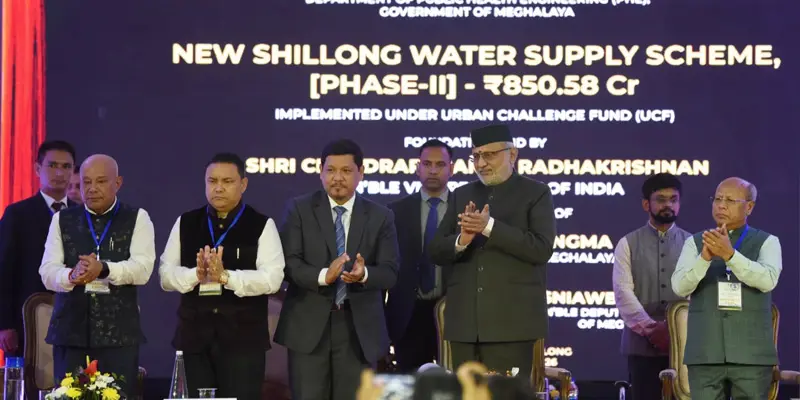
The rest of the list is the ordinary furniture of a State catching up: two road connectivity projects under the North East Special Infrastructure Development Scheme, a thirty-bed AYUSH facility at Shillong Civil Hospital, and a 132/33 kV substation at Mawkhanu under PM-DevINE. Speaking on connectivity, the Vice-President said more than 46,000 kilometres of rural roads have been built in the North East under the Pradhan Mantri Gram Sadak Yojana in the last decade, at an outlay of over ₹47,000 crore.
What India gains
Water, a road, a substation and a hospital are not a portfolio; they are the four things that decide whether a family stays in a hill district or leaves it. The Vice-President put the frame himself: every State, village and citizen must become developed for India to be developed by 2047.
BLITZ DATA CARD
THE RECORD
Foundation stones laid, 7 September 2026: 5 projects, ₹1,010.95 crore
New Shillong Water Supply Scheme Phase II, Part A (Urban Challenge Fund): ₹850.58 crore
Also: 2 road projects under NESIDS · 30-bedded AYUSH facility, Shillong Civil Hospital · 132/33 kV substation at Mawkhanu under PM-DevINE
Inaugurated: Maternity and Children’s Hospital, Nongstoin, National Health Mission — ₹31.05 crore
Rural roads built in the North East under PMGSY in the last decade: over 46,000 km
Outlay on those roads: over ₹47,000 crore
THE COMPARISON — the day’s ₹1,042 crore
Water supply scheme ████████████████████████████████▌ ₹850.58 crore
Everything else ██████▌ ₹191.42 crore
BLITZ CALCULATION — derived here, absent from the release
Leg-sum check: ₹1,010.95 crore + ₹31.05 crore = ₹1,042.00 crore, matching the release’s own “about ₹1,042 crore” exactly — the legs sum to the published total.
The water scheme alone is 81.63 per cent of the day’s value; the other five works together are 18.37 per cent, a difference of 63.26 percentage points.
₹47,000 crore ÷ 46,000 km = about ₹1.02 crore per kilometre of rural road in the North East over the decade.
WHAT INDIA GAINS
Piped water for a growing hill capital, a maternity hospital in a district town, and a rural road network in the North East built at about a crore a kilometre.
BLITZ APPRECIATES
Shri Conrad K. Sangma, Chief Minister of Meghalaya, and his Council of Ministers, whom the Vice-President congratulated by name for the State’s progress; and the engineers of the Public Health Engineering Department who will build the Shillong water scheme.’
#Meghalaya #Shillong #NorthEastIndia #PMDevINE #NESIDS #JalJeevanMission #PMGSY #UrbanChallengeFund #ViksitBharat2047 #BlitzIndia