
When gold outshines groceries
New Delhi, 14 September A shopper who filled a vegetable basket in August paid less for it than a year earlier. Tomatoes were 31.09% cheaper. Potatoes were 13.14% cheaper. Yet the number the country will argue about tonight — retail inflation of 4.82% — went up, and the reason is sitting behind glass in a jeweller’s showcase.
The Ministry of Statistics and Programme Implementation, in its consumer price index release of 14 September 2026, put all-India retail inflation for August at 4.82% provisional, against 4.45% final for July. Rural inflation was 5.23%, urban 4.31%. Food inflation, measured on the consumer food price index, was 5.95% against 5.52% a month earlier.
The five commodities that fell fastest were tomatoes at minus 31.09%, potatoes at minus 13.14%, motor cars and jeeps at minus 6.72%, lady’s finger at minus 5.41% and pointed gourd at minus 3.60%. Four of those five are things a household buys every week.
The five that rose fastest were silver ornaments at 107.11%, ginger at 73.82%, onions at 48.27%, garlic at 43.60% and gold, diamond and platinum ornaments at 35.53%.
Two of the top five are precious metals. That is where the arithmetic gets interesting.
Where the country stands apart
The rural–urban gap widened. In July it was 0.88 percentage points; in August, 0.92. The village is paying more than the city for the same year.
Among the larger States, Telangana recorded the highest combined inflation at 6.27%, followed by Tamil Nadu at 5.92%, Madhya Pradesh at 5.55%, Andhra Pradesh at 5.53% and Odisha at 5.52%. At the other end, Mizoram recorded 2.35%, Delhi 2.61% and Meghalaya 2.74% — a spread of nearly four percentage points across one country in one month.
Health inflation was 1.34%. Housing, water, electricity, gas and other fuels came in at 2.61%.
Blitz Data Card
New Delhi : At a glance
Retail inflation, August 2026: 4.82% (provisional)
Retail inflation, July 2026: 4.45% (final)
Rural 5.23% · Urban 4.31%
Food inflation, August 2026: 5.95%
All-India index, August 2026: 108.74 (base 2024=100)
What India gains
A price index collected from 1,407 urban markets and 1,465 villages with a 100% response rate gives every household, State and lender the same honest number to plan against.
Freeze the fraud, not your wallet
New Delhi, 14 September Anyone who has had a bank account frozen over a transaction of a few thousand rupees knows the shape of the problem: the disputed money is small, the paralysis is total, and the salary, the rent and the school fee stop with it.
The Reserve Bank of India has proposed a framework under which banks would temporarily freeze only the disputed transaction amount rather than the whole account, when an unusual transfer of Rs 1,000 or more is flagged as possibly linked to a mule account or cyber fraud, All India Radio reported on 14 September 2026, citing the central bank’s proposal.
India and Mercosur hit the expansion button
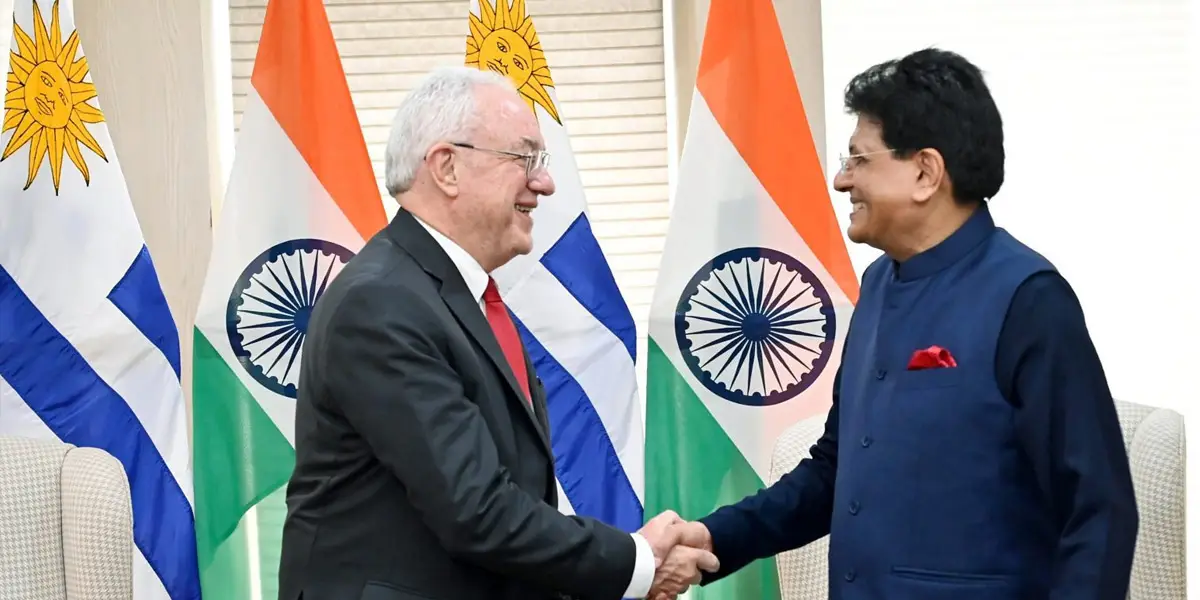
New Delhi, 14 September Commerce and Industry Minister Piyush Goyal and Uruguay’s Foreign Minister Mario Lubetkin, holding Mercosur’s pro tempore presidency, announced the launch of negotiations to expand the preferential trade agreement between India and the South American bloc, the Ministry of Commerce and Industry said in its release of 14 September 2026.
Both sides agreed to widen the existing agreement into areas of mutual interest, and are finalising the terms of reference that will define the scope and structure of the expanded pact.
The same day, India and Mercosur signed the first additional protocol to the agreement, covering electronic certificates of origin. Paperwork that today travels as stamped paper between customs houses on two continents will travel as data.
For an Indian exporter that is the difference between a consignment that clears and one that waits. Mercosur — Argentina, Brazil, Paraguay and Uruguay, with Bolivia — is India’s principal trading counterpart in South America, and the existing pact has been narrow since it took effect.
India–Vietnam partnership gets a fresh push
New Delhi, 14 September External Affairs Minister S Jaishankar co-chaired the 19th India–Vietnam Joint Commission Meeting with his Vietnamese counterpart Lê Hoài Trung in New Delhi on 14 September 2026, All India Radio reported the same evening.
Writing on social media afterwards, Jaishankar described the meeting as outcome-oriented and said the two sides discussed ways of strengthening the relationship.
From silicon to systems, India’s big bet
New Delhi, 14 September The fifth Semicon India will run from 17 to 19 September 2026 at Yashobhoomi in New Delhi, with Prime Minister Narendra Modi inaugurating it on the opening day, the Ministry of Electronics and Information Technology said in its release of 14 September 2026.
More than 600 exhibitors, among them 300 international companies, will occupy 15,000 square metres, with delegations from over 40 countries, six country pavilions, twelve State pavilions and about 40 start-ups. The theme is “From Silicon to Systems: Building the Ecosystem”.
The numbers behind the show are the ones that matter. Twelve semiconductor projects have been approved under the Semiconductor India programme; three of those twelve are in commercial production. Electronic design automation tools have gone to more than 400 academic institutions and 105 start-ups, and 24 start-ups have been cleared under the design linked incentive scheme.
India’s semiconductor demand, now around 50 billion US dollars, is projected to reach about 103 billion by 2030, against a global market the ministry puts at roughly 796 billion in 2025 and above two trillion by 2030.
India powers Nepal through winter
New Delhi, 14 September The Ministry of Power has approved the export of power to the Nepal Electricity Authority for eighteen hours a day, from midnight to 6 pm, from 13 September 2026 to 31 December 2026, the ministry said in its release of 14 September 2026.
The approval covers up to 600 megawatt through the Muzaffarpur–Dhalkebar line. Power crosses that border in both directions depending on the season — Nepal sends surplus hydro south in the monsoon and buys through the dry months. A grid that trades rather than merely supplies is worth more to both countries than either could build alone.
BRICS maps energy resilience beyond oil
New Delhi, 14 September Leaders at the two-day BRICS summit in New Delhi held that energy security is a foundation of social and economic development, of national security and of the welfare of nations, All India Radio reported on 14 September 2026.
The member economies pressed for enhanced energy security through a mix that does not depend on a single source, a single route or a single supplier.
For a country that imports most of the crude it burns, that sentence in a summit document is not decoration. It is the argument India has been making in every forum it can reach, and it has now been made in Delhi by the group that met there.
A tiny chick, a giant conservation win
Naliya, Kutch, 14 September The Great Indian Bustard has been counted in the low hundreds for years. In Kutch this month, a chick hatched from a swapped egg passed its first three months alive in the wild — the first time that has happened in Gujarat.
Union Minister for Environment, Forest and Climate Change Bhupender Yadav visited the bustard habitat at Naliya on 14 September 2026 and inaugurated a soft release centre there, the Ministry of Environment, Forest and Climate Change said in its release of the same date.
Gujarat’s Forest and Environment Minister Arjun Modhwadia was with him.
How the jump-start works
The technique is called jump-start, and it is unusual enough to be worth explaining. A wild female bustard that has laid an infertile egg will keep sitting on it, and the season is lost. Under this programme the infertile egg is removed and a viable egg from the conservation breeding line is placed under her instead. She raises a chick she did not lay.
The second such attempt produced the chick that has now crossed three months in the wild. One bird is not a population. But a wild female successfully rearing a captive-bred egg is the step that a breeding centre alone can never take, and it had not been demonstrated in this State before.
The ground underneath
Around it sits work that is less dramatic and no less necessary. About 11 square kilometres of grassland degraded by Prosopis juliflora — the gando bavaL that has swallowed Kutch’s pasture — has been restored. A 30-kilometre predator-proof fence now encloses 15 square kilometres. Thirty-three patrolling and rescue vehicles were flagged off for the Kutch forest circle on the same day.
At Jakhau, about 3.49 lakh mangrove seedlings have been raised in the nursery. Under the MISHTI programme, mangrove planting in Kutch has been completed over 27,652 hectares against a cumulative target of 29,250 hectares for 2023-24 to 2026-27, of which 12,450 hectares lie in the Kori Creek area.
Blitz worked the two figures out: that is 94.54% of a four-year target reached with a year of the period still to run, and Kori Creek alone accounts for 45.02% of everything planted.
At Sanyara, a Van Kavach of 9.46 square kilometres has been raised by the Miyawaki method — over 10,000 saplings of 47 native species chosen for the Gulf of Kutch and its low water. The ministry expects it to pull local temperature down by 1.5 to 2 degrees Celsius.
Who is doing it
The names belong in the record: the Gujarat Forest Department, the Wildlife Institute of India, and around 50 Border Security Force personnel who planted mangroves at Jakhau alongside more than 50 residents. At Naliya the minister sat with representatives of the Jat Sumra and Darbar communities in a khatala sabha — the traditional sitting at which such things are settled in Kutch — and asked for their continued support.
That last detail is the one to hold. A fence keeps a predator out for as long as somebody mends it. A pastoralist who has agreed to the bird’s presence is a longer guarantee than any wire.
Blitz Data Card
Naliya : At a glance
Grassland restored from Prosopis juliflora: about 11 sq km
Predator-proof fence: 30 km, enclosing 15 sq km
Patrolling and rescue vehicles flagged off: 33
Mangrove seedlings raised at Jakhau nursery: about 3.49 lakh
Sanyara Van Kavach: 9.46 sq km, over 10,000 saplings, 47 native species
What India gains
A shoreline that holds against storm surge, a nursery that employs people who live beside it, and a bird that exists nowhere else on earth kept in the country that is its only home.