Blitz Bureau
NEW DELHI: Liberia’s Foreign Minister landed in Delhi this morning for two days of talks. Almost every account of what India and Liberia trade begins with iron ore. Open the Commerce Ministry’s own commodity table for 2025-26 and there is no iron ore in it at all — the growth came from palm kernel oil, natural rubber and scrap metal.
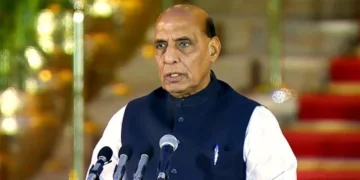
Sara Beysolow Nyanti, Liberia’s Minister of Foreign Affairs, arrived in New Delhi on the morning of 13 August for a two-day visit and was scheduled to meet the External Affairs Minister, Dr S. Jaishankar, at Hyderabad House during the day. It is the most senior Liberian visit since the two countries held their first-ever Foreign Office Consultations in Monrovia in December 2024, a round Ms Nyanti co-chaired herself. The agenda both sides have described publicly is broad — trade, investment, mining, agriculture, health and pharmaceuticals, education and capacity building. The trade record underneath it is narrower, more recent and considerably more interesting than the agenda suggests.
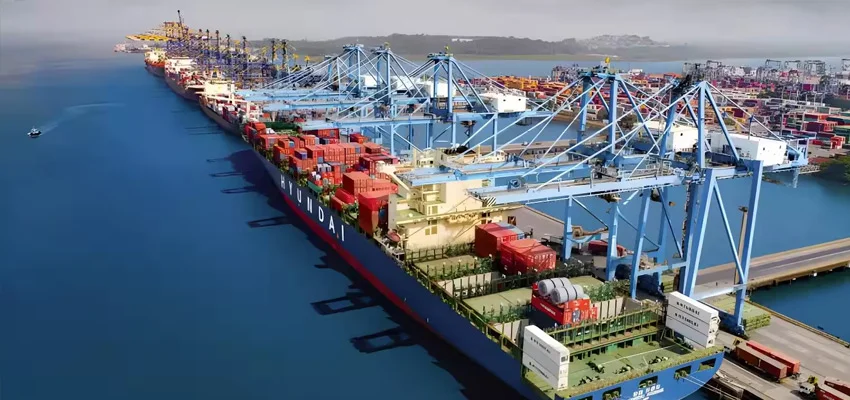
Where the cargo lands: an Indian container port. Liberia’s fastest-growing shipments to India in 2025-26 were crude palm kernel oil, natural rubber and scrap metal — not the iron ore that dominates the popular account of the relationship.
Two countries can trade for years and still be wrong about what they trade. The commodity table is the corrective.
At a Glance
• Total bilateral trade, 2025-26: $390.06 million
• Liberia to India: $44.91 mn, up from $20.39 mn — more than 120 per cent
• India to Liberia: $345.15 mn, down from $376.33 mn
• Crude palm kernel oil: $2.17 mn to $10.38 mn in one year
• Natural rubber: $8.30 mn to $12.94 mn
• Copper scrap: $1.29 mn to $4.89 mn; aluminium scrap $3.81 mn; spent lead-acid batteries $2.02 mn
• Iron ore concentrates: no significant shipments in the period
• Access route: India’s Duty-Free Tariff Preference scheme, in force since 2012, zero duty on more than 98 per cent of tariff lines
• Visit: Foreign Minister Sara Beysolow Nyanti, New Delhi, 13–14 August 2026
Read the two columns together and the shape of the year becomes clear. Liberia’s exports to India more than doubled, from $20.39 million to $44.91 million. India’s exports to Liberia fell, from $376.33 million to $345.15 million. Total two-way trade therefore edged down — $390.06 million against $396.72 million the year before — even as the smaller partner had its best year on record. What actually moved was the ratio. India used to sell Liberia about eighteen dollars of goods for every dollar it bought; it now sells about eight. That is not a slowdown in Indian exports so much as the arrival of Liberian supply, and it is the number a policymaker in Monrovia will care about most. Underneath it sit two commodities and one surprise. Crude palm kernel oil went from $2.17 million to $10.38 million in a single year. Natural rubber rose from $8.30 million to $12.94 million. Between them the two crops earned more than half of everything Liberia sold India. The surprise is the third line: copper scrap nearly quadrupled to $4.89 million, aluminium scrap held at $3.81 million, and spent lead-acid batteries brought in $2.02 million — a recycling trade that barely registered two years ago and now feeds Indian secondary smelters.
Two things follow, and both are constructive. The first is that India’s Duty-Free Tariff Preference scheme is doing what it was designed to do. Introduced in 2012 for least-developed countries, it gives Liberia zero-duty entry on more than 98 per cent of India’s tariff lines; the goods that grew fastest — agricultural raw material and recyclable metal — are precisely the goods a tariff wall would have stopped first. The second is that the growth is in sectors that employ people outside the mining enclave: plantations, agro-processing, collection and scrap handling. That is a better development outcome than an iron-ore boom would have produced, and it is the argument India can make in Hyderabad House today without exaggeration. Where the relationship still has ground to cover is on the Indian side of the ledger: bilateral trade of $390 million is modest for two economies of this size, India’s resident mission in Monrovia is only five years old, and the technical cooperation — thirty Liberian mining officers, geologists and engineers trained at the Indian Institute of Coal Management in Ranchi in February this year, and a memorandum recognising the Indian Pharmacopoeia as an approved standard for medicines — is still counted in dozens rather than hundreds. The sensible ambition for this visit is not a headline number. It is to put the palm-oil, rubber and recycling lines on a predictable footing, and to let the arithmetic compound.