Blitz Bureau
NEW DELHI:This monsoon has staged a genuine recovery, and the sowing figures show it. Storage is a separate arithmetic, and it is the one that governs what India eats next summer.
The season began badly. Cumulative rainfall was running roughly 35 per cent below normal at the end of June; by 19 August the shortfall had narrowed to about 12.6 per cent. That is a recovery of some 22 percentage points in seven weeks, and it has fed through to the fields: kharif sowing, more than 20 per cent behind in late June, had closed to about 2 per cent behind a year earlier by mid-August. Live storage in 166 major reservoirs, however, stands at 44.39 per cent of capacity — which is to say they are 55.6 per cent empty, with roughly five weeks of monsoon left to fill them.
Those two facts are not in conflict, and the reason they diverge is the structural story. Rainfall waters a standing crop directly; storage is what is captured and held. A monsoon that arrives late and then falls hard delivers the seasonal total but delivers it as runoff — water moving too fast, over ground too dry to absorb it, past catchments designed for a steadier distribution. The kharif crop drinks the rain as it falls. The rabi crop — wheat, mustard, gram, the winter sowing that begins in October — drinks the reservoir. So does the drinking-water supply of a great many towns, and so does hydropower through the dry months.
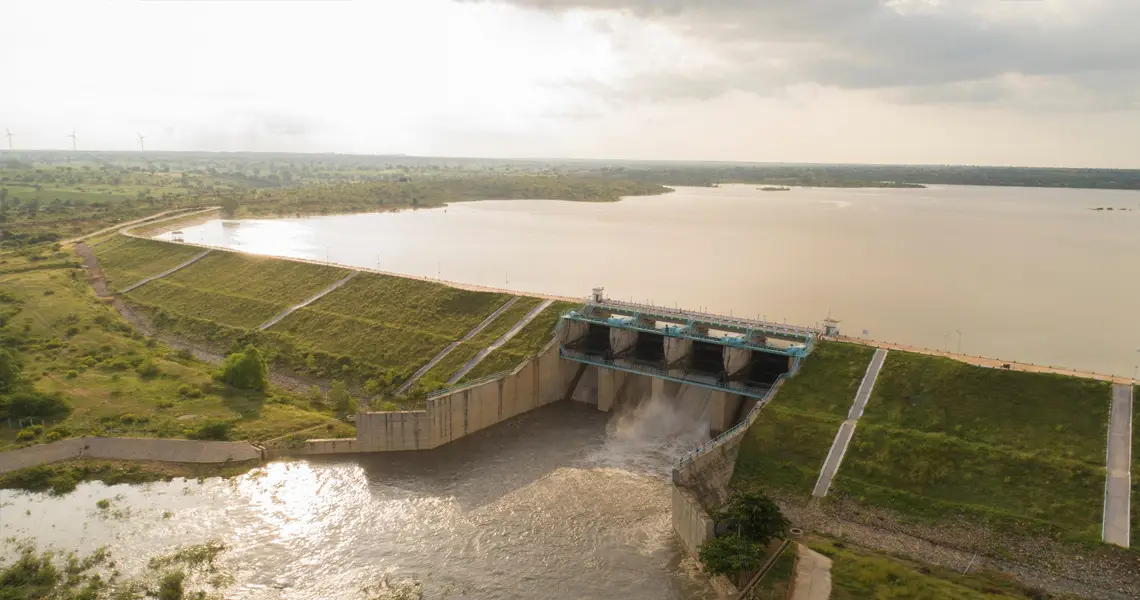
The number that outlasts the season. A reservoir in southern India. Rainfall is reported daily and storage rarely, yet it is storage — 44.39 per cent of capacity across 166 major reservoirs — that determines the winter crop, the summer tap and the dry-season turbine.
Rainfall is a flow. Storage is a stock. India reports the flow daily and the stock rarely, and lives off the stock.
At a Glance
• Monsoon deficit: about 35% at end-June, narrowed to roughly 12.6% by 19 August
• Kharif sowing: over 20% behind in late June, about 2% behind by mid-August
• Reservoir storage: 44.39% of capacity across 166 major reservoirs
• Implication: the reservoirs are 55.6% empty with roughly five weeks of monsoon left
• What storage governs: the rabi crop, urban drinking water, dry-season hydropower
• IMD outlook: below-normal rainfall — under 94% of the long period average — for August–September
• Structural remedy: groundwater recharge, watershed treatment, micro-irrigation, crop choice
The deeper problem is that India’s water security has been built around a storage model designed for a rainfall pattern that is shifting. The number of rainy days is falling while the intensity of individual events rises — the same seasonal total, delivered in fewer, heavier bursts. Reservoirs cannot be enlarged fast enough or cheaply enough to catch that, and in most basins there is nowhere left to put a large dam. The engineering answer therefore moves underground and upstream: aquifer recharge, watershed treatment, check dams and farm ponds, which capture water where it falls instead of routing it to a distant impoundment. India’s aquifers hold far more than its dams; the constraint is not capacity but recharge rate.
The demand side is where the largest gain is available, and it is genuinely achievable. Agriculture takes roughly four-fifths of India’s water, and the bulk of that goes to paddy and sugarcane grown in places their water budgets do not justify. Micro-irrigation under Per Drop More Crop, the Atal Bhujal groundwater programme and the watershed component of PMKSY are the existing instruments, and the ones that have worked share a design feature: they pay the farmer for the switch rather than merely permitting it. A pipeline of constructive work follows from that — publish reservoir storage as prominently as rainfall so the public tracks the stock and not just the flow; extend crop-diversification incentives in the districts where the aquifer is falling fastest; and treat recharge structures as core infrastructure with the budget line that implies. The monsoon will recover most years. The storage will not recover on its own.