Ramraj erases Usha’s mark, takes bronze
Nagoya, 29 September: Vithya Ramraj crossed the line in the women’s 400-metre hurdles in Aichi-Nagoya in 54.75 seconds and, in doing so, deleted a mark that had stood in the Indian record books since before most of her team-mates were born. The record was P T Usha’s. It had lasted more than four decades. Ramraj took bronze, and took the record with it.
That is one of eight medals India collected at the Asian Games on 28 September It was the country’s heaviest single day of the Games so far. India now stands twelfth in the medal standings with 45 medals — four gold, 20 silver and 21 bronze.
Sreeshankar Murali defended the long-jump silver he won at the previous Games with 8.07 metres, then pulled up injured on his fourth attempt and withdrew. Esha Singh, 21, shot 38 points for silver in the women’s 25-metre pistol. Parul Chaudhary clocked 15:14.61 for bronze in the 5,000 metres, three days after her bronze in the 3,000-metre steeplechase. Pincky Balhara took bronze in the women’s under-78-kilogram kurash, having beaten South Korea’s Lim Garam 3-0 in the quarter-final.
The PMO posted congratulations to each of them through the day; the message to Gulveer Singh, noted that the achievement was made more special by being a personal best.
At a glance
India’s total at the Asian Games 2026, Aichi-Nagoya: 45 medals, as on 28 September 2026
Gold: 4
Silver: 20
Bronze: 21
Position in the standings: 12th
Medals won on 28 September alone: 8
What India gains
Podium presence across a far wider spread of events than a decade ago, built on domestic coaching and facilities — and a national record in the 400-metre hurdles that had stood since P T Usha set it.
India, UAE push rupee-dirham trade rails
Mumbai, 29 September: India and the United Arab Emirates have agreed to move on the timely implementation of local-currency trade settlement, the integration of their payment and messaging systems, and central-bank digital currencies, according to the Commerce and Industry Ministry statement issued after the 14th meeting of the India-UAE High Level Joint Task Force on Investments in Mumbai on 28 September 2026.
The task force, set up in 2013, was co-chaired by Commerce and Industry Minister Piyush Goyal and the Managing Director of the Abu Dhabi Investment Authority, Sheikh Hamed bin Zayed Al Nahyan.
Bilateral trade reached $101.25 billion in 2025-26, and non-oil trade $76.2 billion in 2025. The two sides hold to a shared target of $200 billion by 2032. Work out what that requires and the ambition becomes concrete: getting from $101.25 billion to $200 billion in six years needs compound growth of about 12% a year, every year. That is not a slogan; it is a delivery schedule, and it explains why settlement plumbing — currencies, messaging, digital rails — was on the agenda ahead of anything more ceremonial.
The task force reviewed a proposed $11.5 billion integrated aluminium complex in Odisha and a food park project in Gujarat, and welcomed Emirates NBD’s roughly $3 billion purchase of a majority stake in RBL Bank and International Holding Company’s $1 billion investment in Sammaan Capital. It examined an aviation and logistics hub at Dholera in Gujarat, and reviewed the UAE-India Fast Track Mechanism for resolving investor disputes.
What India gains
Settlement in rupees and dirhams takes a third currency, and its conversion cost, out of a $101 billion trade relationship — and the exporter who feels that first is the small one.
India’s green cover touches 25.17pc
Rome, 29 September: India’s forest and tree cover now stands at 8.274 crore hectares, or 25.17% of the country’s geographical area, the Ministry of Environment, Forest and Climate Change said in its press release on its statement to the 28th session of the Food and Agriculture Organization’s Committee on Forestry, which opened in Rome on 28 September 2026 and runs to 2 October.
Check that pair of figures against each other and they hold: 8.274 crore hectares at 25.17% implies a geographical area of 32.87 crore hectares, which is India’s. A leg-sum that holds is worth saying so.
The statement set India ninth in the world for forest area and third for net annual gain in forest area, on the FAO’s Global Forest Resources Assessment 2025. Under the Bonn Challenge, India has committed to restore 2.6 crore hectares of degraded and deforested land by 2030; 2.176 crore hectares have already been brought under restoration. That is 83.7% of the commitment delivered with four years still to run — the single most useful number in the statement, and one it does not itself work out.
On carbon, the ministry said India had created an additional sink of 2.29 billion tonnes of carbon dioxide equivalent by 2021, and has raised its own target to 3.5–4.0 billion tonnes by 2035 against 2005 levels. Meeting the lower end of that range means adding 52.8% to what has been achieved; the upper end means adding 74.7%.
Under the Aravalli Green Wall, about 64.5 lakh hectares of degraded land has been identified for restoration. The MISHTI initiative is restoring mangroves along the coast. India’s Ramsar sites now number 101. Ek Ped Maa Ke Naam — Plant4Mother — has put more than 3.5 billion saplings in the ground.
India asked the FAO to move international co-operation past declarations and towards country-driven implementation, capacity building, technology transfer and measurable results on the ground, and pressed for effective, sustained finance for developing countries. It said it would work with the FAO on shaping the proposed UN Decade on Afforestation and Reforestation, 2027-2036.

Goyal heads to US for trade talks, G20 meet
NEW DELHI, 29 September: Commerce and Industry Minister Piyush Goyal will be visting the United States from 29 September to 5 October and will attend the G20 trade ministers’ meeting at Milwaukee, Wisconsin, on 30 September and 1 October. This will be at the invitation of the United States Trade Representative.
India will argue there for a rules-based, open and non-discriminatory multilateral trading system with the World Trade Organization at its centre, and for adequate policy space for developing countries. Goyal will also hold a bilateral meeting with his American counterpart to advance a balanced India-United States bilateral trade agreement and to finalise an interim agreement in line with the joint statement of 7 February 2026. In Milwaukee and Chicago he will meet chief executives in manufacturing, consumer goods, agri-business, retail and technology.
No photograph
India opens GIFT City door to French universities
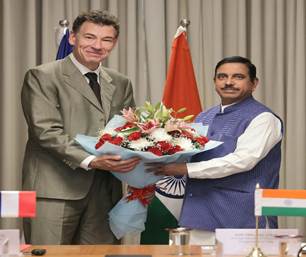
New Delhi, 29 September: Education Minister Pralhad Joshi has invited French higher education institutions to open branch campuses in India, including at GIFT City in Gujarat. This was specified in a press release issued by the Ministry of Education.
Baptiste is in India from 28 to 30 September. The two ministers discussed revising the India-France Mutual Recognition of Qualifications agreement, expanding the movement of students, faculty and researchers, and co-operation in life sciences, social sciences and the humanities. Joshi described the India-France Year of Innovation 2026 as the occasion for it, and thanked the French government for supporting the opening of India Innovates 2026 at Nice, which gave Indian deep-tech start-ups a global platform.
The practical gain sits in the qualifications agreement: revise it and an Indian degree becomes portable into the French system without a second examination, which matters to every student who pays for one.
Kolkata to host India Energy Week 2027
Kolkata, 29 September: The India Energy Week 2027 will be held at the New Town Convention Centre in Kolkata from 28 to 31 January, the Ministry of Petroleum and Natural Gas announced.
It is the fifth edition and the first in eastern India. The theme is “Fuelling Innovation. Securing Energy. Shaping the Future.” More than 75,000 energy professionals and over 700 international exhibitors are expected. The fourth edition, held in Goa in 2026, drew more than 75,000 professionals, over 700 exhibiting companies, participants from more than 120 countries and over 6,500 conference delegates, along with 17 ministers and deputy ministers from countries including the UAE, Canada, the Netherlands, Oman, Brunei, Myanmar and Tanzania. The event is organised by the Federation of Indian Petroleum Industry, with Informa Markets as conference organiser.
_20260928205304_442fca.jpeg)
RBI questions credit-deposit ratio as sole risk gauge
New Delhi, 29 September: Since 2022-23 bank credit in India has grown faster than deposits, pushing the credit-deposit ratio past 80% and prompting a steady line of commentary about whether credit growth can be sustained. An article in the Reserve Bank of India’s September 2026 Bulletin, released on 25 September 2026 and written by Saurabh Ghosh, Prabhat Kumar, Madhuresh Kumar and Monica, takes that question apart.
Its central finding is a piece of monetary mechanics that is easy to state and easy to forget: in a modern monetary system, deposits are created at the moment a bank lends or invests. A bank does not have to gather liabilities before it can extend credit. Profitability, the movement of deposits between banks and prudential regulation then pull credit growth back into line with the underlying economy — but the deposit base is not the binding constraint it is usually taken to be.
From that the authors reach a conclusion worth quoting to anyone who uses the ratio as a warning light: the credit-deposit ratio, by itself, may not be an appropriate measure of the funding vulnerability of a banking system that is growing its credit quickly. India’s high ratio at end-March 2026, they find, came from liability-side adjustment — borrowings raised at lower cost than in earlier periods, and higher capital — and from a change in the composition of assets, with reserves and other balances redeployed into lending.
A second article in the same Bulletin, by Purnendu Kumar, Snigdha Yogindran, Sukti Khandekar and Bhavyashree K, reads the phasing plans that private companies file with their lenders and puts envisaged private corporate capital expenditure at ₹3.2 lakh crore for 2026-27, with infrastructure taking the major share and power leading it.
The Bulletin’s own assessment of the economy records real growth of 7.8% in the first quarter of 2026-27, headline inflation at 4.8% in August, a narrower merchandise trade deficit on strong exports, and foreign exchange reserves at an all-time high. The Reserve Bank notes that the views in Bulletin articles are the authors’ own.
The caution a reader should carry away is the authors’ own: the finding is that one ratio is a poor single gauge, not that credit growth carries no risk. The measures that do bear on it — asset quality, capital, liquidity coverage — are published separately and should be read alongside.
No new CAG report tabled in Parliament, states
New Delhi, 29 September: No new report of the Comptroller and Auditor General was found tabled in Parliament or in a State legislature in the period covered by this slot. The most recent tabled material traced remains the performance audit of BharatNet and the audit of the Green India Mission, both of August 2026, and this desk has not yet worked from the tabled reports themselves — under the Blitz standard an audit finding is written from the report as laid, never from a summary of it, and no item runs until that reading is done.
The Public Accounts Committee, the Committee on Public Undertakings and the departmental standing committees are checked again in the next slot, together with the Accountants General in the States, and the BharatNet and Green India Mission reports are being obtained for a full reading.
Saying so is the report. An oversight column that fills itself on a day with no tabled material is worth less than an empty one that says why.