Blitz Bureau
NEW DELHI: Every June, India debates the monsoon. Every year, the more consequential number moves quietly in one direction and is barely discussed. Per capita water availability in India has fallen from roughly 5,177 cubic metres a year around 1951 to approximately 1,486 cubic metres today — below the 1,700 cubic metre threshold that international convention treats as the onset of water stress.
The decline is arithmetic before it is anything else. The volume of water the country receives has not collapsed; the number of people sharing it has more than quadrupled. That distinction matters, because it means the problem cannot be solved by a good monsoon and will not be caused by a bad one. What a poor season does is expose how little buffer exists — and this year’s forecast, with July rainfall expected below 94 per cent of the long period average after one of the driest Junes on record, is the kind of season that does the exposing. Around 110 lakh hectares are now under micro-irrigation, and under the accelerated irrigation programme 71 of 123 projects had been completed as of May, achieving about 65 per cent of a target irrigation potential of 4,531.86 thousand hectares. The Union Budget for 2026–27 allocated ₹6,587 crore to the Pradhan Mantri Krishi Sinchayee Yojana under the water resources department.
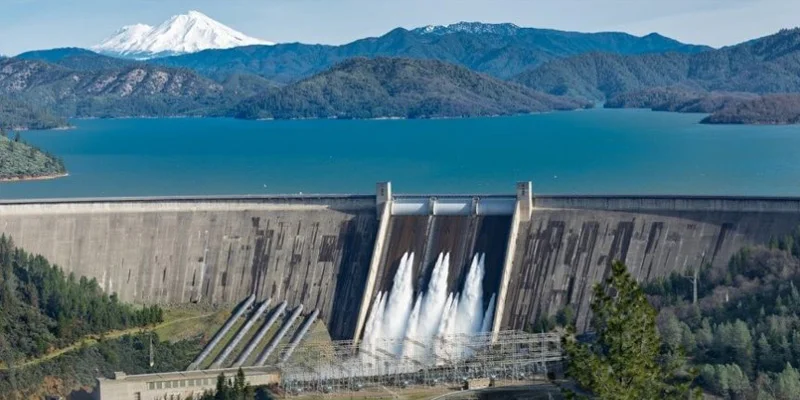
Storage is the buffer: a country whose per capita availability has fallen below the stress threshold is judged less by how much rain falls than by how much of it is kept.
Rainfall is weather. Water availability is arithmetic. India has spent seventy years arguing about the first and living with the second.
At a Glance
• Per capita water availability: about 5,177 cubic metres a year in 1951; roughly 1,486 today
• Stress threshold: 1,700 cubic metres per person per year under the standard international measure
• Principal driver: population growth, not a fall in total rainfall
• Micro-irrigation: about 110 lakh hectares covered
• Accelerated irrigation programme: 71 of 123 projects complete as of May 2026; about 65% of a 4,531.86 thousand hectare potential achieved
• PMKSY allocation, 2026–27: ₹6,587 crore under the water resources department
• This season: July rainfall forecast below 94% of the long period average
Roughly four-fifths of India’s water goes to agriculture, which makes farming both the problem and the only place a solution of sufficient size can be found. The inefficiency is not mysterious: flood irrigation applies far more water than a crop can use, and the cropping pattern in several states favours thirsty crops in exactly the districts least able to support them, because the incentives — procurement, power tariffs, assured markets — point that way. Micro-irrigation is the single highest-return technology available, typically cutting water use sharply while raising yields, and 110 lakh hectares is real progress and still a fraction of India’s irrigated area. Scaling it further is less a technical challenge than a financing and extension challenge: the equipment pays for itself within a few seasons, but the farmer has to find the capital and the confidence first.
Three other levers do most of the remaining work, and India is already pulling all three. The first is groundwater, where the country is the world’s largest user and where the binding constraint is measurement — aquifers cannot be managed at village level until their levels are known at village level, and cheap sensing plus community-managed budgets have worked wherever they have been tried seriously. The second is storage, in both the old sense and the new: reviving traditional tanks and step-wells, which were designed for exactly this climate, alongside modern reservoirs and recharge structures. The third is reuse, which is where the largest untapped volume sits — treated urban wastewater is a dependable, weather-independent supply for industry and irrigation, and a circular water economy for industrial users is now explicit national policy. Interestingly, this week’s floating solar scheme touches the same ledger: panels shading a reservoir reduce evaporation from it. None of this is dramatic, and none of it produces a ribbon-cutting photograph. But a country whose per capita availability has fallen by two-thirds in seventy years is not short of rain. It is short of the discipline to keep what it gets — and that discipline is, unlike the monsoon, entirely within India’s control.