Blitz Bureau
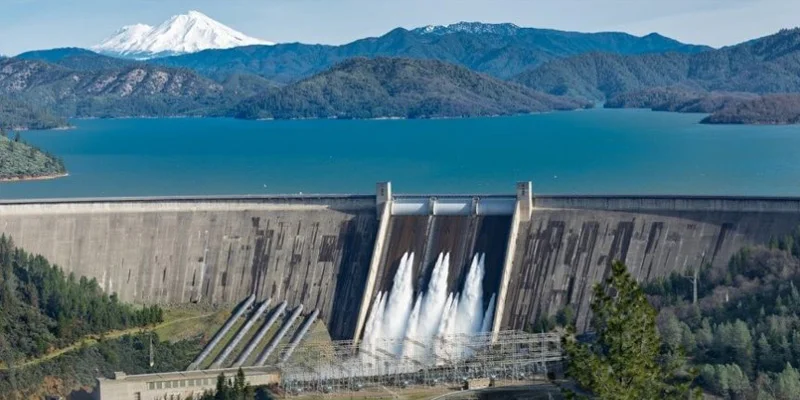
NEW DELHI: India receives a great deal of water and keeps very little of it. The Central Water Commission’s monitoring of 166 major reservoirs showed 70.432 billion cubic metres of live storage on July 23 — 38.37% of their combined capacity, against 110.519 BCM at the same point last year. That is 63.73% of last year’s level and 93.09% of the ten-year normal. Rainfall for the season to July 25 has run about 15% below normal. Those are this year’s numbers, and they will change. The structural fact underneath them will not: the country’s water security is determined less by how much rain falls than by how much of it is caught, held and shared.
The arithmetic of the Indian monsoon is unforgiving in a way that is easy to underestimate. The bulk of the annual rainfall arrives in a few concentrated weeks, and increasingly in fewer, heavier bursts — a pattern that delivers the same seasonal total while dramatically reducing how much of it soaks in rather than runs off. A basin that receives its water in twelve intense days rather than forty moderate ones will record a normal monsoon and an abnormal shortage. Storage capacity, groundwater recharge and the timing of releases are therefore not secondary infrastructure. They are the difference between rainfall and water.
Capacity is not the same as security: The 166 monitored reservoirs held 70.432 BCM on July 23 — 38.37% of live capacity, and 63.73% of last year’s storage on the same date.
A normal monsoon delivered in twelve violent days is not a normal monsoon. It is a flood followed by a drought, recorded in the ledger as neither.
The Long View
• Storage: 70.432 BCM in 166 major reservoirs on July 23 — 38.37% of live capacity
• Comparison: 110.519 BCM a year earlier; 63.73% of last year, 93.09% of normal
• Rainfall: about 15% below normal for the season to July 25
• Regional: southern-state reservoirs have recorded the steepest declines
• Kharif: sowing at roughly 35.1 million hectares by early July, running behind last year
The distribution problem is as important as the total. Storage this season has fallen most steeply across the southern states, while parts of the north-east and east have fared better — a divergence that shows up in kharif sowing, which was running at roughly 35.1 million hectares in early July, behind the same point last year, with rice, pulses and coarse cereals showing the widest gaps. India’s agricultural economy, its urban drinking-water systems and a meaningful share of its hydropower all draw on the same reservoirs, and they draw hardest at the same time of year. A shortfall is never confined to one sector.
None of this is unsolvable, and much of the solution is already known and partly underway. Watershed development and check dams raise the share of rainfall that recharges groundwater rather than running to the sea, and they work at village scale with village labour. Micro-irrigation — drip and sprinkler — delivers the same yield on substantially less water, and is the single largest available saving in a country where agriculture takes the overwhelming majority of freshwater withdrawals. Shifting cropping patterns towards millets and pulses in water-stressed districts reduces demand at source rather than rationing it at the tap. Treated-wastewater reuse for industry and urban landscaping frees fresh water for drinking. Real-time reservoir telemetry and basin-level coordination let managers release water on evidence rather than convention. Each of these is incremental. Together they are transformative, and unlike the monsoon, every one of them is within India’s control.
The constructive way to hold this issue is to treat water the way the country has learned to treat electricity and digital payments — as national infrastructure with measurable service standards, published data and accountable operators, rather than as an annual weather story. India already publishes reservoir levels weekly, which is more transparency than many countries manage. The next step is to make the same discipline reach groundwater, where most of the country’s water actually sits and least of it is measured. A nation that can see its water can manage it. The rain will do what it does.