A digital spine for India’s tourism economy
New Delhi, 27 September 2026 The tourist who used to arrive with a folded map now arrives with a phone, and from today the Government of India is building the plumbing behind that phone. At Bharat Mandapam, Union Minister of Tourism Gajendra Singh Shekhawat launches the National Digital Tourism Stack — open digital public infrastructure meant to make a homestay in Ziro or a licensed guide in Hampi as findable as a train seat — along with Dekho Apna Desh 2.0, which sets out to push visitors towards places that are ready for them and away from the handful that are buckling.
The occasion is World Tourism Day, observed on 27 September, and this year the United Nations Tourism theme is Digital Agenda and Artificial Intelligence to Redesign Tourism.
What the sector already carries
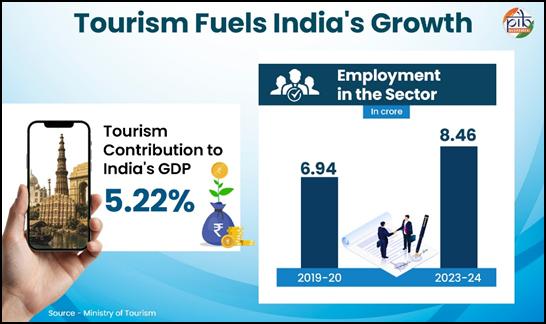
According to the Press Information Bureau backgrounder issued by the Ministry of Tourism on 26 September 2026, tourism contributes 5.22% of India’s gross domestic product on the most recent Tourism Satellite Account estimates for 2023-24. Employment in the sector rose from 6.94 crore in 2019-20 to 8.46 crore in 2023-24 — an addition of 1.52 crore jobs, a rise of 21.9%, recomputed here from the ministry’s own two figures.
Travel itself has come back with force. Domestic tourist visits went from 67.7 crore in 2021 to 428.55 crore in 2025. Foreign tourist arrivals went from 0.1 crore to 2.53 crore over the same years, and foreign exchange earnings from tourism from ₹63,978 crore to ₹2,76,831 crore — 4.33 times, on the same source.
Those two numbers, divided, say something the release does not. Every foreign tourist who came to India in 2025 left behind an average of ₹1,09,419. For 169 domestic trips, the country earns nothing in foreign currency at all. That is not an argument against domestic tourism, which pays hotel staff and bus drivers in the same rupees. It is an argument about where the marginal marketing rupee goes.
The visa is now electronic
The e-visa began in 2014 for nationals of 43 countries. It now covers 172 — 129 more — through 88 international entry points. The ministry’s own break-up is 37 airports, 38 seaports and 13 land ports; those legs sum to exactly 88, which is worth saying because published totals often do not. About 78% of all Indian visas are now issued electronically, and roughly 95% of e-visa applications are processed within 72 hours.
Where the money has gone
Under Swadesh Darshan, the ministry has sanctioned 76 projects worth more than ₹5,295.24 crore across 15 theme circuits, of which 75 are complete. Swadesh Darshan 2.0 carries 53 projects worth ₹2,207.08 crore, and its Challenge Based Destination Development sub-scheme 37 projects worth ₹687.99 crore. PRASHAD accounts for 54 projects worth ₹1,726.74 crore at pilgrimage and heritage sites. The Special Assistance to States for Capital Investment window put ₹3,295.76 crore into tourism in 2024-25 at 100% central funding, across 40 projects in 23 States; Nagaland, Mizoram and Himachal Pradesh have each been sanctioned and released ₹250 crore under the revised 2025-26 guidelines.
Connectivity is the quieter half of this. The ministry records 687 RCS-UDAN routes operationalised, connecting 95 airports, and a ₹28,840 crore outlay approved for the modified UDAN scheme from 2026-27 to 2035-36, with 100 airports and 200 heliports planned.
The registry nobody notices
NIDHI+, the National Integrated Database of the Hospitality Industry, is the least glamorous item on the list and possibly the most useful. As on 23 September 2026 it carried 63,740 accommodation units, 54 convention centres, 215 food business operators, 1,450 online travel aggregators and 15,531 tourism service providers. A registry of that size is what lets a digital stack answer a question rather than merely display a brochure.
Cruise passenger traffic has grown from 1.08 lakh in 2014-15 to 4.62 lakh in 2025-26 — the ministry states 328%, and the arithmetic here returns 327.8%, which is the same claim. International cruise terminals at Visakhapatnam, Mumbai and Chennai have been upgraded and commissioned, and QR-based immigration clearance has brought the per-passenger clearance time down to about 30 seconds.
India’s share of the global MICE market — meetings, incentives, conferences and exhibitions — stands at 5% of an industry the ministry expects to grow from $870 billion to more than $1.4 trillion by 2030. Ten Indian cities, particularly in the south, have been identified as capable of becoming global MICE destinations.
Worldwide, travel and tourism contributed 10% of global GDP in 2024, or $10.9 trillion, supporting 357 million jobs.
What an Indian gains
A homestay owner in a village that no tour operator has heard of gains a listing that a search can find. A guide gains a credential that a traveller can check. A district that has never appeared in a brochure gains a chance to appear in a query. The stack does not create demand; it stops demand from being wasted on the six places everyone already knows.
Tourism cooperation also entered India’s diplomatic agenda this year. The BRICS tourism ministers’ meeting at Jaipur in August 2026, under India’s chairship, adopted the Jaipur Declaration on four priorities: artificial intelligence and tourism, sustainable and responsible tourism, tourism skills and capacity building, and tourism exchange with easier travel facilitation.
At a glance
Tourism’s share of GDP, 2023-24 Tourism Satellite Account estimate: 5.22%
Jobs supported, 2023-24: 8.46 crore (6.94 crore in 2019-20)
Domestic tourist visits, 2025: 428.55 crore (67.7 crore in 2021)
Foreign tourist arrivals, 2025: 2.53 crore (0.1 crore in 2021)
Foreign exchange earnings, 2025: ₹2,76,831 crore (₹63,978 crore in 2021)
E-visa coverage: 172 countries, 88 entry points
NIDHI+ listings as on 23 September 2026: 63,740 accommodation units
How it compares
Domestic tourist visits, 2025: 428.55 crore — the larger flow, 100%
Foreign tourist arrivals, 2025: 2.53 crore — 0.6% of the domestic flow
India made 169 domestic trips for every foreign arrival in 2025.
What the numbers add up to
Jobs added, 2019-20 to 2023-24: 8.46 − 6.94 = 1.52 crore, a rise of 21.9%
Foreign exchange for each foreign tourist, 2025: ₹2,76,831 crore ÷ 2.53 crore = ₹1,09,419
Foreign exchange earnings, 2021 to 2025: ₹2,76,831 crore ÷ ₹63,978 crore = 4.33 times
Entry points: 37 airports + 38 seaports + 13 land ports = 88, so the legs sum to the published total
E-visa countries added since 2014: 172 − 43 = 129
What India gains
A listing that a search can reach for every registered homestay, guide and operator — which turns a district nobody markets into a district a traveller can find.
Blitz appreciates
The Ministry of Tourism, for publishing the Tourism Satellite Account employment series for both 2019-20 and 2023-24 in the same document, which is what makes the four-year comparison above possible at all.
Figures from the Press Information Bureau backgrounder of the Ministry of Tourism, 26 September 2026, Release ID 2315270; checked on pib.gov.in.
Blitz View
One number in the ministry’s own material deserves a follow-up rather than a headline. Of 1,497 DPIIT-recognised travel and tourism startups across 262 districts, 58% sit in Tier II and Tier III cities, and together they employ about 13,919 people — an average of nine. Startups that small do not lack ideas; they lack working capital and a way of being found. The digital stack answers the second half. The first half is still open, and a tourism-specific credit window worked out with the Small Industries Development Bank of India would answer it faster than another marketing campaign.
Kandla will sell ships a cleaner fuel
Gandhidham, 27 September 2026 A ship leaving the Gulf of Kutch for Rotterdam burns fuel oil. In about fifteen months it will be able to fill up, at the same port, on methanol made from sunlight, seawater and carbon dioxide that would otherwise have gone up a chimney.
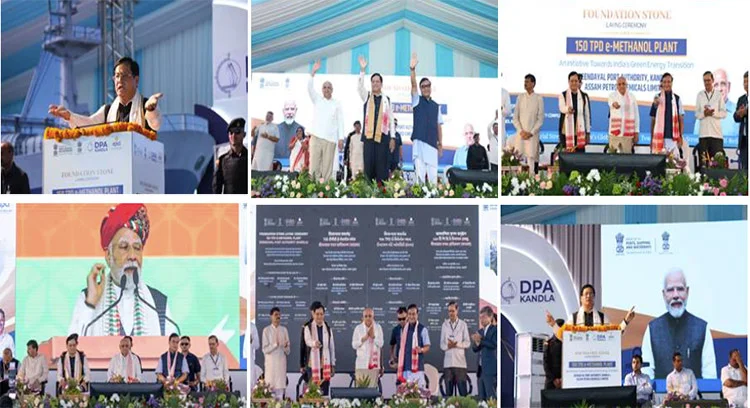
The foundation stone of India’s first port-based e-methanol plant was laid at Deendayal Port Authority in Kandla on 26 September 2026 by Chief Minister of Gujarat Bhupendra Patel, Union Minister of Ports, Shipping and Waterways Sarbananda Sonowal and Chief Minister of Assam Himanta Biswa Sarma.
What is being built
According to the Ministry of Ports, Shipping and Waterways release of 26 September 2026, the plant will make 150 tonnes a day of e-methanol from renewable power, water and biogenic carbon dioxide, for supply to vessels on the Asia-Europe international trade corridor. The investment is ₹2,300 crore, split across two phases: Phase I adds 50 tonnes a day for ₹1,200 crore by January 2027, Phase II a further 100 tonnes a day for ₹1,100 crore by March 2027.
It is a joint venture of Deendayal Port Authority and Assam Petro-Chemicals Limited of Namrup, in a capital ratio of 76:24. The port authority brings equity of ₹567.32 crore, 75 acres, desalinated water and renewable power in the form of green hydrogen. The ministry expects more than 3,500 direct and indirect jobs.
The number the release does not print
Phase I costs ₹24 crore for every tonne of daily capacity. Phase II costs ₹11 crore. The second phase is 54.2% cheaper per unit of capacity than the first — the arithmetic is the ministry’s two figures divided by the ministry’s two capacities, done here. That is what a modular design is for: the first module pays for the utilities, the jetty connection and the learning, and the second one rents them.
The ministry puts the plant’s green methanol at $750 a tonne against a global rate of about $1,300. That is 42.3% below the world price, a gap of $550 a tonne. At the full 150 tonnes a day the plant would make 54,750 tonnes a year, and that gap would be worth about $30.1 million annually against imported molecules — on the ministry’s own price assumptions, which a fuel market can move.
Set the capital against the jobs and each position costs ₹65.7 lakh of investment. That is ordinary for process chemistry and worth stating plainly, because a plant is not a jobs programme and should not be sold as one.
Assam to Kutch
Sonowal, who represents Dibrugarh in the Lok Sabha, noted that Assam Petro-Chemicals sits in Namrup in his constituency. “In the years ahead, Kandla will become a green-fuel hub on the Singapore–Rotterdam route, and this plant is a model for every major port in the country,” he said at the ceremony at the DPA Exhibition Ground in Gandhidham on 26 September 2026.
“This plant turns our renewable strength into an export and makes Gujarat’s coast a gateway for India’s green energy to the world,” Patel said on the same occasion.
Sarma said Assam, with the Brahmaputra, abundant sunshine and hydropower potential, was ready to become a green energy producer: “Today, an Assam company carries that strength from Namrup to Kandla.”
What India gains
International shipping buys its fuel where it is cheapest and cleanest, and from 2027 it will increasingly be required to buy it clean. A port that can sell that fuel earns twice — once on the cargo and once on the bunker. India currently sells the world its cargo handling; this is the first serious attempt to sell the world its molecules.
The release places the project inside a wider maritime push: 100 new ships planned for the merchant fleet over five years, a stated aim of being among the world’s top five ship-owning nations by 2047, a ₹1,520 crore DPA-Cochin Shipyard shipbuilding project at Vadinar, and in-principle approval for a greenfield shipbuilding and repair cluster at Kuchhadi, Porbandar.
At a glance
Total investment: ₹2,300 crore
Capacity at full build: 150 tonnes a day
Phase I: 50 tonnes a day, ₹1,200 crore, target January 2027
Phase II: 100 tonnes a day, ₹1,100 crore, target March 2027
Equity ratio, port authority to Assam Petro-Chemicals: 76:24
Direct and indirect jobs expected: more than 3,500
How it compares
Global green methanol: about $1,300 a tonne — the reference price, 100%
Kandla green methanol: $750 a tonne — 58% of the global price
Kandla is 42.3% below the global rate, a gap of $550 on every tonne.
What the numbers add up to
Phase I capital per tonne of daily capacity: ₹1,200 crore ÷ 50 = ₹24 crore
Phase II capital per tonne of daily capacity: ₹1,100 crore ÷ 100 = ₹11 crore
Phase II is 54.2% cheaper per unit of capacity
Full-capacity output: 150 × 365 = 54,750 tonnes a year
Price gap at full capacity: 54,750 × $550 = about $30.1 million a year
What India gains
A bunkering product India can sell to foreign ships on the Asia-Europe route, made from Indian renewable power and Assamese process capability, at a price no current producer matches.
Blitz appreciates
Deendayal Port Authority and Assam Petro-Chemicals Limited, for structuring the plant as scalable modules rather than one large bet — the decision that produced the cost fall between the phases.
Figures from the Ministry of Ports, Shipping and Waterways press release of 26 September 2026, Release ID 2315327; checked on pib.gov.in.
Kabaddi keeps both golds at Aichi-Nagoya
Aichi-Nagoya, 27 September 2026 India’s men’s kabaddi team did not win the Asian Games gold. It kept it — a harder thing, because everybody has now watched the tape.
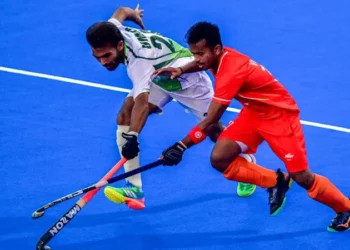
Both Indian kabaddi teams took gold on the seventh day of competition at the Asian Games in Aichi-Nagoya, Japan. Akashvani reported the double at 8.55 PM on 26 September 2026. The Prime Minister’s Office, in a release of the same evening, said Prime Minister Narendra Modi congratulated the men’s team “on retaining the Asian Games Gold”, adding that “their success will also motivate several upcoming players.”
The Prime Minister’s Office issued separate congratulations the same evening to the women’s kabaddi team on its gold; to Tajinderpal Singh for silver in the men’s shot put; to Prachi Chaudhary for bronze in the women’s 400 metres; to Tilottama Sen, Vidarsa Vinod Kochlumkal and Ashi Chouksey for silver in the women’s 50m rifle three-position team event; to Manush Shah and Diya Chitale for bronze in table tennis mixed doubles; and to Joshna Chinappa and Velavan Senthilkumar for bronze in the squash mixed team event.
On the aggregate, the ANI report of 26 September 2026 put India’s tally at 30 medals — four gold, 12 silver and 14 bronze — across 12 sports, with shooting contributing 11, and India tenth in the standings. The Games run from 19 September to 4 October 2026, so that figure will not survive the week.
Anahat Singh and Abhay Singh had reached the squash singles finals, Akashvani reported at 1.34 PM on 26 September 2026.
What India gains
here is not a place on a table. It is the thing the Prime Minister’s own message pointed at — a fourteen-year-old in Jind watching a raider hold a corner and deciding that this is a thing a person can do for a living.
At a glance
Indian kabaddi golds on day seven: 2 — men’s and women’s
Men’s title: retained
Games window: 19 September to 4 October 2026
How it compares
Medals recorded on the ANI tally of 26 September 2026: 30 in total
Bronze: 14 — the largest share, 47% of the 30
Silver: 12 — 40% of the 30
Gold: 4 — 13% of the 30
Bronze medals exceed gold medals by 250%.
What the numbers add up to
4 + 12 + 14 = 30, so the legs of the published tally sum to the published total.
Shooting’s 11 medals are 36.7% of India’s 30, from one of the 12 sports that produced a medal.
What India gains
A defended title in a sport India invented, and eleven medals from a shooting programme that now delivers across age groups rather than around one name.
Blitz appreciates
The men’s and women’s kabaddi squads, and the shooting contingent, whose eleven medals are the quiet arithmetic behind the tally.
Figures from the Prime Minister’s Office press releases of 26 September 2026, Release ID 2315357 among them, and the ANI day-seven report of the same date; checked on pib.gov.in.
Guntur loses a level crossing gate
Guntur, 27 September 2026 Level crossing gate number 3 on the Guntur-Krishna Canal section is to be replaced by a four-lane road overbridge, and the foundation stone was laid on 26 September 2026 by Minister of State for Railways and Jal Shakti V. Somanna and Minister of State for Rural Development and Communications Pemmasani Chandra Sekhar.
According to the Ministry of Railways release of 26 September 2026, the 668-metre bridge is sanctioned at about ₹108 crore, funded 100% by the railways, and needs 2.9 acres of land. It joins Bus Stand Road to Goranthla village near Guntur’s inner ring road. That works out to ₹16.17 lakh a metre, recomputed here.
Somanna said removing level crossing gates through modern overbridges was a necessary step towards accident-free movement and punctuality. The release records that 74 railway stations in Andhra Pradesh are being rebuilt with an investment of ₹3,500 crore.
What a Guntur commuter gains is measured in minutes that stop disappearing at a closed gate — and what the railway gains is a section where a train no longer has to assume a road.
Photograph — place here: https://www.pib.gov.in/PressReleasePage.aspx?PRID=2315288 — caption: “Foundation stone of the four-lane road overbridge replacing level crossing gate no. 3, Guntur, 26 September 2026.” Credit: Photo: PIB.
E-visa now reaches 172 countries
New Delhi, 27 September 2026 India’s electronic visa, which began in 2014 for nationals of 43 countries, now covers 172, according to the Ministry of Tourism backgrounder of 26 September 2026 — an addition of 129 countries.
Entry is permitted through 88 international points: 37 airports, 38 seaports and 13 land ports. Those three legs sum exactly to the published total of 88, a check worth recording. About 78% of all Indian visas are now issued electronically, and roughly 95% of e-visa applications are cleared within 72 hours.
The seaport count is the number to watch. Thirty-eight of the 88 entry points are ports, which is what a cruise itinerary needs before it will call at an Indian coast.
Cruise traffic multiplies four times over
Mumbai, 27 September 2026 Sea cruise passenger traffic rose from 1.08 lakh in 2014-15 to 4.62 lakh in 2025-26, the Ministry of Tourism said in its backgrounder of 26 September 2026. The ministry states the rise as 328%; recomputed here it is 327.8%, or 4.28 times the base.
International cruise terminals at Visakhapatnam, Mumbai and Chennai have been upgraded and commissioned, and the east coast cruise circuit has been extended to include Puducherry. A QR-based immigration clearance system has cut per-passenger clearance to about 30 seconds, with digitised customs procedures and e-group visit visas for international cruise groups.
Thirty seconds a passenger is the whole story. A cruise ship discharges two thousand people at once, and a terminal that takes four minutes a head cannot be on an itinerary.
Green hydrogen meets waste carbon at Kandla
Gandhidham, 27 September 2026The chemistry behind the Kandla plant is worth setting out, because the phrase “green fuel” covers several quite different things.
E-methanol is made by combining hydrogen with carbon dioxide. What makes it green is where each half comes from. The Ministry of Ports, Shipping and Waterways release of 26 September 2026 states that the Kandla plant will use renewable power, water and biogenic carbon dioxide, and that Deendayal Port Authority’s contribution includes renewable energy in the form of green hydrogen. Hydrogen split from water using renewable electricity carries no fossil carbon; carbon dioxide of biogenic origin — from plant matter rather than from a fossil seam — was in the air recently and returns to it.
The distinction matters for a shipowner. A molecule assembled from fossil-derived hydrogen, or from carbon dioxide captured off a coal flue, does not earn the same treatment under shipping’s fuel rules as one assembled the way this release describes. The commercial case and the chemistry are the same case.
Two things the release does not establish, and which the desk could not verify from it: the source of the biogenic carbon dioxide, and the installed renewable capacity dedicated to the electrolysers. Both decide whether $750 a tonne holds at full output.
One in five trained hospitality workers placed
New Delhi, 27 September 2026 A scheme that trains people is judged on what happens after the certificate, and on this the Ministry of Tourism has published an outside body’s count rather than its own.
The ministry’s backgrounder of 26 September 2026 records that an assessment by the Quality Council of India in 2025 found the Capacity Building for Service Providers scheme had trained more than 1.68 lakh people between 2020-21 and 2024-25, and placed more than 36,000. Recomputed here, that is a placement rate of 21.4% — roughly one in five.
The figure needs reading carefully rather than loudly. Short-duration hospitality training is taken by people already in work who want a better grade, by students, and by people looking for a first job; a placement count captures only the third group, and the scheme’s own design includes upskilling and reskilling of people who were never unemployed. A one-in-five placement rate is therefore a floor on the scheme’s effect, not a measure of it.
What it does establish is that four in five trainees are not accounted for by the metric the assessment used. That is a gap in measurement before it is a gap in performance, and the distinction is the whole difference between an audit finding and an accusation.
The ministry records related work under the same head: the Paryatan Mitra and Paryatan Didi initiative launched in 2024 has trained about 4,382 local service providers — cab and auto drivers, transport and hotel staff, homestay owners, guides, police personnel, street vendors, shopkeepers and students — and curriculum revision is under way with 21 central Institutes of Hotel Management and eight hospitality groups.
Blitz View
The Quality Council’s next assessment would be more useful if it separated trainees who were already employed from those who were not, and reported a placement rate only for the second group. The ministry holds the enrolment data that would allow it. A number that can be defended is worth more to a scheme than a number that is large.