Blitz Bureau
NEW DELHI: Roughly 29 per cent of the monsoon’s rain and about a fifth of India’s kharif sowing land in August alone. That compression — a season’s decisions taken in four or five weeks — is the permanent feature of Indian agriculture, and this year it is being tested.
The India Meteorological Department has forecast below-normal rainfall for August, meaning under 94 per cent of the long-period average, and its second long-range forecast placed the season as a whole at about 90 per cent of that average with a margin of four percentage points either way. The sowing figures have followed the rain. Kharif planting was running roughly 23 per cent behind last year in late June; by the end of July the shortfall had narrowed to about 3 per cent, with total planted area trailing by some 3.88 million hectares. Rating agency assessments now expect the season’s sowing to finish 1 to 2 per cent below last year.
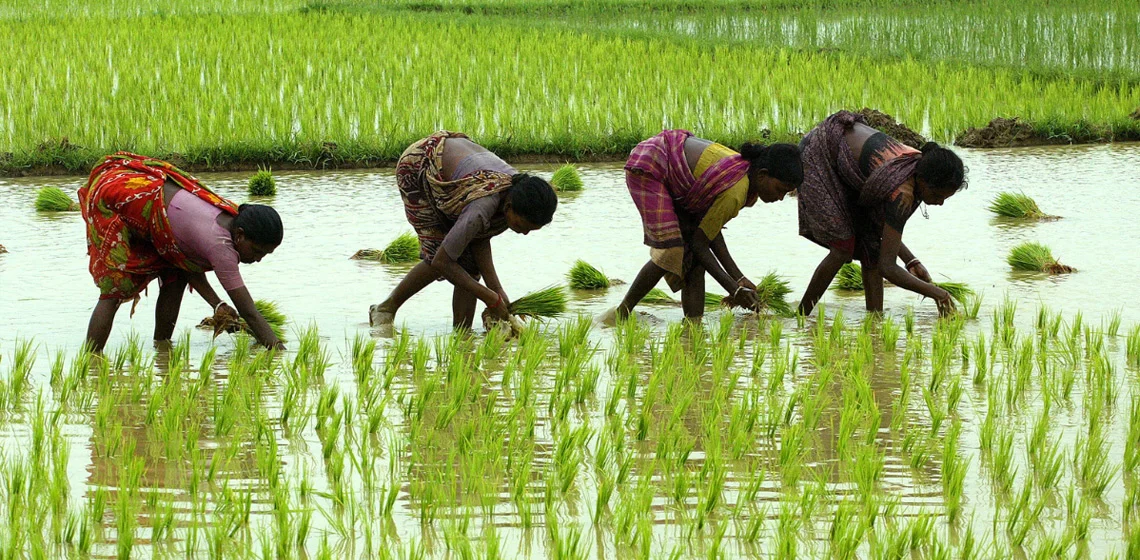
Four weeks that set a year: about a fifth of India’s kharif sowing takes place in August. Planted area was trailing last year by roughly 3.88 million hectares at the end of July 2026.
A twenty-three per cent gap in June became a three per cent gap in July. That recovery is not luck. It is irrigation, and it is the story of the last twenty years.
At a Glance
• August’s share of monsoon rain: about 29 per cent
• August’s share of kharif sowing: about 20 per cent
• IMD August forecast: below normal, under 94 per cent of the long-period average
• Season forecast: about 90 per cent of LPA, ±4 percentage points
• Sowing gap, 25 June: about 23 per cent behind last year
• Sowing gap, end-July: about 3 per cent behind
• Area trailing: roughly 3.88 million hectares
• Expected season outcome: 1–2 per cent lower sowing year on year
The recovery from 23 per cent to 3 per cent in five weeks is the single most instructive number in the series, and it deserves more attention than the deficit itself. A farmer cannot sow without moisture; that a fifth of the country’s kharif area could be planted that quickly once the rain arrived means the seed, the credit and above all the assured water were in place to take the chance. Two decades of tube wells, canal rehabilitation, farm ponds and micro-irrigation are what turned a June that looked like a crop failure into a July that looks like an ordinary bad year. This is the structural gain that gets lost when coverage jumps from the forecast straight to the price of pulses. It is also, precisely, why the remaining gap is concentrated where irrigation is thinnest — the rainfed uplands of central and eastern India, and the oilseed and coarse-cereal belts.
The forward agenda follows from that geography and it is a long one, which is the point of calling this a permanent subject rather than a monsoon story. Three things move the needle over a decade. First, short-duration and drought-tolerant varieties need to be physically available at the block level in the week the rain breaks, not notified in a circular in April; a fifteen-day-shorter paddy is worth more to a late-sowing district than any subsidy. Second, micro-irrigation coverage has to keep extending into exactly the rainfed districts where it is hardest to finance, because that is where the residual 3 per cent lives. Third, the forecast has to get closer to the field: block-level and week-ahead advisories, delivered in the language the farmer reads, turn a national percentage into a sowing decision. India has spent twenty years making a bad monsoon survivable. Making it uneventful is the next twenty years’ work, and the encouraging part is that the mechanism is already visible in this year’s own numbers.