Blitz Bureau
NEW DELHI: The most consequential examination in Indian public life gained a new custodian this weekend. Pralhad Joshi assumed charge of the Ministry of Education a day after Dharmendra Pradhan tendered his resignation; on the advice of the Prime Minister, the President accepted it under Article 75 of the Constitution and gave Joshi additional charge of the portfolio. The change arrives at a pivotal moment: the Supreme Court takes up the Centre’s roadmap for permanent NEET-UG reform on Monday, July 27, and Parliament’s Monsoon Session has just convened with the government having assured that accountability in the examination system will be discussed on the floor of the House.
What links the transition and the timetable is a single objective the whole system now shares — restoring the credibility of the test that decides who becomes a doctor. A leadership change at a ministry is, in a parliamentary democracy, one of the ordinary instruments of accountability, and this one lands with the reform agenda already written: a Bench of Justices P S Narasimha and Alok Aradhe has asked the Centre and the National Testing Agency for a detailed plan, including progress on shifting NEET entirely to computer-based testing with the data-protection and cybersecurity safeguards such a move demands. The new minister inherits not a blank page but a roadmap awaiting delivery.
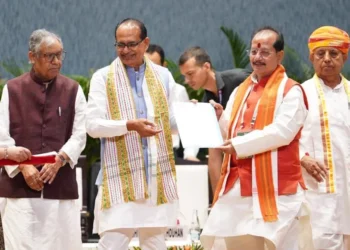
A roadmap awaiting delivery: Pralhad Joshi has taken additional charge of the Education Ministry after Dharmendra Pradhan’s resignation, days before the Supreme Court examines the Centre’s NEET-UG reform plan — including the proposed move to computer-based testing — on July 27.
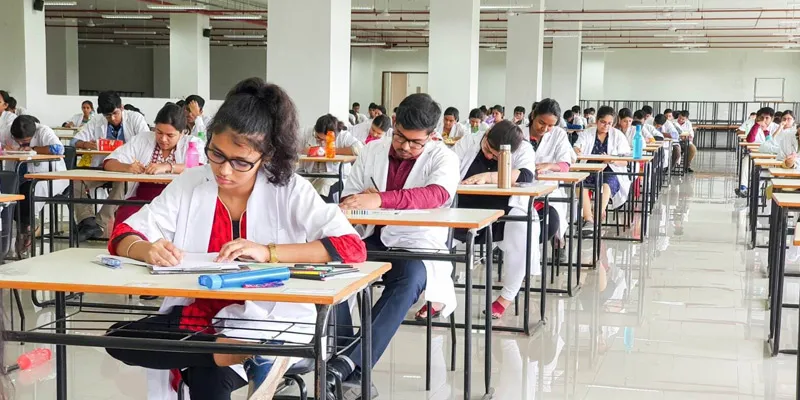
An examination is a promise a country makes to its young: study hard, and the result will be yours alone. Every track now open — a new minister, a courtroom, a Parliament — is an attempt to make that promise unbreakable.
At a Glance
• Change: Pralhad Joshi takes additional charge of Education after Dharmendra Pradhan’s resignation
• Process: resignation accepted by the President under Article 75, on the PM’s advice
• Court: Supreme Court to hear the NEET-UG reform roadmap on July 27
• Parliament: Monsoon Session convened; exam accountability to be discussed
The human dimension of the dispute has not been forgotten in the institutional motion around it. The Delhi High Court on Saturday allowed the education activist Sonam Wangchuk — who ended a 26-day hunger strike on Friday after written assurances from the government — to be shifted to Medanta hospital for continuous care, a decision that puts recovery ahead of everything else. Points of difference between the student representatives and the government remain openly stated, and the venue for the next round of talks is still being settled. That these differences are being worked through the courts, the Cabinet and Parliament rather than only on the street is itself a sign of a democracy processing a painful failure in the open.
The constructive way forward is now unusually clear, because the diagnosis is shared. A secure examination for more than twenty million candidates a year is an engineering and institutional problem before it is a political one: it needs calibrated question banks, centre-level supervision, biometric verification and auditable trails, built at national scale. Monday’s hearing is where the country will see how far that architecture has come; the Monsoon Session is where the accountability conversation moves into the record; and a new minister’s first task is to convert a roadmap into delivery. Handled with the seriousness all three tracks are showing, this is how a system earns back the trust of the students who depend on it — not with a single announcement, but with a fair exam that holds.