Blitz Bureau
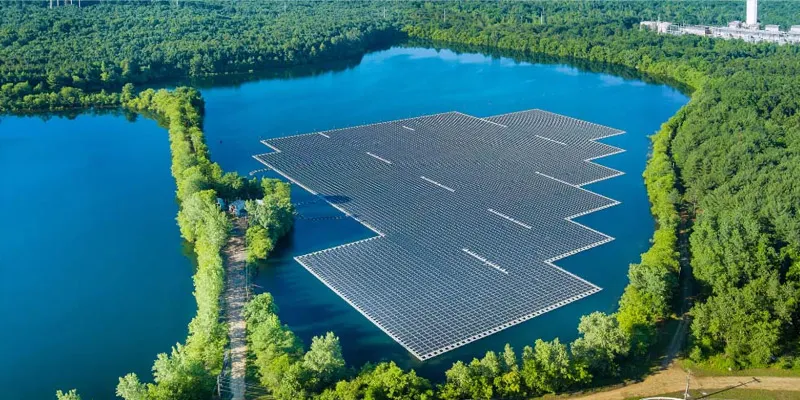
NEW DELHI: India’s solar problem stopped being about generation some time ago. It is about the four hours after sunset, and this scheme is written for those four hours. The Union Cabinet has approved the Pradhan Mantri Surya Sarovar Yojana, a scheme for floating solar photovoltaic projects with co-located energy storage, carrying a total outlay of ₹5,070 crore.
The scheme envisages 5,000 MW of floating solar capacity, each project paired with an energy storage system of at least two hours — 10,000 MWh in total. Projects will be sanctioned between FY 2026–27 and FY 2030–31, with financial support disbursed up to FY 2032–33. Central financial assistance is set at ₹1 crore per MW after commissioning, with up to ₹50 lakh available for feasibility studies. The government expects the scheme to avoid around 10 million tonnes of carbon dioxide emissions a year and to create roughly 16,000 to 17,000 jobs. It sits inside a sector that had 288.58 GW of installed renewable capacity as of June 30, of which solar accounted for 162.15 GW.
Two hours, mandated: every megawatt of floating solar under the scheme must come with at least two hours of co-located storage — 10,000 MWh across 5,000 MW.
Land is the scarcest input in Indian infrastructure and water bodies are already public. Putting the panels on the reservoir solves two problems with one decision.
At a Glance
• Scheme: Pradhan Mantri Surya Sarovar Yojana (PM-SSY)
• Outlay: ₹5,070 crore
• Capacity: 5,000 MW of floating solar photovoltaic projects
• Storage: minimum two hours per project — 10,000 MWh in total
• Sanction window: FY 2026–27 to FY 2030–31; support disbursed to FY 2032–33
• Central assistance: ₹1 crore per MW post-commissioning; up to ₹50 lakh for feasibility studies
• Expected impact: about 10 million tonnes of CO₂ avoided a year; 16,000–17,000 jobs
• Sector context: 288.58 GW renewable capacity installed as of June 30, solar 162.15 GW
The design detail that matters most is the storage mandate. A solar plant without storage produces its power in the middle of the day and nothing at all in the evening, which is exactly when Indian electricity demand peaks — lights, fans and air conditioning arriving together as generation falls to zero. Every additional gigawatt of unstored solar therefore displaces slightly less coal than the gigawatt before it. Requiring two hours of co-located storage on every project converts a midday surplus into evening supply, and it does so at the point of generation, where the connection already exists. That is a smaller and cheaper intervention than building storage separately, and it is why the mandate is more important than the megawatts.
Floating installations bring a second set of advantages that are easy to overlook. They use surfaces India already owns — reservoirs, canal stretches and the water bodies attached to hydro and thermal stations — which removes the land acquisition that is the longest item on the critical path of almost every Indian solar project. Water cools the panels, improving efficiency slightly, and the shade reduces evaporation from the reservoir beneath, a genuine benefit in a country where storage losses to evaporation are significant. The engineering questions are real and solvable: anchoring systems that survive drawdown when reservoir levels fall, maintenance access on water, and careful siting so that aquatic ecosystems and existing uses are not disturbed. The scheme’s provision for feasibility studies suggests those questions are being asked at the right stage, which is before construction rather than after.