Blitz Bureau
NEW DELHI: Tomorrow, for the first time, Vande Mataram will be sung from the ramparts of the Red Fort. The ramparts have belonged to the anthem for seventy-nine years. What changes when the national song is given the same ground?
India marks its 80th Independence Day tomorrow, and the ceremony has been built around two ideas rather than one. The first is an anniversary: 2026 is the 150th year of Vande Mataram, and the national song will be sung from the ramparts of the Red Fort at the start of proceedings — something that has not happened before. The second is a theme, Yuva Shakti, linking the energy of young Indians to the Viksit Bharat @2047 goal, and it has been given effect in the guest list rather than only in the speeches.
The detail that repays attention is who has been invited to sit there. Nineteen Indian students who won medals at the 2026 International Physics, Chemistry, Biology and Mathematical Olympiads are among the guests at the Red Fort. Olympiad medallists are not a category India has traditionally seated at a state ceremony; sportspeople and soldiers are. Placing them on the lawn on the morning the country turns eighty is a small, deliberate statement about which achievements the Republic intends to treat as national ones.
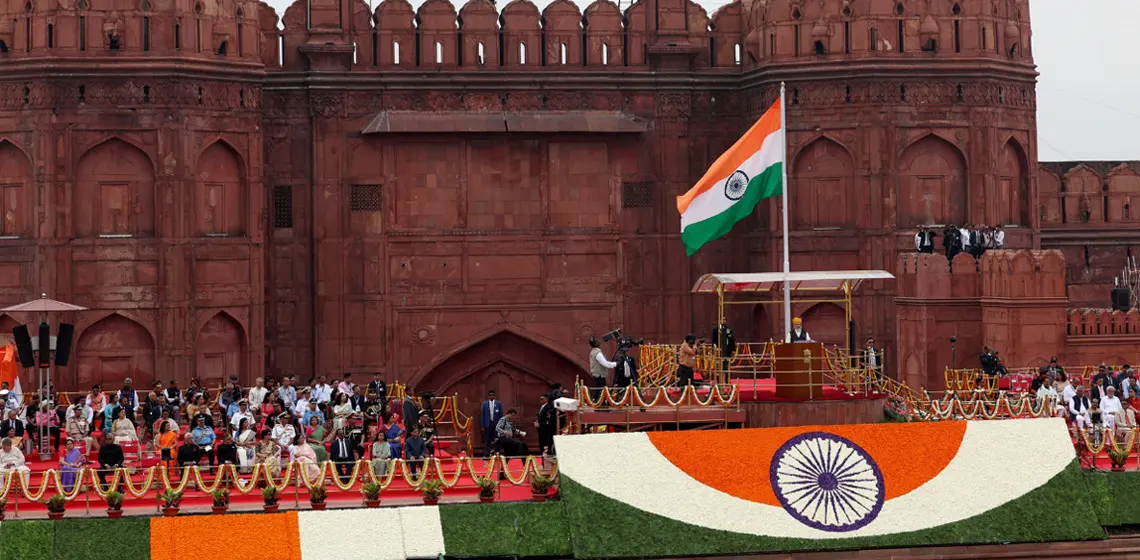
Eighty years of the same ground: the Red Fort ramparts, where the national song will be sung for the first time on 15 August 2026, in the 150th year of Vande Mataram.
A ceremony tells you what a country honours. This one has moved the Olympiad medallist to the front row.
At a Glance
• Occasion: India’s 80th Independence Day, 15 August 2026
• Anniversary: 150 years of Vande Mataram
• The first: the national song sung from the Red Fort ramparts, at the start of the ceremony
• Theme: Yuva Shakti — leading the journey to Viksit Bharat @2047
• Invited: 19 Indian medallists from the 2026 International Physics, Chemistry, Biology and Mathematical Olympiads
• On Gyanpath: about 2,500 NCC cadets and My Bharat volunteers forming the words “वंदे मातरम्”
• Flypast element: an Indian Air Force Mi-17 carrying a 150-years banner, showering flower petals
• Nationwide: band performances at 343 locations through 15 August
• Announced: at a Ministry of Defence briefing, 10 August 2026
The staging has been thought through for a crowd and for a camera. Around 2,500 NCC cadets and My Bharat volunteers are to form the words “वंदे मातरम्” on Gyanpath, directly opposite the ramparts, so that the song has a shape as well as a sound. An Indian Air Force Mi-17 will carry a banner marking the 150 years and shower flower petals over the gathering. Away from Delhi, the band performances at 343 locations are the part most Indians will actually encounter — a district headquarters bandstand rather than a televised flypast.
There is a reason a country returns to a song at a moment like this. Vande Mataram entered public life in 1876 as literature and left it as an instrument — sung on marches, at meetings, in jails, by people who had no guarantee of seeing what came next. To give it the ramparts in its 150th year, in a ceremony organised around the generation that will carry the Republic to its centenary in 2047, is to make a straightforward argument about continuity: that the effort which produced independence and the effort now being asked of the young are the same effort, twenty-one years short of its hundredth year. The ceremony is a morning. The argument is the part that has to last.