



Blitz Bureau
NEW DELHI: Spanning over turbulent rivers, deep gorges, and restless seas, India’s bridges stand as silent testimonies to the country’s engineering ambition. They connect not just towns and regions, but people, cultures, and economies, often in places where geography had long dictated isolation. Across the country, bridges shape everyday life in ways most of us barely notice. They shorten distances, open access to remote communities, and withstand nature at its fiercest. Among the countless bridges that form a vast network throughout the country, several key bridges exemplify the scale and vision of India’s infrastructure. Each one carries its own tale, of daring design, relentless weather, and the human resolve to overcome terrain.
Defining connectivity
Atal Setu: Stretching across the Arabian Sea like a bold stroke on the city’s canvas, the Atal Setu, also known as the Mumbai Trans Harbour Link (MTHL), marks Mumbai’s biggest step towards a horizon unrestrained by traffic and time. It has been developed to ease the heavy traffic burden of Mumbai’s island city. Its impact, however, extends beyond transportation. The MTHL has helped boost tourism in Mumbai and nearby regions, while also enhancing connectivity for trade and industry, contributing to the growth of the local economy.
Chenab Bridge: India’s engineering prowess has reached a new pinnacle with the completion of the Chenab Bridge, the world’s highest railway arch bridge. It has been hailed as a testament to the brilliance and commitment of the country’s engineers and workers as the project confronted hurdles, from difficult terrain and extreme weather to falling rocks in the mountains, making construction exceptionally demanding. Perched 359 metres above the Chenab River, the bridge forms a crucial segment of the Udhampur–Srinagar–Baramulla Railway Link (USBRL). With Vande Bharat trains set to operate on the route, travel time between Katra and Srinagar will reduce to just about three hours.
Vertical lift bridge
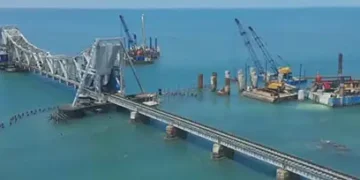
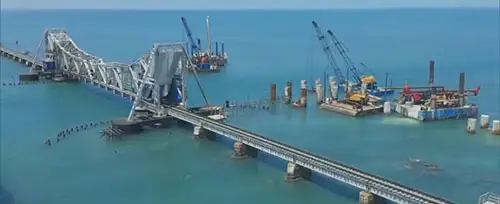
New Pamban Bridge: The newly constructed Pamban Bridge, connecting Rameswaram with the mainland, is India’s first vertical lift railway sea bridge. It has emerged as a standout symbol of modern Indian infrastructure on the world map. The 2.07- km structure includes a 72.5-metre vertical lift section that can rise 17 metres, allowing ships to pass safely without halting train movement. The new Pamban Bridge’s construction encountered major environmental and logistical challenges, including turbulent waters, strong winds, cyclones and seismic risks, and the difficulty of transporting heavy materials to the remote site within tight tidal windows.
Dhola–Sadiya Bridge: Also known as the Bhupen Hazarika Setu, it is a vital link between Assam and Arunachal Pradesh, providing the first permanent road connection between northern Assam and eastern Arunachal Pradesh. Built as a beam bridge, it sweeps over the Lohit River, one of the Brahmaputra’s major tributaries, connecting Dhola in Tinsukia district to Sadiya in the north. Stretching 9.15 km, it is built to withstand the load of 60-tonne military tanks, including the Indian Army’s Arjun and T-72 models. This capability adds significant strategic value to the structure.
Unmatched scale
Anji Khad Bridge: The bridge pierces the Himalayan landscape with an elegance and scale unmatched, emerging as India’s first cable-stayed railway bridge and a key link in the Katra–Banihal section of the Udhampur-SrinagarBaramulla Rail Line. Located about 80 km from Jammu and set against snowcapped peaks, the bridge soars 331 metres above the Anji River valley and extends 725 metres across the gorge. Its defining feature is an inverted Y-shaped pylon rising 193 metres above its foundation, supported by 96 high-tensile cables. More than 8,200 metric tonnes of structural steel reinforce the bridge, enabling it to withstand seismic activity. The bridge was built through extremely rugged conditions marked by cherty limestone formations and unstable hill-wash debris. India’s bridges are more than infrastructure; they are statements of intent, connecting a nation defined by scale and contrast. They rise from mountainsides, pierce through monsoon clouds, and skim the surface of some of the subcontinent’s most volatile waters. Through every corner of this vast terrain, these bridges reflect India’s drive and determination.