Deepak Dwivedi
INDIA’S northeast region (NER), long viewed as a peripheral frontier, is now emerging as a strategic geoeconomic bridge between South and Southeast Asia. Under the Act East Policy, New Delhi envisions the NER as a gateway to the IndoPacific, linking India’s hinterland with ASEAN economies through multimodal infrastructure. This vision has been unfolding within a rapidly evolving regional landscape, where China’s growing dominance in infrastructure, trade, and connectivity across India’s neighbourhood presents both opportunities and challenges.
Landlocked NER’s true potential lies in its connectivity to the Bay of Bengal and the broader Indo-Pacific. Traditionally reliant on resource-based industries – tea, petroleum, bamboo, and handicrafts – its future hinges on transforming into a trade and transit hub between India and Southeast Asia. At a time when India envisions a geoeconomic role for the NER, China’s expansive infra projects in Myanmar and Bangladesh directly impact its economic prospects. India’s attempt to counterbalance through initiatives like the Bay of Bengal Initiative for Multi-Sectoral Technical and Economic Cooperation (BIMSTEC) and the Indo-Pacific Economic Framework (IPEF) depends on overcoming domestic infrastructure constraints, insurgencies, and diplomatic challenges.
For industries in the NER, China’s expanding footprint presents both opportunities and risks. Improved regional connectivity could give Assam’s tea industry and Manipur’s handloom sector access to broader markets. However, the influx of cheap Chinese goods through informal border trade with Myanmar has weakened local manufacturing. With the region struggling to develop a robust industrial base, its dependence on imported consumer goods remains high. Additionally, China’s aggressive trade diplomacy with Bangladesh and Myanmar has further eroded the competitiveness of Indian exports.
The key challenge for India is to ensure that its connectivity projects do more than open transit routes – they must also drive industrial growth that strengthens local supply chains and reduces vulnerability to Chinese economic influence. To fully harness the NER’s geoeconomic potential within the Indo-Pacific, India and its partners must adopt a multi-pronged strategy to enhance connectivity, foster industrial growth, and ensure inclusive, sustainable development that benefits local communities.
Accelerating connectivity and trade facilitation is crucial. Upgrading physical connectivity should remain the top priority, particularly fast-tracking projects like the Kaladan corridor and the India-Myanmar-Thailand Highway by resolving security and financing bottlenecks in coordination with Myanmar and Thailand. Diplomatic engagement with Myanmar must ensure that these corridors are treated as shared economic lifelines.
Additionally, easing non-tariff barriers and simplifying export procedures for northeastbased firms can help local entrepreneurs engage in cross-border commerce more easily. Developing competitive industrial clusters is key to positioning the NER as a hub for specialised industries. Policymakers should identify sectors where the region holds a comparative advantage – like agro-processing (tea, fruits, spices), handicrafts and textiles (leveraging GI tagging and branding), pharmaceuticals (establishing pharma parks in Assam and Sikkim), and bamboo-based industries – and develop export-driven industrial clusters around them.
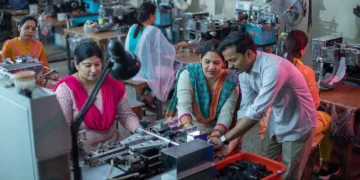
Special Economic Zones and industrial parks must be operationalised, offering ‘plugand-play’ infrastructure, tax breaks, and single-window clearances to attract investors. Enhancing access to credit for MSMEs is also essential. Enhancing human connectivity and soft infrastructure is as vital as physical connectivity. Investing in human capital is critical to integrating the NER with Indo-Pacific economies, requiring expansion of skill development programmes aligned with emerging industries, including training in logistics, foreign languages, and technical expertise for manufacturing.