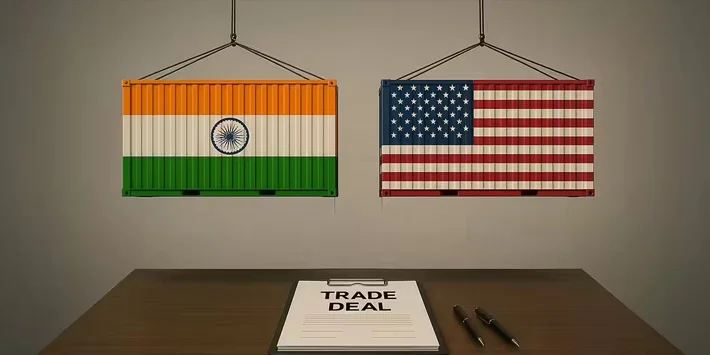
The shifting American tariff regime has complicated negotiations for the finalisation of the Indo-US trade deal. Failure to clinch a deal would not derail India’s growth story, but it could expose a critical vulnerability: the gap between its ambition to become a global manufacturing hub and its ability to secure predictable access to major export markets. At stake are not merely export earnings, but India’s capacity to attract global supply chains, generate jobs and sustain export-led growth.
Altered landscape
Negotiations for the first phase of the India-US Bilateral Trade Agreement remain stalled, despite a framework announced in February.
Commerce Minister Piyush Goyal recently acknowledged that circumstances had changed and final terms would reflect new realities. Finance Minister Nirmala Sitharaman has described the talks as having reached a “plateau”, while US Trade Representative Jamieson Greer has indicated that a deal is not imminent.
Washington had agreed to remove the additional 25 per cent penalty imposed on India for purchasing Russian oil and reduce reciprocal tariffs on Indian goods to 18 per cent. However, the US Supreme Court’s February 20 ruling striking down reciprocal tariffs imposed under emergency economic powers legislation, followed by a blanket 10 per cent tariff announced on February 24 for 150 days, altered the negotiating landscape. New Delhi must now secure commercially meaningful concessions amid continuing legal and policy uncertainty.
RBI Governor Sanjay Malhotra has warned that failure to conclude an agreement would hurt the economy, depending on the tariffs ultimately imposed. The exposure is substantial. India’s merchandise exports to the US reached $42.79 billion during April-August 2026, against $40.39 billion a year earlier. As America remains India’s largest export destination, additional duties could erode competitiveness.
Prolonged uncertainty could delay investments or divert them towards countries offering more predictable trading conditions, undermining India’s manufacturing ambitions
Strategic consequences
Labour-intensive industries, including textiles, garments, gems and jewellery, would face particular pressure. Higher tariffs could make Indian products costlier than competing supplies, squeezing exporters’ margins, weakening orders and constraining employment. Smaller enterprises, with limited financial reserves, would be especially vulnerable. The strategic consequences could extend beyond immediate trade losses.
Global manufacturers considering India as an alternative to China assess not only production costs and capacity, but also reliable access to major consumer markets. Prolonged uncertainty could delay investments or divert them towards countries offering more predictable trading conditions, undermining India’s manufacturing ambitions.
India is widening its options through negotiations with the UK, Canada, Israel, Chile, the Gulf Cooperation Council and other trading blocs. Such agreements can diversify exports, but cannot immediately replace American demand. Nor can market access alone overcome weaknesses in logistics, productivity and competitiveness.
Equally, New Delhi should not pursue an agreement at any cost. A failed deal is manageable. The greater danger is prolonged uncertainty that costs India investment, employment and valuable time in an increasingly competitive global economy.