
SUKUMAR SAH
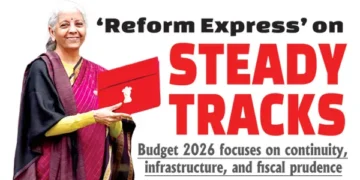
NEW DELHI:The Union Budget 2026-27, presented by Finance Minister Nirmala Sitharaman on February 1 reinforces the Modi Government’s preference for continuity over disruption. In a period of persistent global uncertainty, the Budget highlights infrastructure, public investment, and fiscal prudence as the bedrock of India’s growth strategy, offering a steady hand rather than dramatic new initiatives.
The FM described the past decade as one of “stability, fiscal prudence, sustained growth and moderate inflation,” emphasising action over rhetoric even when external conditions threatened to destabilise the economy. Hailing it as historic, Prime Minister Narendra Modi said “this Budget is a highway of immense opportunities, one that fulfills the dreams of the present and strengthens the foundation of India’s bright future.” He noted that the Reform Express, on which India is riding, will gain new energy and new momentum through this Budget.
The allocation of Rs12.2 lakh crore for capital expenditure, a near 9 per cent increase over last year, reflects the Government’s enduring focus on infrastructure as an engine of growth and employment. From high-speed rail corridors to semiconductor hubs and emerging technology missions, the Budget signals an ambition to create a “future-ready Bharat.” The absence of transformative welfare measures or sweeping labour reforms suggests that the Government prefers consolidation of existing schemes over risky experimentation.
Fiscal discipline remains central, with a projected deficit of 4.3 per cent of GDP. Employment and skills development, while emphasised, hinge largely on better implementation of existing programmes rather than new interventions. The Budget, in effect, is a promise of steady governance, seeking to maintain macroeconomic stability while cautiously nudging India toward structural change.
Industry reactions to the Budget were largely supportive, but measured. The Confederation of Indian Industry welcomed infrastructure commitments but urged faster execution and deeper reforms to “crowd in” private investment. Ficci stressed the importance of job creation and export competitiveness, while MSMEs noted persistent challenges in taxation and credit access.
While the Government’s emphasis on continuity and incremental reform may help maintain macro stability, it might leave industry and political stakeholders asking for more substantive reforms. Ultimately, the 2026–27 Budget is a statement of cautious pragmatism. It underscores India’s growth ambitions and structural priorities without overstretching resources, but it also exposes the limits of incrementalism. For a nation with a burgeoning workforce and pressing socio-economic needs, the Union Budget 2026-27 signals stability and continuity, yet the test will be whether this approach can deliver both growth and tangible benefits to ordinary citizens.