Blitz Bureau
NEW DELHI:
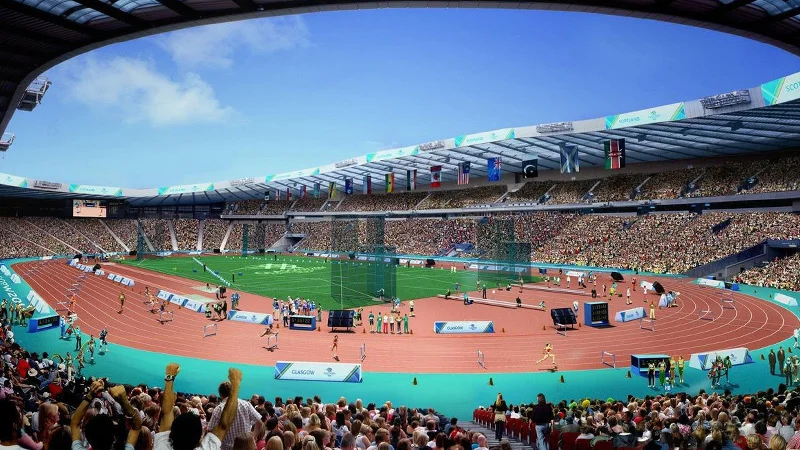
There is a particular sound a stadium makes when two athletes from the same country come down the straight together, and Glasgow heard it on Wednesday evening. Dilip Mahadu Gavit won the men’s T47 100 metres in 10.71 seconds — a Games record and a season best — with Mohammed Basil M crossing 0.12 seconds later in 10.83 for silver. A one-two finish in a Commonwealth Games sprint final is rare for India in any classification. That it happened in a para event, on the same track and in the same programme as every other final, is the part of the story worth slowing down for.
Murali Sreeshankar took silver in the men’s long jump the same day with 8.09 metres on his second attempt, repeating the colour he won at Birmingham in 2022, and six Indian boxers reached their semi-finals, which under Commonwealth rules guarantees six more medals before a punch is thrown. India ended Day 6 on fifteen medals — three gold, nine silver and three bronze — eighth in the overall table, ahead of New Zealand, Jamaica and Wales, with a 122-strong squad and the Games running to August 2.
One programme, one stadium: the Commonwealth Games has integrated para events into the main schedule for two decades — which is why an Indian one-two in a T47 sprint counts on the same medal table as every other final.
A country that can put two sprinters in the top two of any Commonwealth 100 metres has depth, not luck. The
classification does not change that arithmetic.
At a Glance
• Men’s T47 100m: Dilip Mahadu Gavit gold in 10.71s — Games record and season best
• Silver: Mohammed Basil M, 10.83s — an Indian one-two
• Long jump: Murali Sreeshankar silver, 8.09m on his second attempt
• Boxing: six Indian boxers into the semi-finals — six medals guaranteed
• Tally after Day 6: 15 medals — 3 gold, 9 silver, 3 bronze; eighth overall
• Squad: 122 athletes; Games run July 23 to August 2
• Thursday’s card: Neeraj Chopra in javelin qualifying; Tejaswin Shankar in the decathlon; Martina Devi Maibam in the women’s 86+kg weightlifting final; India’s track cycling campaign opens
The structural point behind Wednesday is that the Commonwealth Games has for two decades run para events inside the main programme rather than as a separate meet afterwards, and India’s para-athletics system has quietly become one of the strongest parts of its sporting apparatus. A Games record in a T47 final is not a story about participation; 10.71 seconds is a time that would have been competitive in the able-bodied Commonwealth 100 metres within living memory. Gavit and Basil trained, qualified and competed in a system that treats them as sprinters, and the result on the clock is what that system produces.
Thursday’s card asks the harder question. Neeraj Chopra goes into javelin qualifying as the athlete whose success did most to change what Indians expect from track and field; Tejaswin Shankar contests the decathlon across the 100 metres, long jump and shot put; Martina Devi Maibam has the women’s 86+kg weightlifting final; and India’s track cyclists open a campaign in a discipline where the country has almost no Commonwealth history at all. Nine silver medals against three gold remains the honest weak point — the signature of a system that has solved qualification and is still learning to win finals. The constructive way to spend the last four days of these Games is to treat the silver list as the most valuable document Glasgow produces: a named cohort who came within one attempt of the top step, each with a diagnosable reason why. Publish the analysis, fund against it, and the conversion problem becomes a work plan rather than a lament.