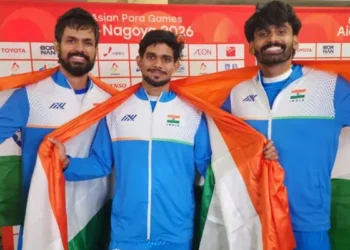


NEW DELHI: There was a point in the Aichi-Nagoya Asian Para Games when the numbers stopped being mere numbers. They became a statement.
India’s para-athletes finished the Games with 114 medals — 30 gold, 35 silver and 49 bronze — to secure their best-ever showing at the continental event and finish fourth in the standings. More remarkable was the manner in which the milestone was achieved: with a contingent of just 168 athletes, almost half the size of India’s squad at the previous edition.
Sumit Antil’s sterling show
At the heart of that surge was Sumit Antil, whose name has become almost synonymous with Indian para javelin. The reigning Paralympic and world champion delivered another statement performance, winning the men’s javelin F42-44/F61-64 combined event with a throw of 72.46 metres. It was more than a gold medal. Antil led an extraordinary Indian sweep, with Mahendra Gurjar taking silver and Sandip Sanjay Sargar bronze.
Nishad Kumar, already a familiar face on the international para-sport circuit, added another chapter to his remarkable career by winning gold in the men’s long jump T47.
Then came the record-breaking performances that gave the closing stages of the Games an almost cinematic quality.
Sandeep, competing in his Asian Para Games debut, announced himself spectacularly in the men’s 400m T64. His time of 52.28 seconds was a world record, and he crossed the finish line not merely as a gold medallist but as the athlete who delivered India’s 100th medal of the Games. His compatriot Ajay Kumar added bronze in a Games-record 53.61 seconds.
Haney’s world record
Haney produced another world-record performance in the javelin F37/38. His 60.49m throw secured gold and provided another reminder that India’s para-athletics programme is producing athletes capable of competing not just for medals but for global records. Together, those performances symbolised the changing landscape of Indian para sport. There is now depth behind the established stars, and the medals are coming from a widening pool of disciplines.
Rich haul in Para badminton
Para-badminton contributed 16 medals, while para-swimming made a significant leap with 11. Para table tennis won seven, archery six and shooting five. The spread suggests that India’s success is no longer dependent on one or two sports.
That matters as much as the record itself.
India’s previous best at the Asian Para Games had come at Hangzhou, where the contingent finished with 108 medals after later adjustments. In Nagoya, the country not only crossed that benchmark but improved its gold tally to 30.
And perhaps the most striking statistic is the size of the contingent that achieved it.
A smaller team produced a bigger haul.
That is a powerful indication of improving quality, preparation and competitiveness across India’s para-sport system. The performances of Antil and Nishad reflected experience and consistency; the world records of Haney and Sandeep pointed towards the next generation.
The fourth-place finish behind China, Japan and Uzbekistan may not yet put India among the continental giants. But 114 medals have moved the benchmark.
The Asian Para Games in Aichi-Nagoya were not simply about India’s biggest medal haul. They were about a para-sport movement acquiring depth, confidence and ambition.
Para glory
• India’s contingent returns with a record 114 medals, including 30 golds, to finish fourth.
• Sumit Antil and Nishad Kumar lead a dominant athletics campaign that delivers 65 medals.
• Sandeep and Haney add world-record glory, signalling the emergence of a new generation of para-stars.
• Medals across badminton, swimming, table tennis, archery and shooting underline India’s growing para-sp