Blitz Bureau
NEW DELHI: Answers tabled in Parliament this week set out three numbers about India in orbit that are rarely printed together. ISRO has performed nine collision-avoidance manoeuvres so far in 2026, against 20 across the whole of 2025. Twenty of India’s 22 active low-earth-orbit satellites sit in the higher-risk band. And India tracks 129 pieces of orbital debris that came from its own missions.
A collision-avoidance manoeuvre is not a dramatic event. It is a controlled burn that shifts a satellite by a few hundred metres to open a gap against a conjunction the tracking data has flagged days ahead. But every one of them costs propellant, and propellant is the single non-renewable resource on a spacecraft. A satellite designed for a decade of station-keeping that spends its fuel dodging debris does not fail; it simply retires early. That is why the manoeuvre count is a better proxy for the health of the orbital environment than any headline about a near miss.
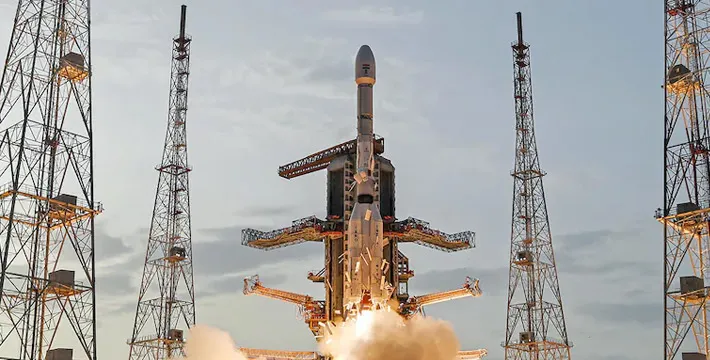
Every launch leaves something behind: of the Indian-origin debris now tracked, spent rocket bodies from PSLV, GSLV and LVM3 flights account for 40, four and three objects respectively.
A satellite that spends its fuel avoiding debris does not fail. It retires early — and the country has to launch the replacement sooner than it planned to.
At a Glance
• Manoeuvres: nine collision-avoidance manoeuvres in 2026 so far; 20 in the whole of 2025
• Exposure: 20 of India’s 22 active low-earth-orbit satellites are in the higher collision-risk band
• Why LEO: below 2,000 km the population of tracked objects is far denser than at higher altitudes
• Indian-origin debris tracked: 129 objects, including 23 defunct satellites in low-earth orbit and 26 in geostationary orbit
• Spent stages: 40 from PSLV flights, four from GSLV, three from LVM3
• International work: participation in the Inter-Agency Space Debris Coordination Committee and the UN working group on long-term sustainability of outer space activities
• Human spaceflight: the uncrewed Gaganyaan G1 flight, carrying the half-humanoid Vyommitra, is targeted within 2026, with G2 and G3 before a crewed flight
• Station: the first module of the Bharatiya Antariksh Station is planned for 2028
Read the debris figure alongside the human spaceflight programme and the two stop being separate subjects. The uncrewed Gaganyaan G1 flight, carrying the half-humanoid Vyommitra to test life support without risking a crew, is targeted within 2026; two further uncrewed flights follow before an astronaut goes up; the first module of the Bharatiya Antariksh Station is planned for 2028. A crewed vehicle and a permanently crewed station both operate in exactly the altitude band where 20 of India’s 22 satellites already face elevated risk. Debris management is therefore not an environmental footnote to the human spaceflight programme. It is one of its engineering preconditions, and it is being treated that way — which is why India counts its own leftovers publicly and reports them to the international coordination bodies rather than only tracking everyone else’s.
What makes this a story of progress rather than of exposure is that the number India is publishing is its own. Tracking 129 objects that originated in Indian missions requires an independent surveillance capability, and disclosing the breakdown — which launcher family left what, how many defunct satellites sit in which orbit — is what a mature space power does before it asks the same of others. The work ahead is concrete: passivating spent upper stages so they do not fragment, planning end-of-life disposal into the design of each satellite rather than deciding it at the end, and continuing to build the sensor network that makes an early warning early enough to be useful. Nine manoeuvres in seven months is a busy year by any standard. It is also nine occasions on which the warning arrived in time.