



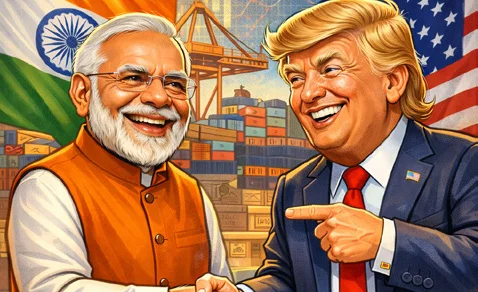
In what marks a calibrated diplomatic reset rather than a mere tariff adjustment, India and the United States have signalled a renewed commitment to deepening their economic partnership, with bilateral trade now explicitly anchored to the target of touching $500 billion by 2030.
The public announcement came on February 2, when US President Donald Trump took to his social media platform to declare that he and Prime Minister NarendraModi had agreed to a ‘trade deal’ that would cut reciprocal US tariffs on Indian exports from 50 per cent to 18 per cent.
The declaration followed a phone call between the two leaders and was widely reported across major outlets as marking a diplomatic breakthrough in the longrunning tariff dispute. “Out of friendship and respect for Prime Minister Modi and, as per his request, effective immediately, we agreed to a Trade Deal between the United States and India, whereby the United States will charge a reduced Reciprocal Tariff, lowering it from 25% to 18%,” said Trump on Truth Social.
Prime Minister NarendraModi thanked the US President “on behalf of the 1.4 billion people of India for this wonderful announcement.”He said he was delighted that Made in India products will now have a reduced tariff of 18 per cent.
The tariff rollback follows months of negotiations in which New Delhi consistently argued that extraordinary tariffs were distorting trade flows rather than correcting imbalances. By bringing India closer to the tariff regimes faced by competing exporters such as Vietnam and Thailand, Washington has effectively acknowledged that India’s earlier treatment had eroded competitiveness across key sectors.
PMModi framed the outcome as part of a wider strategic convergence, noting after his conversation with President Trump that the understanding “reinforces confidence in India as a long-term economic partner and supports shared ambitions for growth, jobs and resilient supply chains.” US officials, in turn, emphasised predictability and scale, underlining that India’s market size and manufacturing potential make it central to the $500-billion trade objective.
Practically, most Indian goods now face 18 per cent tariffs, while electronics, pharmaceuticals, and petroleum products largely remain on existing lower regimes
A sensitive issue in the negotiations was India’s continued purchase of Russian oil. While earlier tariff escalations had been partly justified by Washington on geopolitical grounds, the latest arrangement does not reflect any formal Indian commitment to curtail such imports. Instead, both sides appear to have tacitly agreed to de-link trade penalties from energy choices, preserving India’s strategic autonomy while keeping broader economic engagement on track. The damage inflicted by the earlier tariff regime was real. Indian exporters in labour-intensive sectors such as textiles, engineering goods and gems and jewellery saw margins compressed and orders diverted as US buyers shifted sourcing to lower-duty jurisdictions.
In textiles alone, where the US accounts for over a quarter of India’s exports, elevated tariffs sharply reduced price competitiveness despite stable demand. Not all frictions have disappeared, however. Section 232 tariffs on steel, aluminium and copper remain elevated, and duties on select auto components continue. Yet the broader signal is one of stabilisation through diplomatic recalibration rather than confrontation.
Net positive, says Goldman Sachs
Goldman Sachs has described the US decision to reset tariffs on Indian exports to about 18 per cent as a net positive for India. The American investment bank and financial services firm says the lower tariff rate improves India’s competitiveness in the US market, bringing it broadly in line with other Asian exporters who face duties in the mid-teens to high-teens range, instead of the much steeper punitive tariffs imposed earlier.
On the macro front, Goldman Sachs said the tariff reset could provide a modest but tangible boost to growth. It upgraded India’s calendaryear 2026 GDP growth forecast to around 6.9 per cent, roughly 20 basis points higher than its earlier estimate. It noted that sectors with significant exposure to the US market – including electronics, pharmaceuticals, textiles and chemicals – stand to benefit the most, as lower tariffs improve pricing power and reduce trade friction.