
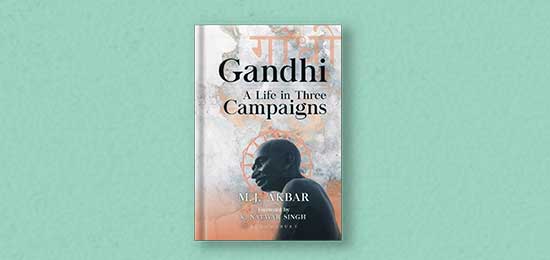
 IT all began with an idea. In 1908, Mohandas Karamchand Gandhi sketched a character for India’s freedom in a ‘booklet’ called Hind Swaraj while aboard a passenger ship from London to South Africa, where he had evolved from a conventional lawyer to a radical activist. The original Gujarati was translated into English and reproduced in early December 1909 in his journal Indian Opinion published from Natal, South Africa. This was compiled into a book, titled Indian Home Rule the following year. The cover of the first addition had a deliciously Gandhian caveat: No Rights Reserved.
The British Raj helpfully added to the book’s reputation by banning it in India as a seditious text. Gandhi was bemused. He felt that his book could be put in the hands of a child for it taught the gospel of love in place of hate, advocated non-violence instead of violence and challenged brute force with ‘soul force’.
The text was structured as a Socratic dialogue, in which the ‘Editor’ answered question from the ‘Readers’. In the second chapter, for example, a reader posits that while the foundation of Home Rule was laid by the Congress, the party could not be ‘considered a real awakening’. The editor replies that it takes a while for a seed to become a tree, and that the real awakening of India only took place after Lord Curzon partitioned Bengal in 1904 in the mistaken belief ‘that Indians only prattle, that they could never take any effective steps’. He added that his was hardly the only colonial crime: the ‘salt tax is not a small injustice’. Just thinking of India’s miserable state, he said, brought tears to his eyes and parched his throat. India’s was ‘groaning unde terrible weight’.
Not all his assertions have aged well, but time has not weakened the remarkable innovations in Gandhi’s doctrine. His central thesis, ‘Home Rule is Self-Rule’, categorically rejected an India that sought replica of English rule without Englishmen, an ‘Englistan’ rather than a Hindustan’, or an India governed by a thin English-speaking elite. ‘That’, said Gandhi, ‘is not the Swaraj I want’. India would never be free, he ventured, until it abandoned the Western civilisation bred by colonialism. Such a civilisation was unhealthy not only for India but for the West as well.
This was not an isolationist view of the world, much less an obscurantist one. Gandhi avidly read authors such as Leo Tolstoy, a genius he admired; the English polymath John Ruskin; and the Americans Henry Thoreau and Ralph Waldo Emerson. Gandhi named his second ashram in South Africa, at Johannesburg, Tolstoy Farm and sent a copy of Hind Swaraj to the venerable Russian. Tolstoy’s last long letter, dated 7 September 1910, was to Gandhi.
The second axis of Gandhis political philosophy challenged the view then held by ‘anarchists’ or the ‘Indian school of violence’ that only guns and bombs could drive away the British. Gandhi accepted the valour of these ‘extremists’ but suggested that they were foolhardy and counterproductive. His path of ahimsa, or non-violence, demanded a much higher degree of courage.
His analysts of British rule upturned conventional thinking. India had succumbed not because of British strength but due to Indian weakness, a frailty caused by casteist evils like ‘untouchability’ and manufactured problems like the Hindu- Muslim discord: ‘The English have not taken India; we have given it to them. They are not in India because of their strength, but because we keep them…Who assisted the East India Company’s officers? Who was tempted at the site of their silver? Who bought their goods? History testifies that we did all this. In order to become rich all at once, we welcomed the Company’s officers with open arms. We assisted them. If I am in the habit of drinking Bhang (a narcotic) and a seller thereof selves it to me, am I to blame him or myself? (Gandhi 1908, chapter 7). Gandhi’s fortitude was anchored in unwavering conviction.
The implications were profound particularly for an age in which the British Empire seemed invincible. Gandhi, however, was certain that the Raj would collapse once Indians lost their fear of the white man, rediscovered unity and revived the skills that had created demand for their products across Asia, Africa and Europe. Colonial policy had driven out Indian products from Indian markets; ergo, the purchase of imported goods was tantamount abetment of British rule. The key to swaraj, or independence, lay in swadeshi, or selfreliance, which would undermine the economic basis of colonialism.
Gandhi boldly addressed a question that had begun to poison the air: had the presence of Muslims ‘unmade’ India? Gandhi’s answer was brief and blunt: ‘India cannot cease to be one nation because people belonging to different religions live in it’. He added: ‘If the Hindus believed that India should be peopled only by Hindus, they are living in dreamland.
The Hindus, the Mahomedans, the Parsees and the Christians who have made India their country are fellowcountrymen, and they will have to live in unity if only for their own interest’. (Gandhi 1908, chapter 10).