• About us
  • Team
  • Privacy Policy
  • Contact
Wednesday, October 14, 2026
  • Login
No Result
View All Result
World's first weekly chronicle of development news
  • Blitz Highlights
    • Special
    • Spotlight
    • Insight
    • Entertainment
    • Sports
  • Opinion
  • Legal
  • Perspective
  • Nation
    • East
    • West
    • North
    • South
  • Business & Economy
  • World
  • Hindi Edition
  • International Editions
    • Dubai
    • Tanzania
    • United Kingdom
    • USA
  • Blitz India Business
  • Blitz Highlights
    • Special
    • Spotlight
    • Insight
    • Entertainment
    • Sports
  • Opinion
  • Legal
  • Perspective
  • Nation
    • East
    • West
    • North
    • South
  • Business & Economy
  • World
  • Hindi Edition
  • International Editions
    • Dubai
    • Tanzania
    • United Kingdom
    • USA
  • Blitz India Business
No Result
View All Result
World's first weekly chronicle of development news
No Result
View All Result

Cooperatives: Boom and transformation

by Blitz India Media
September 5, 2025
in Perspective
0
Boom and transformation
Blitz Bureau

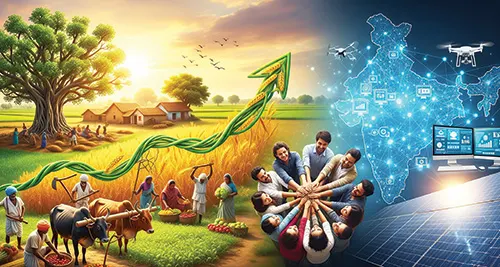
NEW DELHI: INDIA is witnessing a resurgence of its cooperative culture, with grassroots institutions emerging as powerful engines of socio-economic empowerment and inclusive growth. A remarkable example of the transformative power of cooperatives in India comes from Rajasthan’s Borkheda Gram Seva Sahakari Samiti.

Established in 1954 with just 15 members and a share of only Rs. 30, the society has grown into a thriving institution with over 8,299 members and share of Rs 107.54 Lakh today – more than 70 pc of whom belong to marginalised communities. Over the decades, it has evolved far beyond its agricultural roots. It now operates a mini bank with three branches and, in 2018-19 alone, it mobilised deposits worth Rs 4.55 crore.

Nationwide movement

Its e-Mitra Plus centre provides critical citizen services ranging from insurance and Aadhaar-linked facilities to caste and income certificates and utility bill payments. The cooperative society has been honoured with the NCDC National Cooperative Excellence Award (2010) and the NCDC Zonal Award (2018). This transformation is not an isolated case – it is part of a nationwide movement to revitalise the cooperative sector.

At present, India has more than 8.44 lakh cooperative societies spanning 30 sectors, including credit, housing, marketing, dairy, fisheries, and more – functioning as essential instruments for rural credit, self-employment, and collective economic strength.

The momentum of growth is visible even among children in Gujarat. The Bal Gopal Savings and Credit Cooperative Society, based in Sabarkantha, is the country’s only cooperative exclusively for children aged 0-18. Through this unique ‘Baal Bachat Sanskar’ model, children are given saving boxes, and the amounts collected each month are deposited into their bank accounts at 6 pc annual interest. As of March 2024, 19,020 child members from 335 villages have saved Rs 17.47 crore.

The wave of transformation began in 2021 with the creation of the Ministry of Cooperation. In just four years, it has launched 61 structured initiatives designed to modernise, digitise, and diversify cooperative societies. Among the most transformative have been sanctioning of the proposal for the computerisation of 73,492 Primary Agricultural Credit Societies (PACS), the onboarding of 59,920 PACS to a unified Enterprise Resource Planning (ERP) platform, and the formal rollout of multipurpose cooperative models under new by-laws. In Tamil Nadu’s Villupuram district, the Arakandanallur PACCS offers a powerful example of digital preparedness.

When devastating floods destroyed its physical infrastructure and paper records, the society’s prior adoption of PACS computerisation and cloud-based storage enabled swift recovery. Staff accessed member and transaction data remotely, and services resumed quickly. Similar is the case of the Kharsai Vividha Karyakari Society in Maharashtra. Burdened earlier by inefficiencies and paper-based accounting, it adopted fullscale ERP systems under the PACS computerisation programme. Since then, its performance has improved across all metrics.

Massive expansion

The Government’s strategy also includes massive expansion. As of July 22, 2025, 23,173 new multipurpose PACS, dairy, and fisheries cooperatives have been registered. These PACS are being designed to handle grain storage, fertiliser and seed distribution, LPG and petrol pumps, and Jan Aushadhi Kendras, based on a single ERP-based digital architecture. The vision is clear: one cooperative in every village, functioning as a multiservice hub. The digital shift isn’t limited to finance.

As of March 31, 2025, 667 cooperative societies have been registered as buyers on the Government e-Marketplace (GeM). Efforts are also being made to onboard cooperatives as sellers to boost rural artisans’ access to national markets. By March 31, 2025, 2,986 transactions have taken place by these cooperative societies, amounting to Rs 319.02 crore.

Moving from the digital to the sustainable, the Dhondi Solar Energy Producer Cooperative Society in Gujarat’s Kheda district is a notable example. Registered in collaboration with Tata Consulting and IWMI, it is India’s first cooperative solar energy society.


Related Posts

Ayurvedic Medicines Get Stricter Quality Controls
Perspective

STRENGTHENING regulatory norms

October 3, 2026
India Expands Ayush’s Global Healthcare Footprint
Perspective

Expanding international partnerships

October 3, 2026
Ayurveda: Building a Stronger Healthcare Ecosystem
Perspective

In the WHO module

October 3, 2026
Ayurveda: Building a Stronger Healthcare Ecosystem
Perspective

Ecosystem to support growth of AYURVEDA

October 3, 2026
PM SHRI School Selection Process
Perspective

India’s push for future-ready schools

September 18, 2026
PM SHRI School Selection Process
Perspective

Selection is built on quality benchmarks

September 18, 2026
Load More
Next Post
AI: A strategic tool for India’s progress

AI: A strategic tool for India’s progress

Recent News

Rajnath Singh
News

India offers ASEAN joint manufacture of defence systems

by Blitz India Media
October 14, 2026
0

NEW DELHI, 14 October— India is ready to explore building patrol vessels, radars, air-defence systems, helicopters and drones together with...

Read moreDetails
India Canada diplomatic ties

India News: Canada Ties, Ports, Minerals and Stubble Fires

October 14, 2026
Asian Champions Trophy 2026

Pathak returns as India names squad for Asian Champions Trophy

October 13, 2026
Electronics production grows seven-fold : MeitY

New Delhi, 13 October : India’s fintech sector raised $2.2 billion in the first nine months of 2026 (January 1, 2026–September 30, 2026), up 14 per cent from $1.9 billion in the same period a year earlier, a report said. The report from data intelligence platform Tracxn Technologies Limited said funding rounds dipped from 260 to 153, adding that the funding was concentrated in a smaller number of large late‑stage rounds, with five mega‑rounds of $100 million or more accounting for $1.1 billion or 48 per cent of total capital. The report said in the first nine months of 2026, digital lending and payments topped the category rankings, while Bengaluru accounts for over three-fifths of all capital raised. On the exit side, IPOs saw a 50 per cent uptick while overall acquisitions slowed. As many as 30 companies raised their first funding round, down 49 per cent from 59 in the previous year. Series A and later rounds totalled 77, down 31 per cent from 112. Late-stage funding (Series C+, PE, and pre-IPO) led the mix, rising 95 per cent to $1.5 billion in the first nine months of 2026 — up from $751 million during the same period in the previous year. This capital surge pushed late-stage investments to 67 per cent of total market funding, the report noted. Earlier stages experienced contractions in capital and deal counts. Early-stage funding fell 33 per cent to $668 million across 52 rounds, compared to $1 billion across 82 rounds in nine months of 2025. Seed funding fell 57 per cent to $73.8 million across 76 rounds, down from $173 million across 148 rounds. New unicorns crossed the billion-dollar threshold in an average of 7.1 years after their Series A funding. Moreover, the industry saw 3 IPOs in nine months of 2026, up 50 per cent from 2 in the previous year, alongside 11 acquisitions, down 45 per cent from 20.

October 13, 2026
Indian stock market

IBM and MeitY Startup Hub partner to support India’s deep-tech startups with AI, cloud, quantum computing and mentorship.

October 13, 2026

Blitz Highlights

  • Special
  • Spotlight
  • Insight
  • Entertainment
  • Health

International Editions

  • US (New York)
  • UK (London)
  • Middle East (Dubai)
  • Tanzania (Africa)

Nation

  • East
  • West
  • South
  • North
  • Hindi Edition

E-paper

  • India
  • Hindi E-paper
  • Dubai E-Paper
  • USA E-Paper
  • UK-Epaper
  • Tanzania E-paper

Useful Links

  • About us
  • Team
  • Privacy Policy
  • Contact

©2024 Blitz India Media -Building A New Nation

Welcome Back!

Login to your account below

Forgotten Password?

Retrieve your password

Please enter your username or email address to reset your password.

Log In

    No Result
    View All Result
    • Blitz Highlights
      • Special
      • Spotlight
      • Insight
      • Entertainment
      • Sports
    • Opinion
    • Legal
    • Perspective
    • Nation
      • East
      • West
      • North
      • South
    • Business & Economy
    • World
    • Hindi Edition
    • International Editions
      • Dubai
      • Tanzania
      • United Kingdom
      • USA
    • Blitz India Business

    ©2024 Blitz India Media -Building A New Nation