Pratap Singh
NEW DELHI:
Construction Industry is a civilisational industry. Architecture of a particular period, defines an era – whether Indus Valley Civilisation, Mughal Iranian medieval structures or British-era concrete structures. Therefore, it impacts human lives in profound ways. The industry has evolved through ages, leaving a huge imprint on history.
Way back in1910, French artist Villemard imagined construction industry for the year 2000, in his drawings, where in an architect keeps pushing buttons on a console to manipulate a series of machines operating in the usual debris of a construction site. The various machines cut, shape, lift, and place stone blocks to build a house. There are no human labourers in his projection – mechanisation has made them obsolete.
Mark Erlich in his July 2023 article in Harvard Business Review, ‘Can the Construction Industry Be Disrupted?’, and his subsequent writing on modular building argues that the construction sector is uniquely resistant to standard tech disruption. Erlich points out that while the industry is routinely derided as “old-fashioned” and lagging behind manufacturing, the barriers to modernizing it are rooted in the physical realities of the work, not just a reluctance to change.
Dynamic jobsite issue
The most common mistake tech innovators make is treating a construction site like a manufacturing plant. In a factory setting, the environment is static, climate-controlled, and highly predictable – perfect conditions for robotics and automation. A construction site, however, is entirely dynamic. It is exposed to weather, the physical terrain changes daily, and multiple different trades must work around one another in real time.
Flashy ‘automated solutions’ (like robotic bricklayers or autonomous rovers) struggle to find a foothold because they simply cannot adapt to the chaotic, unscripted nature of an active build.
Off-site or ‘modular’ construction, where entire rooms or sections are built in a factory and shipped to the site for assembly, is often hailed as the ultimate disruptor. While it promises up to 50 per cent faster build times, however it faces severe structural barriers preventing it from immediately revolutionising the industry. These include financing mismatch and customisation trap.
Where it’s happening
The following areas have been completely revolutionised in last few decades:
Digital and software automation
This is where the most widespread disruption is currently happening. Before a shovel ever hits the dirt, software is automating the planning and management phases.
• Drones and automated surveying: Drones can fly over a site and use photogrammetry or LIDAR to generate highly accurate 3D topographical maps in minutes, automating a process that used to take human surveying crews days.
• Building Information Modelling: It creates a ‘digital twin’ of the building. The software automates clash detection – for example, alerting engineers if an HVAC duct is routed directly through a plumbing line – before any physical materials are wasted on-site.
• AI scheduling and supply chain: Algorithms can now dynamically adjust project schedules based on real-time weather data, material delivery delays, and labour availability.
Task-specific robots
On-site robotics: While we aren’t yet at the point of fully autonomous jobsites, task-specific robots are stepping in to handle repetitive, physically demanding, or dangerous work. Companies are deploying self-driving bulldozers, excavators, and compactors. Because earthmoving is highly repetitive, these machines use GPS and sensors to grade land perfectly without a human operator in the cab.
Robots like the SAM100 (Semi-Automated Mason) can lay bricks significantly faster than a human. Roving robots can automatically tape, mud, and sand drywall seams, or paint massive commercial walls.
Small, automated tools and rovers are used to rapidly tie structural rebar grids for concrete foundations.
Off-site automation: To bypass the chaos of weather and dynamic jobsites, many companies are moving construction into factories, where traditional manufacturing automation can be applied. Entire sections of a building (like fully plumbed and wired hotel bathrooms or apartment units) are built on an automated factory assembly line.
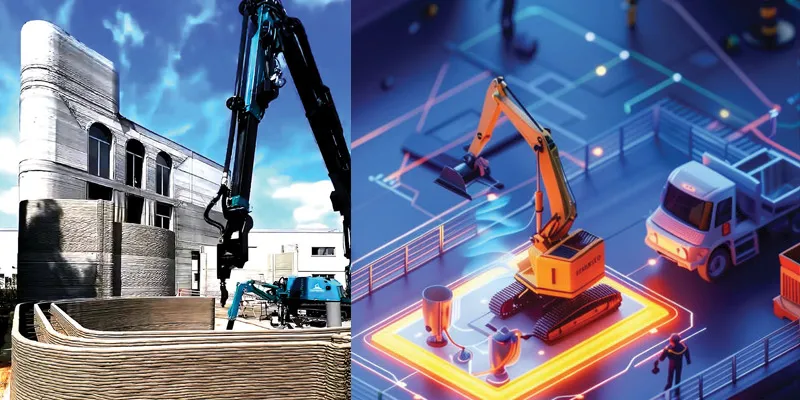
3D concrete printing: Large-scale gantry robots extrude a specialised concrete mixture layer-by-layer to print the structural walls of a house. This allows for rapid construction and complex, curved architectural designs.
Project cost saving
Automation is reducing costs today, but those savings are almost entirely a byproduct of speed. In construction, cutting a project’s timeline eliminates months of labour overhead, equipment rental fees, and loan interest. The reality is that cost reductions are significant, but they require massive upfront capital investment in plant and machinery, meaning only the largest firms are reaping the benefits right now. Automation is impacting bottomline in following ways.
Speed is Money’ equation: In traditional manufacturing, you lower costs by buying cheaper materials or paying lower wages. In construction, you lower costs by getting off the jobsite faster. Current AI-driven scheduling and project management platforms are compressing project timelines by 30-40 pc. Finishing a commercial building early means less of paying site supervisors and hourly labour, less of renting cranes, scaffolding, and temporary fencing and paying lesser interest on construction loans.
Hard cost reductions: Beyond just saving time, certain technologies are aggressively cutting hard operational costs. AI-augmented Building Information Modelling (BIM) is now catching 50 to 75 pc more design clashes before construction starts. Fixing a plumbing and HVAC collision on a computer screen costs nothing; fixing it after the walls are poured costs thousands in wasted materials and rework.
Construction is notoriously dangerous, and insurance is a massive line item. Firms using AI computer vision networks (cameras that automatically flag safety hazards like missing hardhats or dangerous equipment proximity) are seeing injury rates drop significantly, leading to 8 to 20 pc reductions in insurance premiums.
The catch – ROI gap
While the operational savings are real, the barrier to entry is keeping automation out of the hands of everyday builders. A fully equipped autonomous earth-moving robotic platform can require significant investment, and integrating it into legacy workflows often takes several months. Because of this, the cost savings of physical robotics are currently locked behind a massive ‘paywall’.
Whether prefabrication helps: Prefabrication (prefab) reliably speeds up construction, but its ability to reduce costs is conditional and depends heavily on the scale and type of the project. While it is often pitched as a silver bullet for affordable building, the reality of prefab economics is more nuanced.
The speed advantage of prefab is undeniable, but the acceleration comes from two main factors. Parallel processing: In traditional construction, the process is strictly linear: you cannot frame the walls until the foundation is poured and cured. With prefab, the process runs in parallel. While earthmoving and foundation pouring are happening on the jobsite, the walls, floors, and sometimes fully finished modules are simultaneously being built in a factory. Weather independence: Factory environments are climate-controlled. Snow, heavy rain, or extreme heat do not halt production.
Prefab becomes significantly cheaper when there is high repetition. Building one custom architectural home via prefab offers little to no cost benefit. However, manufacturing 500 identical bathroom pods for a large hotel or hospital leverages factory efficiency, drastically lowering the cost per unit. Therefore prefab buildings are excellent for high volume, highly standardised projects, building hundreds of identical units.
Structural steel use
Similar to the prefabrication dynamic, using structural steel is a guaranteed way to accelerate a construction timeline, but it is not an automatic path to a cheaper project. Here is a breakdown of how steel alters the timeline and the budget:
The speed advantage: Steel is fundamentally faster than traditional reinforced concrete, consistently reducing project timelines by 20 to 40 per cent. It requires no curing time like concrete buildings that require time to pour, set, and cure before they can bear weight or before the next floor can be built.
The cost equation: On a purely material basis, structural steel is almost always more expensive than the equivalent volume of concrete and rebar. However, it claws back material costs in several indirect ways, like Foundation savings: Steel has a significantly higher strength-to-weight ratio than concrete. Labour efficiency: Concrete is incredibly labour-intensive, as compared to steel industry requiring large crews to build wooden forms, tie rebar, pour the mixture, and vibrate it, and Reduced overhead: Just like prefab, finishing a building 30 pc faster means shedding months of loan payments and generating operational revenue sooner.
When to use what: The tipping point between steel and concrete usually comes down to height and span. Steel wins decisively in high-rises, skyscrapers, and vast industrial warehouses or aircraft hangars where you need massive open spaces without columns. Concrete wins in low-to-mid-rise residential buildings, parking garages, and structures where heavy soundproofing and thermal mass are the primary goals.
Flashy ‘automated solutions’ (like robotic bricklayers or autonomous rovers) struggle to find a foothold because they simply cannot adapt to the chaotic, unscripted nature of an active build
Energy-efficient buildings
Making a building energy efficient requires a two-pronged approach: passive (preventing energy from being wasted in the first place) and active (using technology to optimise the energy that must be consumed).
Modern buildings use advanced materials like spray polyurethane foam (SPF) or vacuum insulated panels (VIPs) to create an airtight seal. This prevents conditioned air from leaking out and blocks outside temperatures from penetrating the walls.
Advanced glazing: Premium developments now use double or triple-paned glass treated with low-emissivity (Low-E) coatings. In sun-drenched, high-heat environments, these microscopic metallic coatings reflect solar heat outward while letting natural light in, drastically reducing the cooling load.
Cool, green roofs: Reflective roofing materials bounce sunlight away rather than absorbing it. Green roofs (living vegetation) provide massive thermal mass, naturally insulating the building below.
Global experience
China has revolutionised the construction industry with its speed and execution. It can complete a 10-storey apartment building going up in 28 hours, or a 57-storey skyscraper in in just 19 days, it looks like a magic trick. However, the secret isn’t that they are building incredibly fast on the jobsite; the secret is that almost none of the actual building happens on the jobsite. It is an example of almost 90 per cent prefab work in a factory and assembly/fixing pieces on site.
While this method is incredibly fast, highly energy-efficient, and structurally sound, it requires a massive, industrialised supply chain that is difficult to replicate.
Outside of China, like in US or Europe, the focus is on software disruption, sustainable materials, and solving severe skilled labour shortages plaguing Western markets. The global consensus is clear: the future of construction involves fewer hard hats on-site and significantly more robotics, factory floors, and AI servers working behind the scenes.
(The writer is an IRS Officer with over 35-year experience of working at senior positions in the Government across the country. He is a trained Civil Engineer and holds M Tech Degree in Civil Engineering from IIT Kanpur)
The tipping point between steel and concrete usually comes down to height and span. Steel wins decisively in high-rises, skyscrapers, and vast industrial warehouses or aircraft hangars