Blitz Bureau
NEW DELHI: When automated teller machines (ATMs) were introduced in India more than three decades ago, they were immediately embraced by customers. Crowded banks heaved a sigh of relief, and customers no longer had to stand in long queues to withdraw their own money. For those facing emergencies, ATMs were a lifeline as the service was available round the clock.
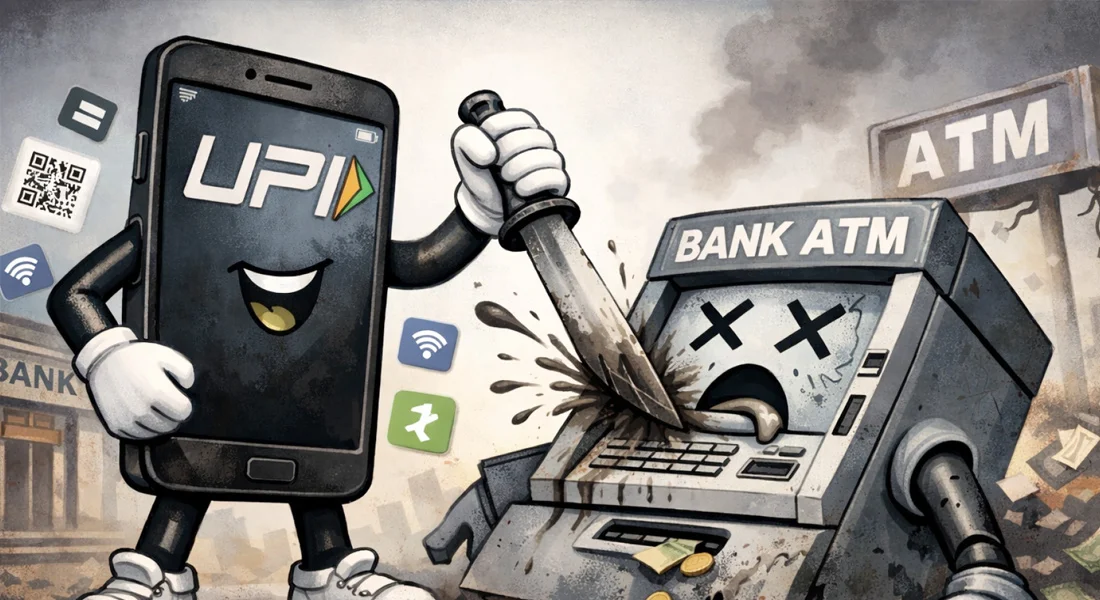
Come 2025, however, and these once indispensable machines have begun to disappear. This year alone, banks have removed thousands of ATMs. Private banks have led the contraction, cutting their ATM networks to 77,117 from 79,884, while public sector banks have reduced their count by more than a thousand.
According to a report by the Reserve Bank of India (RBI), the primary reason behind this decline is the rapid growth of electronic payment systems, which has reduced customers’ need for cash withdrawals even as bank branches continue to expand. A large number of people now use the Unified Payments Interface (UPI), which allows money transfers within seconds.
Cost efficiency is another factor driving the shift. Running an ATM involves significant expenditure for banks. Many machines are located in rented premises, requiring banks to pay monthly rent and, in many cases, deploy security guards. Since ATMs are electronic machines, they also require proper cooling systems, often involving air conditioners. This increases operating costs, especially as commercial electricity tariffs are expensive, said a senior State Bank of India (SBI) official.
He explained that banks are increasingly trying to reduce these costs by installing ATMs within their own buildings. Doing so eliminates additional expenses and do not require separate security arrangements.
There have also been instances of criminals uprooting and taking away entire ATMs located in remote areas. With the number of bank branches increasing significantly, banks are now installing ATMs within these branches. In such locations, cash can be withdrawn from 9.30 am to 6 pm, after which the branches close.
This also helps banks manage overcrowding. Meanwhile, the rise of UPI in India has been phenomenal. It now accounts for about 85 per cent of India’s digital payment volume, driven by free, instant transactions and widespread merchant adoption, cementing its role in accelerating the country’s cashless economy.
As of mid-2025, UPI serves about 491 million users and 65 million merchants, connecting 675 banks. In the coming years, more ATMs are likely to disappear. Banks, particularly private ones, are closely monitoring the usage of each machine. If transactions fall below a certain level, the ATM is likely to be shut down.