Blitz Bureau
NEW DELHI: In a significant advancement for next-generation electronics, Indian researchers have developed a novel method to control the structural, optical, and electrical properties of nanomaterials using temperature. This could facilitate future electronic devices, tuneable optoelectronic systems, responsive materials, and bioelectronic interfaces.
The breakthrough was achieved by a team from the Centre for Nano and Soft Matter Sciences (CeNS), Bengaluru, in collaboration with the Jawaharlal Nehru Centre for Advanced Scientific Research (JNCASR). Both institutions operate under the Department of Science and Technology (DST), Government of India.
The researchers focused on a small organic compound known as naphthalene diimide (NDI), an amphiphilic molecule capable of self-organising in water through supramolecular self-assembly. This process allows molecules to form well-defined nanostructures through noncovalent interactions—an essential feature for advanced material design.
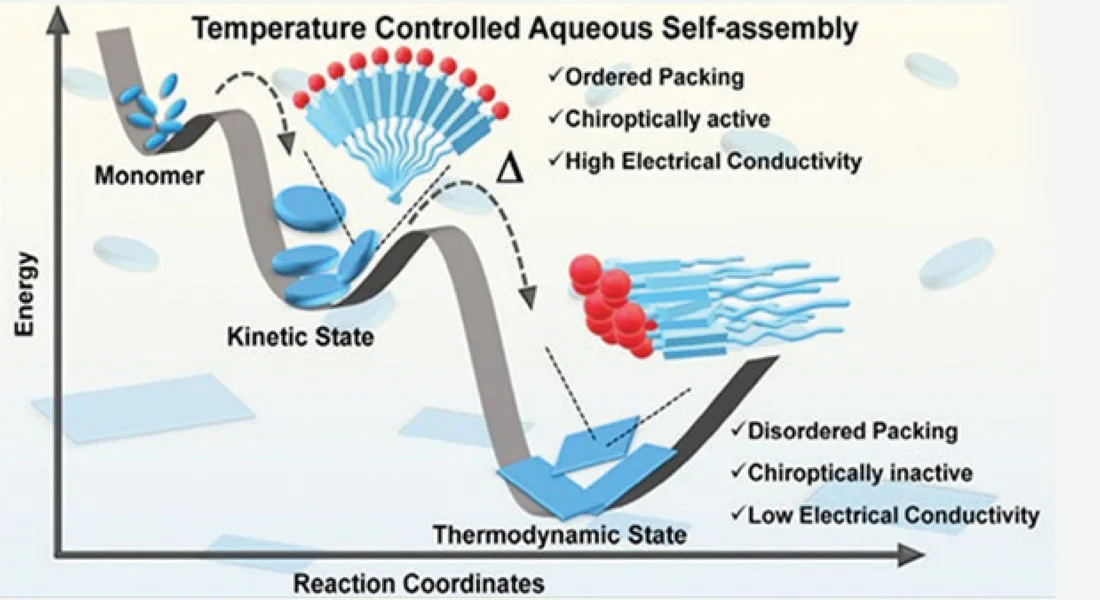
The study found that at room temperature, the molecules assemble into circular nanostructures called nanodisks. These nanodisks exhibit unique optical properties, including chiroptical activity, enabling them to interact distinctively with polarized light.
However, when heated, the nanodisks undergo a structural transformation into two-dimensional nanosheets, losing their chiroptical properties in the process. This demonstrates that temperature alone can act as a switch to alter both the structure and optical behaviour of the material.
The researchers also observed a significant change in electrical performance. The nanodisks showed higher electrical conductivity, which dropped nearly sevenfold when they transformed into nanosheets. This indicates that the material’s electronic properties can be precisely tuned by controlling its assembly pathway—a rare capability in small organic molecules.
Experts say this ability to dynamically modify material properties using temperature could pave the way for innovations in electronics, photonics, sensors, and bioelectronic interfaces.
The findings, published in the journal ACS Applied Nano Materials by the American Chemical Society, highlight the growing potential of supramolecular chemistry in designing responsive and multifunctional materials.
The research was led by Dr. Goutam Ghosh of CeNS, along with his PhD student Sourav Moyra and collaborator Tarak Nath Das from JNCASR. Scientists believe the study provides a simple yet effective strategy for engineering highly tunable nanomaterials, bringing India a step closer to developing future-ready electronic and smart systems.