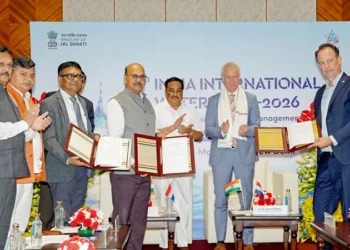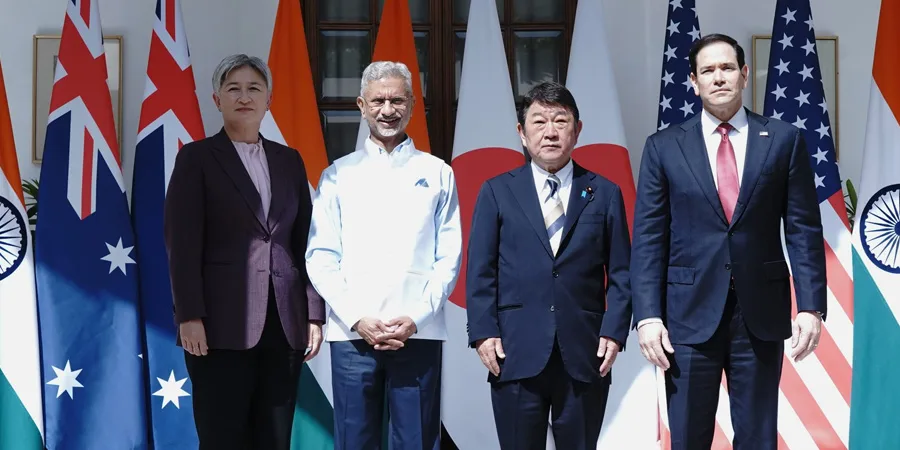
The Quad foreign ministers have sharpened their focus on trade, energy security and maritime cooperation, with India, the US, Australia and Japan announcing a series of initiatives aimed at strengthening economic resilience and supply chain stability across the Indo-Pacific region. The discussions took place during the Quad grouping, hosted by India in its capacity as the current chair of the grouping.
External Affairs Minister S Jaishankar, US Secretary of State Marco Rubio, Australian Foreign Minister Penny Wong and Japanese Foreign Minister Toshimitsu Motegi attended the meeting.
Addressing a press conference after the conclusion of the meeting, Additional Secretary in the Ministry of External Affairs K Nagaraj Naidu said, the meeting reaffirmed the QUAD’s commitment to a free and open Indo-Pacific. He also highlighted that counter-terrorism is a significant pillar of the QUAD cooperation and the Foreign Ministers strongly condemned terrorism in all its forms and manifestations, including cross-border terrorism. He said that in the joint statement, terrorist attack in Pahalgam was condemned.
The four countries announced five major initiatives spanning maritime surveillance, port infrastructure, critical minerals, regional maritime coordination and energy security, signalling a shift towards more operational cooperation within the Quad framework.
Addressing the meeting, Jaishankar said the Indo-Pacific would become increasingly important for global economic activity, energy trade and maritime commerce in the coming years.
“As democratic nations, we also devoted attention to countering the common threat of terrorism. There must be zero tolerance for terrorism and nations have the right to defend themselves,” he said.
The discussions also focused on strengthening resilient supply chains and ensuring stability in maritime routes amid rising geopolitical uncertainties and energy security concerns.
US Secretary of State Marco Rubio said the Quad was evolving into a “partnership of action” focused on delivering practical outcomes across areas of cooperation.
“Our goal collectively has been to turn this from a forum in which we meet and talk about problems to one where we actually do something about it,” Rubio said. Australian Foreign Minister Penny Wong highlighted the economic impact of tensions in West Asia, particularly concerns surrounding the Strait of Hormuz.
“We know the consequences for our region of the Iranian closure of the Strait of Hormuz and what that means for our energy security, for our economies and for our people,” Wong said.