Anoop Saxena
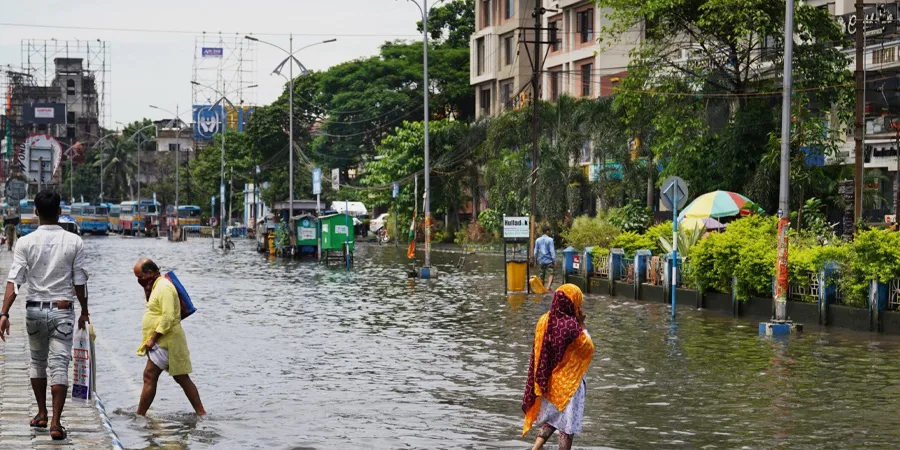
NEW DELHI: For decades, the monsoon in India has followed a predictable, tragic script – three days of heavy rain, followed by three weeks of ‘Venetian’ commutes in Bengaluru and Mumbai.
Our cities, built on the ‘grey infrastructure’ model of the 20th century, were designed to fight water – to funnel it into concrete pipes and whisk it away as fast as possible. But as 2025’s record-breaking deluges proved, the pipes are full, and the water has nowhere to go but into our living rooms.
Enter the ‘sponge city’! Urban planning in India is now undergoing a quiet, green revolution. From the ‘sponge parks’ of Chennai to the rejuvenated lake clusters of Bengaluru, the goal is no longer to fight the rain, but to invite it in.
Chennai ‘soak-in’
Chennai is the poster child for this transformation. As of early 2026, the Greater Chennai Corporation (GCC) has operationalised 78 sponge parks. The crown jewel is the Dr MS Swaminathan Wetland Eco Park in Porur.
Once a neglected parking lot buried under asphalt, it is now a vibrant blue-green lung that can absorb millions of litres of runoff, recharging the parched aquifers below rather than overloading the Cooum River.
“We stopped thinking of rain as a ‘disposal problem’ and started seeing it as a ‘resource opportunity’,” says a senior urban planner at the GCC. “By replacing concrete with permeable pavers and native bioswales, we’re letting the earth do what it does best: breathe and soak.”
The shift isn’t just about digging pits; it’s about data. The launch of the Sujalam Bharat digital framework in late 2025 has provided city administrators with what they call ‘digital twins’ of their water systems. By March 2026, cities like Indore and Vadodara are using AI-driven simulations to predict exactly which neighbourhood will ‘saturate’ first during a cloudburst.
Under the Amrut 2.0 Mission, which is reaching its peak implementation this year, every major Indian city has submitted a City Water Balance Plan (CWBP). This isn’t just a document; it’s a blueprint for a circular water economy. We are finally seeing the marriage of ancient wisdom – like the cascading tank systems of the Cholas – with 21st century sensors.
The Sujalam network
To understand how India is transforming into a ‘sponge nation’, it is essential to look at the Sujalam Bharat framework. While often discussed in the context of rural greywater, in 2026, it has evolved into the overarching digital and policy ‘brain’ behind urban and rural water resilience.
The Sujalam Bharat mission did not start as a single project but evolved through a series of high-intensity campaigns designed to tackle India’s twin crises – water scarcity and groundwater depletion.
Sujalam 1.0 (August 2021): Started as a 100-day campaign to create one million soak pits and manage greywater in rural areas to achieve ‘ODF Plus’ status for villages.
Sujalam 2.0 (March 2022): Launched on World Water Day with a focus on ‘making the invisible visible’ (groundwater). It expanded the scope to institutional greywater management in schools, panchayats, and health centers.
Vision for Sujalam Bharat (2025): In November 2025, the Government convened the Sujalam Bharat Summit, which elevated these campaigns into a national roadmap for a “water-secure and climate-resilient India.”
Governance approach
The Ministry of Jal Shakti is the nodal ministry. However, the unique ‘whole-of-Government’ approach means it operates through two key departments:
Department of Drinking Water and Sanitation (DDWS): Handles the “liquid waste management” and rural aspects.
National Water Mission (NWM): Focuses on conservation, groundwater recharge, and the urban “sponge city” integration.
To ensure the ‘sponge’ concept works, nine different ministries (including Rural Development, Education, and Panchayati Raj) signed a joint advisory to converge their funds (like MGNREGS and the 15th Finance Commission grants) towards water assets.
The Sujalam Bharat mission provides the digital public infrastructure (DPI) that makes sponge cities viable. Here is how the ‘technical engine’ works:
The Sujal ID: Just as citizens have Aadhaar, in 2026, every major water body, sponge park, and recharge well is assigned a Sujal ID. This allows the ministry to track the ‘health’ and water levels of these assets in real-time.
The City Water Balance Plan: Under Sujalam’s technical guidance, cities must now prove where every drop of rain goes. They cannot just ‘drain’ it; they must ‘balance’ it by showing how much was absorbed (the sponge) versus how much was discharged.
Groundwater Governance: The mission moved the needle from ‘extraction’ to ‘replenishment’. By 2026, any major urban construction must show a ‘Sujalam-certified’ recharge plan, effectively making developers responsible for the ‘sponginess’ of their own plot.
The ‘Wuhan’ warning
While India looks to global models like the Wuhan Sponge City initiative in China, the 2026 reality is a bit more grounded. The Chinese model showed that sponges work brilliantly for one-in-five-year storm events but can still be overwhelmed by ‘black swan’ climate events.
Indian planners are taking a ‘hybrid’ approach.’ They are building ‘green-grey’ systems. India still needs the big drains (the grey), but they are now supported by a network of urban forests, rain gardens, and permeable pavements (the green) that act as a massive shock absorber.
The transition isn’t cheap. The Union Budget 2026-27 has earmarked significant capital for ‘Climate-Resilient Urban Infrastructure’. However, the ‘cost of doing nothing’ is higher. Between 2020 and 2025, urban flooding cost the Indian economy an estimated $15 billion in damages and lost productivity. Investing in ‘sponginess’ isn’t just an environmental choice; it’s a fiscal imperative.
As we move toward the 2030 SDG deadlines, the ‘sponge cities’ like Chennai and Bengaluru are teaching us that resilience is not about how hard you can hit back at nature; it’s about how much you can absorb and still keep standing.
While often discussed in the context of rural greywater, in 2026, the Sujalam Bharat framework has evolved into the overarching digital and policy ‘brain’ behind urban and rural water resilience