Blitz Bureau
NEW DELHI: India achieved a defining milestone in its space journey, becoming the third country globally – after the United States and China – capable of launching a privately-developed, orbital class rocket into space. The achievement marks the coming of age of the country’s private space industry.
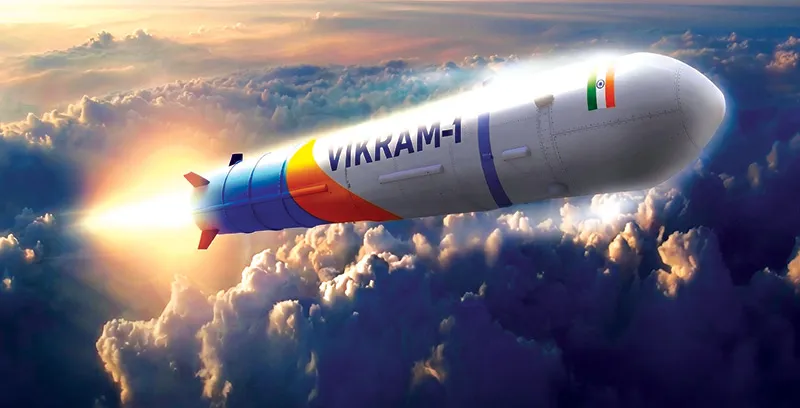
Hyderabad-based Skyroot Aerospace successfully launched Vikram-1 rocket on its maiden orbital mission from the Satish Dhawan Space Centre in Sriharikota, on July 18. After a brief countdown hold, the 22-metre-tall rocket lifted off carrying multiple customer payloads and in-orbit technology experiments.
Around 15 minutes later, Vikram-1 successfully deployed its payload into a 450- km low-Earth orbit, completing the primary objectives of its debut Mission Aagaman. Prime Minister Narendra Modi hailed the launch as “a defining moment in India’s space journey”. Speaking to the Skyroot founders after the mission, he said the growing role of the private sector was opening new frontiers and accelerating innovation. Earlier, he had described the Vikram-1 as “a historic new frontier.”
Leading space startup Skyroot declared Mission Aagaman a complete success, saying it validated critical systems, including propulsion, avionics, telemetry, guidance, navigation and flight control. The company said data from the mission would support future demonstration launches before commercial operations begin.
Founded in 2018 by former ISRO engineers, Skyroot has become one of India’s leading space startups. Earlier this year, it became the country’s first space startup to cross the $1-billion valuation market
Founded in 2018 by former ISRO engineers, Skyroot has become one of India’s leading space startups. Earlier this year, it became the country’s first space startup to cross the $1-billion valuation mark, reflecting growing investor confidence in the country’s commercial space ambitions.
Vikram-1 can carry payloads of up to 350 kg to low-Earth orbit. It uses three solid-fuel propulsion stages and a liquid-fuel orbital adjustment module powered by a 3D-printed engine, showcasing advanced indigenous launch technologies. The mission also carried technology demonstration satellites and experimental payloads for Indian and international customers.
Space sector opening
The success builds on Skyroot’s Vikram-S mission in 2022, the first privately built rocket launched from Indian soil on a suborbital flight. Achieving orbit represents a far greater technological challenge, requiring precise stage separation, orbital insertion and payload deployment.
The launch also validates the Government’s 2020 decision to open the space sector to private participation. The reforms ended decades of Government monopoly over launch services and enabled startups to build rockets, satellites and other space technologies.
With India targeting expansion of its space economy from about $8 billion to $44 billion by 2033, Vikram-1’s success strengthens the country’s position in the fast-growing global commercial launch market.