PRABHU CHAWLA
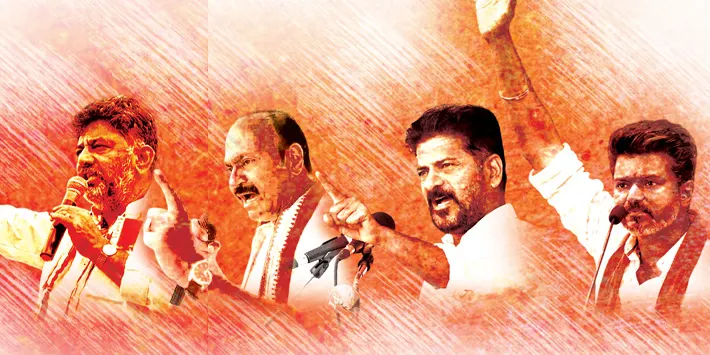
NEW DELHI: In the sprawling Rashtrapati Bhawan complex, where Niti Aayog’s national narrative unfolded as polite choreography between the Centre and the states, four chief ministers arrived not as supplicants, but as a single, coordinated force.
Kerala’s VD Satheesan, Telangana’s A Revanth Reddy, Karnataka’s DK Shivakumar and Tamil Nadu’s Joseph Vijay walked in together on what was meant to be another routine meeting. They left having altered the grammar of Indian federalism itself. Their combined weight is impossible to dismiss. These four states command 104 Lok Sabha seats, nearly one-fifth of the lower House. They generate close to 26 per cent of India’s GDP and contribute roughly 30 per cent of the direct tax revenues.
Not one of their governments belongs to the ruling dispensation at the Centre. What they brought to Delhi was not a list of grievances, but individual structural diagnoses delivered with authority. It was the deliberate construction of leverage.
For decades, Indian Opposition politics has mistaken noise for power. Regional leaders have often confused visibility with influence, treating protest as an end rather than a means. During their first meeting, the southern quartet has broken that pattern. By appearing as an ideologically opposed bloc rather than four separate petitioners, they have rendered southern solidarity legible to the national imagination.
Model federal citizens
The grievance they have placed on the national table is both real and self-inflicted by the constitutional order. Southern states have behaved as model federal citizens by every technocratic metric. They curbed population growth when it mattered most for national development. They built human-capital foundations through education and health. They created export-oriented economies that now feed the Union’s redistributive machinery.
Their reward, under the delimitation exercise scheduled after the next Census, is a diminished share of parliamentary representation. The current formula prizes raw population numbers above all else. They feel success in governance is penalised; demographic expansion is rewarded. For the South, this is not an administrative footnote. It is a constitutional contradiction that turns federal equity on its head.
Revanth Reddy, 56, has given this contradiction its sharpest national articulation. His proposed hybrid formula – half the seats allocated by population, half by economic contribution – does not invent new principles. It lifts that recognition from budgetary arithmetic into the architecture of the Lok Sabha itself. In doing so, he has transformed a regional anxiety into a constitutional question that any serious federal democracy must eventually confront. He has become the public face of the delimitation argument and possesses both the stamina and the political runway to sustain it across cycles.
Intellectual, moral anchor
Each leader supplies a capability the others cannot replicate. At 62, Satheesan functions as the bloc’s intellectual and moral anchor. A practising lawyer and six-time legislator who rebuilt the Congress in Kerala through patient, principled work rather than inherited advantage, he carries the authority of demonstrated clean governance. Satheesan supplies the steady calibration of principle.
Shivakumar, at 64, is the indispensable organisational engine. An eight-time legislator with unmatched command of booth-level mobilisation and alliance arithmetic, he rescued the Congress in Karnataka from near-extinction and converted survival into stable governance. Karnataka is not merely another southern state; it is the physical and political bridge to the peninsula. Any formation that aspires to national consequence must pass through that gateway. Shivakumar guards it with institutional memory, personal relationships and the unglamorous machinery of power.
Joseph Vijay, at 51, remains the most disruptive element. He entered politics without dynasty, without prolonged apprenticeship inside an established party and without the ideological scaffolding that usually organises Tamil Nadu’s contests. He converted a cultural phenomenon into a governing majority that now controls the South’s largest economy and largest parliamentary contingent – 39 Lok Sabha seats. His presence at the Niti Aayog table in his first term signals that Tamil Nadu’s historic ambivalence towards active engagement with national structures has shifted. More importantly, he commands a cross-community base that conventional categories struggle to contain. These four capabilities are not interchangeable.
A coherent position
They form a functional whole: moral legitimacy, galvanising issue-framing, organisational muscle and mass disruptive appeal. When aligned, they produce something Indian Opposition politics has repeatedly failed to manufacture, a coherent southern position on representation and resources that carries electoral consequences rather than mere rhetorical force. The BJP’s organisational footprint remains thin across most of the southern theatre. In Telangana, Tamil Nadu and Kerala, its electoral ceiling is structurally constrained. Karnataka is the sole genuine contest. This asymmetry grants the quartet strategic breathing room their Hindi-belt counterparts rarely enjoy.
The real adversary, however, is not the BJP. It is entropy. Regional coalitions in India have a well-documented habit of fracturing under the pressures of personal ambition, competing state interests and the centrifugal pull of immediate political calculations. Converting a moment of impressive solidarity into a durable institution is a harder task than any single election, and history offers more examples of failure than success. Yet the structural conditions favouring persistence are stronger than in previous regional experiments. The bloc’s economic weight and parliamentary numbers create objective leverage that sentiment alone cannot generate. The delimitation question supplies a durable constitutional grievance around which coordination can crystallise over time.
Given that none of the four leaders is past the conventional peak of an Indian political career means the human capital exists to sustain the project across a decade. If that discipline holds, the implications extend far beyond the next election cycle. A southern formation commanding such economic and parliamentary leverage could, over successive electoral cycles, force a renegotiation of the terms of federalism.
National coalition arithmetic would shift permanently from One Nation, One Election and One Party to any party or a combination of many aspiring to govern at the Centre. The old binary of national party versus regional formation would give way to a more genuinely multiple polity.
Structural argument
What the southern quartet has already achieved is the first, and perhaps hardest, step. They have compelled a Centre long accustomed to managing regional dissent through selective concession to treat their argument as structural rather than episodic. Whether this becomes the opening chapter of a lasting reordering or merely an impressive season of solidarity will be decided by what these four men do next. The South has found leaders who appear to recognise the stakes.
The centre of political gravity is already beginning to tilt – not through demographic accident, but through deliberate organisation. In that emerging reality, the old assumption that numerical superiority somewhere guarantees national dominance no longer holds as an unchallenged premise. The conversation has changed. The structure of power may yet follow.
Not one of their governments belongs to the ruling dispensation at the Centre. What they brought to Delhi was not a list of grievances, but individual structural diagnoses delivered with authority. It was the deliberate construction of leverage