Blitz Bureau
NEW DELHI: What the Comptroller and Auditor General asked BSNL to fix in 2023, what the enterprise answered, and where the fix stands after a fresh audit tabled this month.
In December 2016 the Telecom Commission approved money from the Universal Service Obligation Fund to hang 25,000 Wi-Fi hotspots off Bharat Sanchar Nigam Limited’s rural telephone exchanges. The logic was thrift. The exchanges already stood, already drew power and already had backhaul; the hotspot was to be the cheap last thirty metres between a village and the fibre already running past it. On the enterprise’s own numbers the scheme was to earn ₹75 crore in 2018-19.
Nine years on, the hotspots are the most closely audited small asset in Indian telecom, and the audit trail is unusually complete: a Comptroller and Auditor General paragraph, a parliamentary committee that took it up as a subject in its own right, the enterprise’s evidence on the record, and a fresh performance audit tabled on 12 August 2026. Read end to end, it is a case study in which half of a recommendation was acted on quickly and half has stayed open.
Of the recommendation’s three limbs, the enterprise contested the first, delivered the second, and the third has been outstanding since 9 August 2023.
WHAT WAS RECOMMENDED
Paragraph 4.2 of the Comptroller and Auditor General’s Report No. 16 of 2023, tabled on 9 August 2023, carries three distinct asks inside one sentence. BSNL should build a mechanism to evaluate implementation issues before it proposes a scheme; it should devise a steady revenue model to make the hotspots self-sustaining, upgrading them to newer technology if that is what it takes, and maintain them properly; and it should conduct impact assessment, with the explicit object of bringing the downtime penalty down.
The audit’s own findings sized the problem. Of the sanctioned sites, 13.77% were later closed or relocated, making the money spent on them unfruitful. Commissioning of 700 hotspots ran late across ten Telecom Circles, the longest delay reaching 790 days. Penalties borne over 2017-18 to 2021-22 came to 9.45% of the revised project cost.
WHAT THE ENTERPRISE SAID
The Committee on Public Undertakings took the paragraph up and presented its Fourteenth Report to Lok Sabha on 12 August 2025. It recorded that 24,333 of the 25,000 hotspots were commissioned, at a revised project cost of ₹642.58 crore, and that audit had physically verified 957 sites.
It also recorded the numbers that make the subject worth reporting. Revenue across 2017-18 to 2021-22 came to ₹3.09 lakh — set against a target of ₹75 crore for a single year. Liquidated damages of ₹81.84 lakh were levied for delay. Downtime penalties borne by BSNL came to ₹60.71 crore.
BSNL did not accept the first limb. It told the Committee it had “submitted proposal of 25K Wi-Fi hotspots to USOF after due diligence and approval”, and located the difficulty in the market rather than the appraisal: “the telecom sector is fast changing, therefore during the execution of the project, the use of landline got reduced leading to rural exchanges becoming non-viable.” On revenue it said the “public perception of rural users is that Wi-Fi service is free or complimentary service and these Wi-Fi hotspots are financially not viable.” Its Chairman and Managing Director went further in oral evidence: “if you are going to only target Wifi as a revenue source, it is not really going to be a wining situation.”
On the ₹60.71 crore of downtime penalty the enterprise gave a contract-design answer that deserves to be carried plainly. It told the Committee the penalty arose “due to the fact that there is no capping on levy of downtime penalty to BSNL” under the agreement. Its vendors, BSNL added, enjoyed a cap of 20% on their own exposure. That asymmetry is a drafting matter, and it is fixable with a standard clause.
On the second and third limbs BSNL did not argue. It told the Committee it would shift hotspots to other locations or divert them to other BSNL Wi-Fi projects, that it was exploring PM-WANI, and that about 1,600 hotspots had already been converted to Public Data Office revenue-sharing arrangements — while the effort moved to 4G saturation and fibre-to-the-home under the amended BharatNet programme.
WHERE THE FIX STANDS
The Comptroller and Auditor General returned to the question in Report No. 19 of 2026, a performance audit of BharatNet tabled on 12 August 2026, and its paragraph 3.2.3 is the number the desk would put in front of any board. Of 1,04,675 Wi-Fi connections installed under BharatNet, 6,293 were still active in March 2024 — 6.01%. By March 2025, 766 were functional across all States, or 0.7%.
The wider picture in the same report is a network largely built and thinly used. Expenditure has reached ₹39,888 crore against an approved ₹42,068 crore. Of 2.26 lakh Gram Panchayats in the revised scope, 2.19 lakh are service-ready. But paragraph 4.2.2 puts the share of service-ready Gram Panchayats actually operational at 33.20%, and paragraph 4.3 puts bandwidth utilisation at 17.91%.
Photograph — a second image runs here, at the top of this section. See the picture slot on this story: no photograph is to be placed, and the Blitz data card described there carries the service-ready figure against the operational figure.
The reasons are mechanical rather than mysterious, and the report states them. About 48% of downtime traces to fibre cable faults or cuts, and the mean time to restore a fibre fault is 17 days. The Fibre Fault Localisation System that would have found those cuts automatically was planned in April 2014 and was not in place as of July 2024. A network without fault localisation is a network repaired by somebody walking the route.
The Ministry’s replies, recorded in the same report, put it in the same terms. Poor uptime, it said in March 2025, comes from “OFC damage due to other development activities, the linear network design … and the lack of electricity connections in many GPs”, and it recorded that a “penalty of ₹34.77 crore has been deducted from BSNL claims”. On the ₹2,001.43 crore of Phase-II funds BSNL had moved to establishment costs and other projects, the Ministry said in November 2025 that BSNL “had since recouped entire amount”. Audit also records 16,271 Gram Panchayats — 39% of the total in six States — left out on cost-cutting grounds.
WHAT HAS BEEN FIXED
The half of the recommendation about technology and revenue has been answered, and answered with numbers. BSNL had 97,068 4G sites installed and 93,511 on air as of 31 October 2025, all upgradable to 5G, according to the Department of Telecommunications’ Year End Review of 19 December 2025. Fibre-to-the-home rose from 3.35 lakh connections in March 2019 to 41.12 lakh by 31 January 2025, and BharatNet carried 13,92,767 fibre-to-the-home connections by 30 November 2025 on the Standing Committee’s record. Wi-Fi hotspot provisioning is under way at about 5,200 Gram Panchayats under Phase-II.
The balance sheet that has to pay for maintenance has also turned. Debt fell from ₹32,978 crore in March 2022 to ₹19,568 crore in September 2023. Asset monetisation reached ₹812.27 crore in 2024-25 against a target of ₹800 crore. Net profit was ₹262 crore in the third quarter of 2024-25 and ₹280 crore in the fourth.
The committee machinery worked as designed. On the Committee’s Sixth Report on BSNL, Action Taken Notes were filed by the Ministry of Communications on 23 May 2025 against the 23 recommendations in that report, and the Committee accepted 17 of the replies it received.
AT A GLANCE
● Sanctioned: 25,000 Wi-Fi hotspots at BSNL rural exchanges, December 2016, from the Universal Service Obligation Fund (CAG Report No. 16 of 2023, para 4.2)
● Commissioned: 24,333 hotspots; revised cost ₹642.58 crore (COPU, Fourteenth Report, 18th Lok Sabha, 12 August 2025)
● Revenue 2017-22: ₹3.09 lakh, against a ₹75 crore target for 2018-19 alone (same report)
● Downtime penalty borne: ₹60.71 crore; vendor penalty capped at 20%, BSNL’s uncapped (same report)
● BharatNet Wi-Fi active, March 2024: 6,293 of 1,04,675, or 6.01% (CAG Report No. 19 of 2026, para 3.2.3)
● Functional by March 2025: 766, or 0.7% (same paragraph)
● Fibre faults as a share of downtime: 48%; mean time to restore 17 days (para 4.2.2)
● BharatNet bandwidth utilised: 17.91% (para 4.3)
● BSNL 4G sites on air, 31 October 2025: 93,511 of 97,068 installed (DoT Year End Review, 19 December 2025)
WHAT IT AMOUNTS TO
A Gram Panchayat counted as service-ready is one where the fibre reaches the building. Whether anyone in the village can use it is a different number, and that number is 33.20%. The distance between the two is where the school that cannot stream a lesson and the health sub-centre that cannot upload a scan both sit. The capital has largely been committed; the service has substantially not arrived.
That is also why the story is not a verdict on anyone. The enterprise took the harder half of the recommendation and acted on it, the finances have turned, and the technology has moved on. What has not closed is the limb about keeping assets working — and the auditor restated it on 12 August 2026 in almost the words it used in 2023: ensure that Wi-Fi access points are operational and properly maintained to enhance utilisation.
BLITZ RECOMMENDS
To the Department of Telecommunications. Roll out the Fibre Fault Localisation System and remote fibre monitoring, integrated with a geographic information system and a central network operations centre, so faults are found by software rather than by a walking party. Twelve years between plan and installation is the single largest recoverable item in the 17-day restoration figure.
To BSNL and the project’s administrative ministry. Move disbursement from installation to service availability. Payment released against a commissioned asset buys commissioning; payment released against measured uptime buys uptime. Audit’s own threshold — above 95% availability written into partner incentives — is the right place to start.
To the enterprise’s contracting cell. Cap BSNL’s downtime exposure on the same basis as the vendor’s. An uncapped penalty on one side of a contract and a 20% cap on the other is not a commercial position; it is an oversight that ₹60.71 crore has already paid for.
To the ministries that would use the network. Anchor tenancy is the cheapest demand there is. Health, education and agriculture departments taking dedicated capacity at tiered rates would move bandwidth utilisation off 17.91% faster than any retail proposition in a village where the expectation is that Wi-Fi is free.
To the districts. Contract local youth and entrepreneurs for fibre operations and maintenance on performance-linked terms, as audit proposes under a Bharat Net Udyami model. A repair crew that lives in the village that lost its connection is the fastest mean time to restore available anywhere.
Rural banks post best year on record
The 28 Regional Rural Banks close 2025-26 with their highest consolidated net profit and their lowest recorded bad-loan ratios.
The Regional Rural Bank system earned a consolidated net profit of ₹10,176 crore in 2025-26, against ₹6,820 crore the year before, the Department of Financial Services said on 25 August 2026. The gain of ₹3,356 crore is the largest single-year rise the system has recorded.
Total business crossed ₹13.5 lakh crore. Gross non-performing assets stood at 5.3% and net non-performing assets at 2.1%, both described by the department as the lowest levels the system has reached. The credit-deposit ratio, at 75.2%, is the highest recorded — a measure of how much of the deposit base is being lent out rather than parked.
The scale behind those ratios is what makes them a development number rather than a banking one. The 28 banks run 22,273 branches across 26 States and three Union Territories, covering about 700 districts, and opened 54.98 lakh new Pradhan Mantri Jan Dhan Yojana accounts in the year.
One qualifier belongs with the comparison. 2025-26 is the first full year after the 2025 amalgamation that reduced the number of Regional Rural Banks to 28, so the year-on-year figure compares a smaller set of larger banks with a larger set of smaller ones. The system-level total is sound; the entity-level comparison is not like for like.
BLITZ RECOMMENDS
A consolidated profit figure across 28 institutions conceals the spread between them. Publishing bank-wise profit and asset-quality data alongside the aggregate, as the Reserve Bank does for scheduled commercial banks, would let sponsor banks and State governments see which of the amalgamated entities is carrying the average and which is being carried by it.
SIDBI opens co-lending to all rural banks
Why The PIB release for this conference (PRID 2303447, 26 August 2026) carries no photograph of the event — its only image is the Azadi Ka Amrit Mahotsav emblem, a masthead device. PIB’s gallery has no album for it. SIDBI’s own photographs are SIDBI’s copyright and carry no reproduction permission, so a handout taken from its website would convey no rights.
Instead Blitz-owned schematic of the co-lending flow: borrower to Regional Rural Bank branch, to the Co-Lending Origination Platform, to in-principle sanction, to credit in the borrower’s account — with the three-bank pilot and the 28-bank expansion marked on it. Footer: Source: SIDBI, Ministry of Finance; Blitz India analysis.
A three-bank pilot goes to the whole Regional Rural Bank network, with the loan file moving on a platform rather than on paper.
The Small Industries Development Bank of India brought the heads of all 28 Regional Rural Banks together on 25 August 2026 to widen its MSME co-lending arrangement beyond a pilot that has so far run in three of them, the Ministry of Finance said in a release on 26 August 2026.
The mechanism is the point. SIDBI’s Co-Lending Origination Platform carries the loan file end to end without paper and returns an in-principle sanction once documents are in, with money credited directly to the borrower’s account. Where a rural enterprise’s application previously moved between a branch and a regional office, the platform moves it between two lenders’ systems.
The reach it would ride on is the network’s own: 22,273 branches. What the release does not carry is a number for what the pilot produced — no sanctioned amount, no disbursement, no borrower count and no target for the expansion.
BLITZ RECOMMENDS
Publish the pilot’s numbers before scaling the arrangement. A co-lending facility judged only by the count of banks joining it tells the Department of Financial Services nothing about whether credit actually reached a rural enterprise that could not previously get it. Sanctioned amount, disbursed amount, median ticket size and first-time-borrower share, reported quarterly, would settle that in one table.
Where India’s project money actually sits
Why A statistical release has no event to photograph. Choosing one project site to stand for 1,775 projects would imply a finding about that project which the report does not make.
Instead Blitz-owned data card, the strongest in the package: 1,775 projects and ₹37.11 lakh crore revised cost; expenditure at 51.91%; the sector split by count and value; and the two progress bars side by side — 38% of projects at 80% or more physical progress against 17% at 80% or more financial completion. Build the chart from the open data platform dataset where available and credit it as: Ministry of Statistics and Programme Implementation, 2026, Flash Report on Central Sector Infrastructure Projects, Open Government Data Platform India, [URL]. Published under Government Open Data License – India.
The statistics ministry’s July register shows more than half the money spent on central infrastructure projects, and just over a third of the projects near physical completion.
India has 1,775 ongoing central sector infrastructure projects of ₹150 crore and above on the PAIMANA portal, carrying a total revised cost of ₹37.11 lakh crore, according to the Ministry of Statistics and Programme Implementation’s flash report for July 2026, released on 25 August 2026. Cumulative expenditure on them is ₹19.26 lakh crore, or 51.91% of the revised cost.
The register is weighted heavily towards transport. Transport and logistics accounts for 1,246 projects worth ₹19.81 lakh crore; energy for 205 projects worth ₹10.66 lakh crore; water and sanitation for 53 worth ₹2.05 lakh crore. The Ministry of Road Transport and Highways alone carries 993 projects with a revised cost of ₹9.62 lakh crore, the largest single block on the register.
By size, 735 are mega projects of ₹1,000 crore and above, costing ₹28.77 lakh crore between them, and 1,040 are major projects of ₹150 crore to ₹1,000 crore, costing ₹4.93 lakh crore.
The pairing worth holding on to is between two of the report’s own columns. Some 675 projects — about 38% — are at 80% or more physical progress, while 305, about 17%, are at 80% or more financial completion. Money moves ahead of concrete, which is what a register of revised costs would predict: the cost in ₹37.11 lakh crore is already-escalated cost, so a rise in it is not by itself a rise in capacity.
BLITZ RECOMMENDS
The flash report is one of the few monthly documents that lets a citizen see a ministry’s whole project book at once, and it is barely read. Publishing the underlying project-level table as a machine-readable dataset on the open data platform, rather than only as a summary release, would put the same information in front of State planning departments and lenders who now reconstruct it by hand.
Steel output rises, imports still lead exports
Why A statistical release, and both routes to an illustrative image closed: PIB’s 25-26 August gallery has no steel album, and Commons file pages could not be opened in this run so no licence could be read. A generic foreign mill from free stock would be worse than nothing — a green-steel story illustrated by a heavy-emitting plant abroad contradicts the copy.
Instead Blitz-owned data card in two panels. Panel one: crude, hot metal and finished steel output for April-July 2026 with the year-on-year growth rates, and imports against exports for the same months. Panel two, visually distinct: Green Steel Certificates, 98 producers across 15 States, with the note that this is a certification count and not certified tonnage. Footer: Source: Ministry of Steel; Blitz India analysis.
Four months of production data from the steel ministry, and a trade balance that runs the other way.
India produced 56.2 million tonnes of crude steel between April and July 2026, up 2.4% on the same four months a year earlier, the Ministry of Steel said on 25 August 2026. Hot metal output was 31.9 million tonnes, up 2.7%, and finished steel 54.7 million tonnes, up 4.7%.
Over the same four months the country imported 2,766.2 thousand tonnes of finished steel and exported 2,292.3 thousand tonnes — an excess of imports over exports of 473.9 thousand tonnes. China supplied 855.8 thousand tonnes, or 30.9% of imports, the largest single source. Vietnam took 354.0 thousand tonnes, or 15.4% of exports, the largest single destination.
Prices in August 2026 stood at ₹58,003 a tonne for TMT bar, ₹70,448 for hot-rolled coil, ₹76,463 for cold-rolled coil and ₹86,668 for galvanised plain sheet.
The ministry also recorded that 98 steel producers across 15 States have received Green Steel Certificates. That is a count of certifications issued, not a volume of low-emission steel produced, and the two should not be read as the same number.
These are four-month cumulative figures. They are not an annual rate and should not be annualised.
BLITZ RECOMMENDS
The green steel certificate is the ministry’s own instrument for turning emission intensity into a market signal, and a count of 98 producers tells a buyer nothing about how much certified steel is available to purchase. Publishing certified tonnage by star rating alongside the producer count would let public procurement — which is where the first demand for low-emission steel will come from — write a specification it can actually source against.
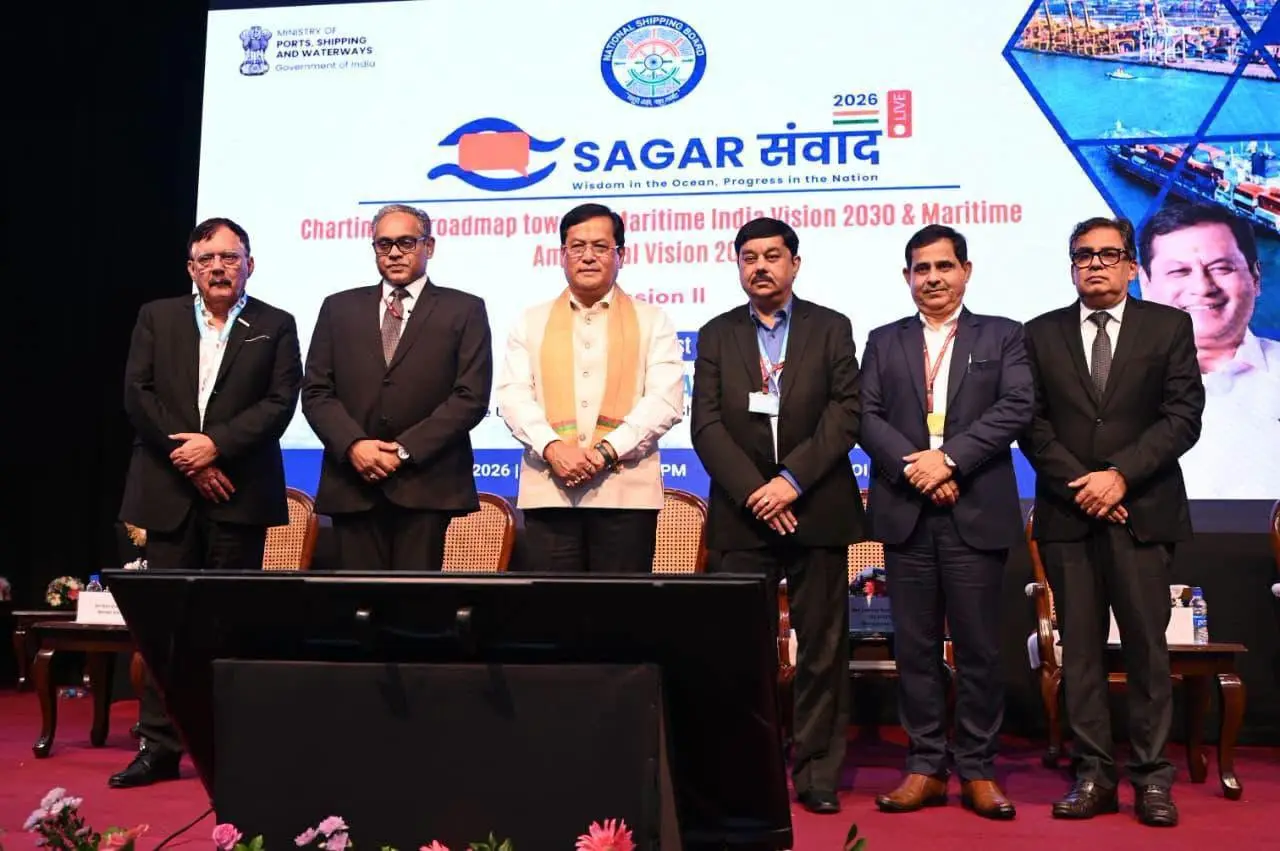
India plans 100 ships in five years
The National Shipping Board’s first Sagar Samvad puts a number on the freight India pays out, and a roadmap against it.
India pays foreign shipping lines about $75 billion a year to move its cargo, Minister of State for Ports, Shipping and Waterways Shantanu Thakur said at the first Sagar Samvad of the National Shipping Board on 25 August 2026. A five-pillar roadmap proposed at the dialogue could add 100 vessels to the Indian merchant fleet within five years.
The obstacle the roadmap has to clear is stated in the same release. Operating a ship under the Indian flag costs 16% to 20% more than operating a foreign-registered vessel, on account of import taxes, seafarer wage deductions, freight taxes and higher capital costs. Until that gap narrows, tonnage will keep registering elsewhere whatever the fleet target.
Ports Minister Sarbananda Sonowal set out a port capacity target of 10,000 million tonnes a year by 2047, and the dialogue also covered the ₹10,000 crore Container Manufacturing Assistance Scheme.
One qualifier: 100 vessels is a stated potential outcome of a proposed roadmap. It is not an order book, a shipyard allocation or a sanction, and no tonnage or financing line is attached to it.
BLITZ RECOMMENDS
The cost premium is the whole problem and it is entirely fiscal in origin. A single reconciliation of the tax treatment of Indian-flag tonnage — import duty on vessels and stores, the treatment of seafarer wages, and the freight tax position — set against the flags Indian owners actually register under would tell the ministry precisely how many percentage points of the 16% to 20% are within its own gift. A fleet target without that arithmetic asks owners to absorb the gap voluntarily.
A third of AMRUT money goes to sewers
Why No photograph of this review could be found on any source carrying a readable licence. PIB’s gallery for 25-26 August 2026 has no Ministry of Housing and Urban Affairs album, and the release sequence across that evening carries no event photographs. The Commons fallback for illustrative sewerage works could not be opened in this run.
Instead Blitz-owned data card built on the sanctioned-against-delivered pairing, which is the point of the story: sewerage and septage allocation of ₹71,133 crore against ₹47,230 crore of projects under way; 36% of investment sitting in 6.8% of projects; and the 48.76 lakh new connections and 60.59 lakh upgrades marked clearly as expected on completion, not delivered. A card showing only sanctioned figures repeats the press note instead of reporting it. Footer: Source: Ministry of Housing and Urban Affairs; Blitz India analysis.
The urban ministry’s review puts sewerage at 36% of approved investment and 6.8% of approved projects.
Sewerage and septage management carries ₹71,133 crore of the AMRUT allocation, the Ministry of Housing and Urban Affairs said after a review of AMRUT 2.0 and CITIIS 2.0 chaired by Minister of State Tokhan Sahu on 25 August 2026. Against a total approved project cost of ₹1,97,191 crore, that is 36% of the investment sitting in 6.8% of the projects by number.
That ratio is the story. Sewerage is capital-heavy and slow: a small number of large works absorbing more than a third of the money, against a much larger number of cheaper water-supply and green-space projects.
Some 394 sewerage projects worth ₹47,230 crore are under way. On completion they are expected to give 48.76 lakh households new sewerage connections and to benefit a further 60.59 lakh households through upgrades to existing systems — about 1.09 crore households in all, in a programme covering 500 cities with roughly 7.41 crore urban households.
Both household figures are expected outcomes on project completion. Neither is a count of connections delivered, and the ₹71,133 crore is allocated rather than spent.
BLITZ RECOMMENDS
The gap between a sanctioned sewerage project and a working household connection is where this programme is judged, and the ministry reports only the first. A quarterly public dashboard showing connections actually given against connections sanctioned, city by city, would let a municipal commissioner and a resident read the same number — and would surface the last-mile connection charge, which is the item that most often stops a laid sewer from reaching a house.
India and Canada open a finance channel
Why The event has not happened. The inaugural dialogue is on 27 August 2026 and this file is dated 26 August, so no photograph of it exists — and a file portrait of either minister placed against this copy would read as a picture of the dialogue and misrepresent the date. PIB’s gallery has no album for the Toronto leg.
Instead Blitz-owned data card in two panels. Panel one, the dialogue: the two principals with their offices, the date, and India-Canada trade in goods and services for the last three years. Panel two, UPI at ten: 24,162 crore transactions worth ₹314 lakh crore in 2025-26, 703 banks against 44 in 2016-17, and the 11-country footprint with the caveat that this is merchant acceptance rather than a domestic system abroad. Footer: Source: Department of Finance Canada; Ministry of Finance; Blitz India analysis. For any 27 August follow-up, check the PIB gallery album for the dialogue and read the licence on that page.
A first standing finance-ministers’ dialogue with a G7 economy, and a payments rail offered as the instrument.
India and Canada hold the inaugural Finance Ministers’ Economic and Financial Dialogue on 27 August 2026, hosted by Canada’s Finance Minister François-Philippe Champagne. Canadian direct and indirect investment in India passed $110 billion in 2024, according to the media advisory issued by the Department of Finance, Government of Canada, on 21 August 2026.
Addressing the Indian community and business leaders in Toronto on 26 August 2026, Finance Minister Nirmala Sitharaman set a two-way trade target of C$70 billion by 2030 and put India’s real growth for 2025-26 at 7.6%, according to Business Standard, which reported the address. She cited the C$2.6 billion uranium supply agreement concluded with Cameco earlier in 2026 as the shape such a relationship can take, and offered the Unified Payments Interface as a rail for India-Canada digital finance.
That offer is worth sizing. In its tenth year the interface carried 24,162 crore transactions worth ₹314 lakh crore in 2025-26, with 703 banks live against 44 in 2016-17, the Ministry of Finance said on 24 August 2026. July 2026 was its peak month at 2,366 crore transactions worth ₹29.88 lakh crore, and the ministry put its share of global real-time payment volume at 49% in 2025, on the International Monetary Fund’s recognition. It operates in 11 countries.
Two qualifiers travel with those numbers. The 49% is a share of volume, not value — the ministry’s own release records that 86% of merchant transactions on the interface are micro-payments below ₹500. And operating in 11 countries chiefly means acceptance at selected merchants for Indian travellers, not a domestic payments system in those countries.
BLITZ RECOMMENDS
A dialogue’s value is the schedule it leaves behind. Fixing the next meeting and its agenda heads at this first sitting — rather than leaving them to be arranged later — is what turns a launch into an institution, and it is the item most often left out of a first-round communiqué. Pension-fund access to Indian infrastructure and a settlement arrangement for the payments rail are the two heads that would justify a second meeting.
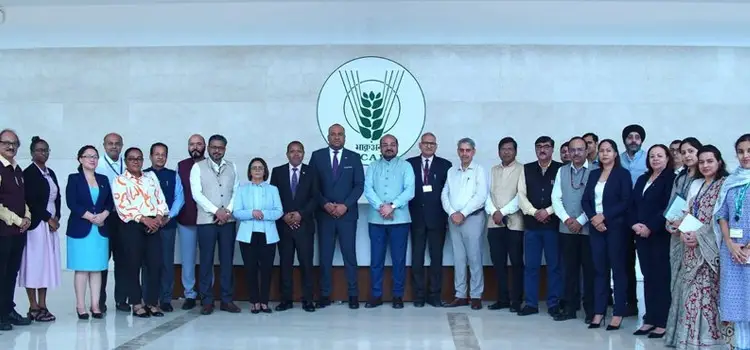
Seychelles seeks a fisheries pact with India
A blue-economy meeting that trades laboratory access and hatchery engineering rather than cargo.
Seychelles has asked India for a bilateral memorandum of understanding on fisheries and aquaculture, at a high-level meeting held on 25 August 2026 and reported by the Department of Fisheries. The two sides discussed marine aquaculture, modern hatcheries, tuna fisheries, stock assessment and post-harvest engineering, and agreed to work towards a structured annual work plan, reciprocal laboratory access and joint pilot projects.
India’s side brought scale to the table. National fish production stands at 19.7 million tonnes and seafood exports at $8.46 billion, the department said, though its release attaches no reference year to either figure, which leaves both undated until a second source supplies the year.
The trade between the two countries is small — Seychelles imported $91.73 million from India in 2024 and exported $2.46 million to it, on figures the Seychelles side gave and ANI reported. The value here is not cargo. It is the technical exchange: laboratory reciprocity is what decides whether an Indian testing report is accepted by a foreign inspection authority, and that is the gate Indian seafood exports pass through.
Nothing was signed. The memorandum remains a request from the Seychelles side.
BLITZ RECOMMENDS
Reciprocal laboratory recognition is the item on this list with the shortest route from meeting to money, and it is the one most likely to be left in a work plan. The Department of Fisheries and the Export Inspection Council should treat mutual recognition of test reports as a standalone deliverable with its own timeline, rather than a clause inside a wider memorandum that has yet to be signed.
India certifies its first 15-metre sleeper bus
A type approval that settles what the longest permissible intercity coach may carry.
The International Centre for Automotive Technology has issued India’s first compliance certificate for a 15 metres multi-axle sleeper bus, the Ministry of Heavy Industries said on 26 August 2026. The vehicle was tested for structural strength, emergency safety, fire safety and passenger comfort under the automotive standards AIS-119 and AIS-153 and the applicable provisions of the Central Motor Vehicles Rules.
The configuration matters more than the length. A fully sleeper variant carries 42 berths; a hybrid variant carries 21 berths alongside 42 seats. On a long intercity route that is the difference between one departure and two.
This is a type approval for one manufacturer’s model. It is a regulatory clearance, not a production run, an order or a road deployment, and permission to run a 15 metres vehicle on a given route remains a State transport authority’s decision.
BLITZ RECOMMENDS
A central type approval that State permit rules do not recognise produces a certified vehicle nobody can operate. The Ministry of Road Transport and Highways and the States should settle route and permit treatment for 15 metres multi-axle coaches alongside the certification, so the first operator to buy one is not the party that discovers the gap.
Netflix funds 100 places at India’s creative institute
A streaming platform underwrites fees and curriculum at a government institute for animation, visual effects and gaming.
The Indian Institute of Creative Technology and Netflix will fund scholarships for 100 students across six professional programmes — two one-year diplomas and four six-month certificate courses — covering up to 80% of course fees, the Ministry of Information and Broadcasting said on 26 August 2026. The programmes span visual effects, virtual art department workflows, character animation, interactive comics, media technology workflow and e-sports management, with two curricula built to Netflix recommendations and international industry standards.
The arrangement follows the Prime Minister’s meeting with Netflix Co-Chief Executive Ted Sarandos on 5 August 2026. The institute’s campus at Film City, Goregaon, extends to 10 acres and is still being developed.
Two things the release does not carry: any rupee value for the platform’s contribution, and any placement commitment. The 80% is a ceiling, not the support each student receives.
BLITZ RECOMMENDS
Curriculum written to one platform’s specification trains for one buyer. The institute should publish the two Netflix-informed curricula openly, so that other studios and the animation, visual effects, gaming and comics industry bodies can align to the same standard — which is what turns a hundred funded places into a qualification the whole sector recognises.
What the Station Audit Asked For
Oversight Desk. The Comptroller and Auditor General’s report on passenger amenities at non-suburban stations, the Ministry of Railways’ reply, and the seven things audit wants done.
Minimum Essential Amenities are not an aspiration. They are a codified entitlement attached to a station’s category, and a passenger has already paid for them in the fare. Report No. 31 of 2026 of the Comptroller and Auditor General, tabled on 12 August 2026, measures the distance between the entitlement and the platform.
Audit sampled 512 non-suburban stations across 16 Zonal Railways — 187 Amrit Bharat stations and 325 others — covering funds and amenity works from 2019-20 to 2023-24, and consultative committees, water quality and complaints for 2022-23 and 2023-24.
Its central finding is that 458 of the 512 stations, or 89%, were short of one or more Minimum Essential Amenities, and 54 had no shortfall at all.
Broken down by amenity, 42% of sampled stations were short of fans, 40% of water coolers and 27% of drinking-water taps. Some 379 stations had no platform shelter over the boarding area used by general second-class coaches. On sanitation, 491 of the 512 — 96% — had neither bio-toilets nor waterless toilets. Audit also recorded the presence of total coliforms and Escherichia coli in drinking water, with shortfalls in testing for residual chlorine.
On accessibility, 227 stations — 44% — were deficient in ramps for Divyangjan and 128 had no wheelchair. Of stations in the NSG-1 to NSG-3 categories, 82% of 159 had no help booth. Of 374 Divyangjan passengers audit interviewed, 131 — 35% — said the amenities were inadequate.
WHAT THE MINISTRY SAID
The Ministry of Railways replied to audit in September and November 2025, and its replies are carried in the report alongside the findings.
On the amenity shortfalls, the Ministry acknowledged the deficiencies and described the deviations as “temporary in nature”, attributing them to “re-categorisation and upgradation of stations, yard remodeling”, and said that “substantial compliance is generally ensured”. It accepted that completion is affected by “statutory clearances and brownfield challenges, including shifting of utilities, speed restrictions”.
On accessibility, it said amenities are “being provided in a phased manner” under the Rights of Persons with Disabilities Act, 2016 and the guidelines of November 2023, “subject to priority and availability of funds”.
It also put substantial delivery on the record. As of 30 September 2025, 1,673 escalators had been provided at 419 stations and 1,889 lifts at 714 stations. Audit’s objection to both replies is narrower than the headline suggests: not that nothing is being done, but that no action plan or timeline was furnished against which anyone, the Ministry included, can measure it.
THE FINDING UNDERNEATH THE FINDINGS
Two of the report’s own columns, read together, say the problem is not money.
Budget grants for passenger amenities ran 36% to 44% under-utilised across 2019-20 to 2023-24. Over the same period, of 395 amenity works examined, 59% ran late — by one year to more than four — and 41% finished on time. A programme cannot be simultaneously short of funds and unable to spend the funds it has. What the pairing describes is a planning and sequencing constraint.
The monitoring machinery that would have surfaced it had stopped turning. Audit records that in no Zonal Railway were the Zonal and Divisional Railway Users’ Consultative Committee meetings held at the prescribed frequency during 2022-24, that Service Improvement Group inspections were not conducted at numerous A1 and A category stations, and that as of March 2024 no Zonal Railway had operationalised the station-wise webpages on amenities and sanitation it was instructed to publish.
STATUS OF THE REPORT
This matters for how the report reads. These are final audit findings in a report laid before Parliament, not draft paragraphs, and the Ministry of Railways has replied and its replies are on the record. No parliamentary committee has yet pronounced on the report: it was tabled on 12 August 2026, no Action Taken Note is due, and nothing in this account carries a committee’s view.
AUDIT’S OWN RECOMMENDATIONS
The report ends with seven, and they are specific enough to be actioned. Achieve the prescribed Minimum Essential Amenity norms at all stations within defined timelines. Prepare and implement station-wise, time-bound action plans for the recommended and desirable amenities. Implement the accessibility provisions of the Rights of Persons with Disabilities Act, 2016. Strengthen sanitation and garbage management so amenities are clean and functional round the clock. Comply with the prescribed protocols for inspecting water supply systems and testing drinking water against every parameter of the Uniform Drinking Water Quality Protocol. Restore regular functioning of the consultative committees and Service Improvement Groups, with documentation and follow-up. And strengthen passenger-facing monitoring — anti-littering enforcement, grievance redressal, and publicity of complaint registers.
BLITZ RECOMMENDS
Start with the calendar, because it is free. Restoring the Zonal and Divisional consultative committee meetings to their prescribed frequency, and the Service Improvement Group inspections at A1 and A category stations, costs a diary rather than capital. It is the cheapest of the seven recommendations and the one that would surface the other six.
Switch on the webpages. Station-wise publication of what each station is entitled to converts an audit paragraph into a check any passenger can run. It was already instructed; it needs implementation, not a fresh decision.
Put the drinking water first. Recommendation five asks only for compliance with a protocol that already exists. Given that audit detected total coliforms and Escherichia coli, it is both the most immediately actionable item in the report and the most urgent.
And give every station a dated plan. The Ministry’s replies show real delivery on escalators and lifts and no timeline against which to read it. A station-wise, time-bound plan, published, would let the Ministry claim its own progress with evidence — which is the answer to an audit finding, not a concession to it.
India’s Own Small Jet Engines
Research Desk. CSIR-NAL puts three indigenous gas turbines on the table, and the laboratory’s own datasheet shows how far each has travelled.
CSIR-National Aerospace Laboratories, Bengaluru, put three indigenous gas turbine engines on public display at CSIR headquarters in New Delhi on 25 August 2026, in the presence of the Chief of Integrated Defence Staff, Air Marshal Tejinder Singh. The Ministry of Science and Technology released an account of the event the same day.
The three are a rising thrust ladder: the NJ-05 at 5 kg thrust, the NJ-50 at 50 kg and the NJ-100 at 100 kg. These are not aircraft engines in the airline or fighter sense. They are the propulsion units that sit inside a jet-powered target drone, a loitering munition, a drone interceptor or a compact missile — a compressor, combustor and turbine working at around a hundred thousand revolutions a minute inside a casing about the width of a coffee mug.
The engineering content, as the release puts it, is in high-speed turbomachinery and high-temperature combustion.
R. Prathapanayaka of CSIR-NAL made the technical presentation. The laboratory’s Director, Abhay A. Pashilkar, said Indian industry, including the aerospace start-up base, has the potential to manufacture the engines at scale. CSIR’s Director General, N. Kalaiselvi, heads the parent council.
WHAT THE LABORATORY’S OWN DATASHEET ADDS
The PIB release states thrust ratings and nothing further. The laboratory’s own technology datasheet for the NJ-5 — the same engine PIB writes as NJ-05, 50 newtons being about 5.1 kilograms-force — carries the specification and, more usefully, the status.
That engine delivers 50 newtons design thrust and 75 newtons maximum, runs at 1,00,000 revolutions a minute, has a pressure ratio of 2.0, a mass flow of 0.20 kilograms a second and a specific fuel consumption of 0.234 kilograms a newton-hour, in a 116 millimetres casing weighing 1.2 kilograms. The datasheet records it at technology readiness level 9 — development complete, flight tested, production ready — developed between 2019 and 2022, with commercialisation “under progress”.
That status attaches to the smallest engine of the three and to no other. For the NJ-50 and the NJ-100 no test record, endurance figure or readiness level is stated in any document the desk could open, and the flight-tested claim must not be carried across to them.
For comparison within the same laboratory, CSIR-NAL’s 50 newtons-class valveless pulsejet, developed in 2023, sits at readiness level 5 — tested, not commercialised.
WHY IT MATTERS
The gap is stated by the developing laboratory itself, on its own technology page: no indigenous micro gas turbines are available in the Indian market.
Policy has closed one door and left the other open. DGFT Notification No. 54/2015-2020 of 9 February 2022 prohibited the import of drones in built-up, completely-knocked-down and semi-knocked-down form, with carve-outs for research and defence — but expressly permitted the import of drone components. India therefore stopped importing airframes while continuing to import propulsion. An indigenous engine family is the piece that closes the second door.
The ecosystem being served is real and countable. PIB’s own backgrounder of 17 February 2026 records 38,575 civil drones on the DGCA register as of 9 February 2026, 39,890 certified remote pilots, 244 approved training organisations and a ₹120 crore production-linked incentive outlay for drones.
The incumbent is identifiable. PBS of the Czech Republic sells the TJ40-G2, rated at 395 to 425 newtons, weighing 3.80 kilograms, with a ceiling of 9,000 metres and a time between overhaul of up to 50 hours, on the manufacturer’s own product page — and it markets it in India through PBS India. The NJ-50, at roughly 490 newtons, is aimed at a class already on sale here.
WHAT IS NOT YET ON THE RECORD
Funding: no scheme, agency or amount appears in the release, the CSIR account or the laboratory datasheet. Patents and licensing: no application, grant, transfer or licensee is stated anywhere; the only entry is the laboratory’s own “commercialisation under progress”. Manufacturing: no partner firm is named, no order exists, and no timeline is given.
The honest constraint is service life. Small turbojets in this class are short-life items — the nearest published comparator states a time between overhaul of up to 50 hours — and CSIR-NAL states no life figure for any of the three. Until it does, India’s position against that benchmark is not established. Nor is there a qualification campaign on the record for the two larger engines; an unveiling is not a qualification.
BLITZ RECOMMENDS
Publish the readiness ladder for all three engines. The laboratory already does this well for the NJ-5. Doing the same for the NJ-50 and NJ-100 — readiness level, hours run, altitude and endurance tested — would let an Indian airframe integrator design against the engine rather than wait for it, and it costs nothing but a datasheet.
State the life figure. Time between overhaul is the number a buyer of an expendable-class engine actually procures on. Its absence, not the thrust rating, is what will send a purchase order to Velká Bíteš.
Close the components gap in the same order it was opened. The 2022 notification restricted drone imports while leaving components open, and that was the right sequence for an industry with no engine. With an engine family reaching readiness, the Department of Defence Production and the Ministry of Civil Aviation now have the basis to phase a propulsion-content requirement into procurement — with enough notice for the laboratory’s manufacturing partner, once one is named, to build the line.
Name the partner. The DRDO Gas Turbine Research Establishment’s route with a private precision-engineering firm on its expendable turbojet is the template. Potential to manufacture is not a contract, and the distance between the two is where the readiness level 9 of 2022 has been sitting.
A Phone Reads the Alzheimer’s Signal
Research Desk. A Bengaluru laboratory’s fluorescent probe and smartphone reader, and the exact distance between what it has shown and what it is for.
Confirming amyloid build-up in a living person means a positron emission tomography scan or a magnetic resonance image — machines that exist in a few dozen Indian hospitals and cost more than most families will spend. A group at the Jawaharlal Nehru Centre for Advanced Scientific Research, Bengaluru, has published work aimed squarely at that constraint.
The molecule is called TZ-48. It is dark until it binds to amyloid-beta fibrils, and then it glows. Two properties take it past being a stain. It does not merely brighten: it changes its fluorescence lifetime, the few billionths of a second over which its glow decays, and that lifetime signature is a fingerprint independent of how much probe was added or how far the dye has faded under the lamp. And it crosses the blood-brain barrier, so it can be used in a living animal rather than only on a slide.
On top of the molecule the group built ADxFluor, a smartphone-based reader: the phone camera captures the probe’s response in a serum sample and an application converts it into a figure for amyloid-beta load.
The work appears in ACS Chemical Neuroscience, online on 18 June 2026 and in the print issue of 5 August 2026, under six authors all at the Bengaluru centre — Krithi K. Bhagavath, Madhu Ramesh, Yogendra Kumar, Sabyasachi Mandal, Hiriyakkanavar Ila and the corresponding author, T. Govindaraju, who chairs the New Chemistry Unit and runs the Bioorganic Chemistry Laboratory there. The Ministry of Science and Technology issued its account on 25 August 2026.
WHAT THE PAPER ESTABLISHES
The published abstract reports a dissociation constant of 41 nanomoles a litre and a limit of detection of 68 nanomoles a litre, selectivity over off-target species, real-time tracking of aggregation, passage across the blood-brain barrier, and imaging that allows early visualisation and staging of amyloid burden in Alzheimer’s-model mouse brains. It reports quantitative detection in serum distinguishing Alzheimer’s-model mice from healthy mice.
Everything demonstrated in a living subject is in mice. The abstract reports no human patients, no human cohort, no sensitivity or specificity against a clinical reference standard and no comparison against amyloid imaging.
That distinction matters because the general-readership accounts of the work describe the intended clinical use, and the paper’s own abstract is narrower and animal-bounded. Where the two differ, the paper governs. Between mouse serum and human serum sit interference from human blood proteins, the effects of age and other conditions, and a validation cohort benchmarked against an accepted reference. The stated limit of detection of 68 nanomoles a litre is exactly where that question will be settled: amyloid-beta circulates in human blood at far lower concentrations, and the abstract claims no human serum sensitivity figure.
The professional position elsewhere is the same. On 16 May 2025, when the United States cleared its first blood-based test for use in diagnosing Alzheimer’s — for adults aged 50 and over already showing signs and symptoms — the Alzheimer’s Association’s own statement was that there is no single stand-alone test to diagnose the disease. A blood-based test is an adjunct inside a clinical work-up, not a verdict.
WHY INDIA IS THE RIGHT PLACE FOR IT
Dementia here is large, under-diagnosed and diagnosed late, and it is late precisely because confirmation needs a machine that is scarce. The US National Institutes of Health’s Fogarty International Center, reporting a nationwide study published on 13 January 2023, put 8.8 million Indians aged 60 and over as living with dementia, a prevalence of 7.4% in that age group. The estimate rests on clinical consensus ratings for 2,528 participants in the Longitudinal Aging Study in India, modelled onto 28,949 seniors.
A serum assay read by a phone, if it validates in humans, addresses the Indian constraint exactly: not the absence of a diagnosis but the absence of the instrument that gives it.
WHO PAID, AND WHAT IS NOT STATED
The paper’s funding record names four funders — the Indian Council of Medical Research, the Anusandhan National Research Foundation, the Council of Scientific and Industrial Research and the Bengaluru centre itself. No amounts are stated. The presence of an award from the Anusandhan National Research Foundation is worth noting on its own: this is the new apex research funder’s money visible on a published result.
No patent application or grant, no technology transfer and no licensee for TZ-48 or ADxFluor appears in the release, the ministry’s account or the article metadata. No human validation study, clinical partner, hospital cohort, regulatory pathway or timeline is stated anywhere. An in-vitro diagnostic in India needs a licence from the Central Drugs Standard Control Organisation under the Medical Devices Rules; no application is on the record.
The same laboratory’s therapeutic candidate for Alzheimer’s, TGR63, is described on its faculty page as under clinical study with a pharmaceutical company. That establishes the group has a translation route. It is a different molecule and says nothing about where TZ-48 stands.
BLITZ RECOMMENDS
Fund the human validation cohort now, not after the next paper. The single step between this result and a usable Indian test is a properly powered human serum study benchmarked against an accepted reference standard. The Indian Council of Medical Research and the Anusandhan National Research Foundation have already funded the chemistry; the cohort is a smaller ask than the discovery was and it is where the value is realised or lost.
Pair the laboratory with a memory clinic. Institutions running cognitive-disorder clinics hold the banked serum and the clinical staging that a validation study needs. A named hospital partner would shorten this by years and costs the funders nothing to arrange.
File the patent position and say so. A diagnostic platform with no stated intellectual-property position is a platform another jurisdiction can build on. Publishing the filing status alongside the paper is normal practice and it is the item a licensing partner asks for first.