Blitz India Business
India’s journey since 2014 reflects a decisive shift towards dignity, opportunity, and inclusive progress. The past 12 years have been characterised by a purposeful transformation of governance, enabled by ambitious programmes and reforms.
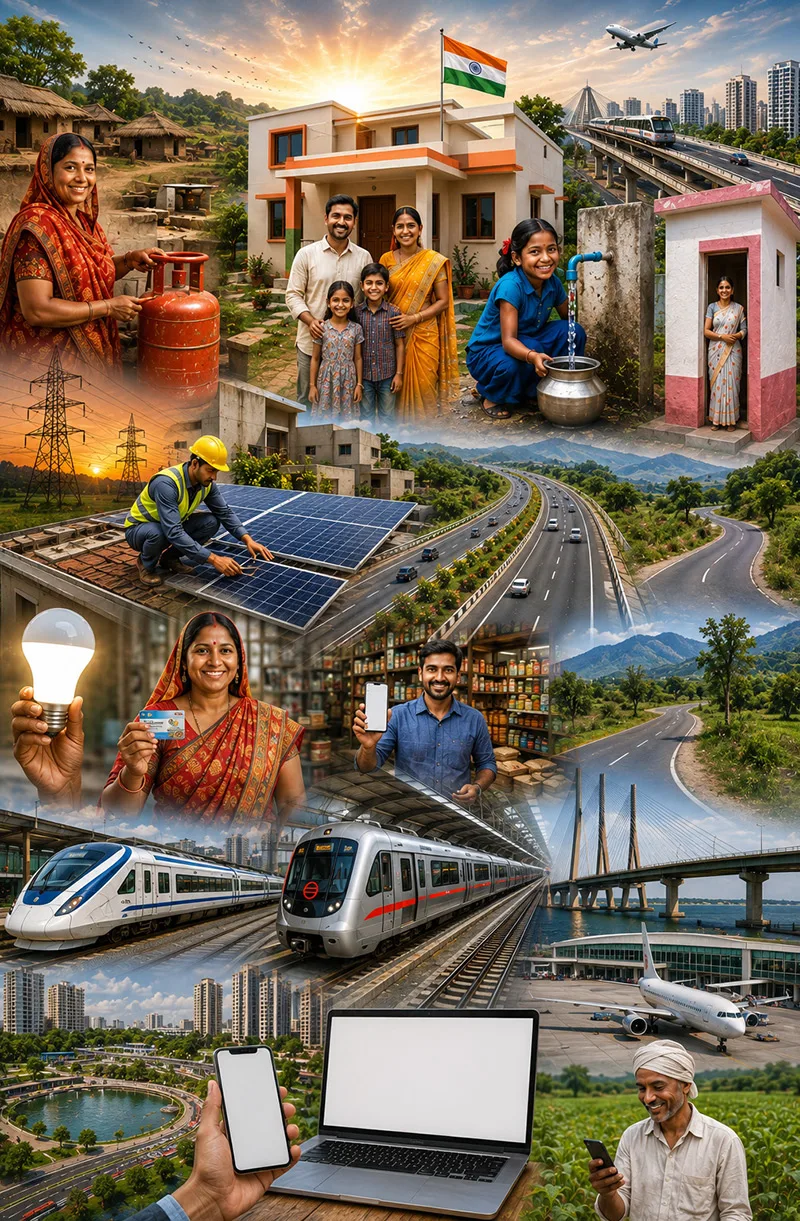
Secure homes under Pradhan Mantri Awas Yojana, clean fuel through Pradhan Mantri Ujjwala Yojana, and safe drinking water under Jal Jeevan Mission reshaped everyday life. Sanitation improved nationwide through the Swachh Bharat Mission, while reliable electricity reached millions of households through SAUBHAGYA. Transport and connectivity expanded at historic speed, with new highways, tunnels, bridges, metro networks, and regional air routes.
Financial inclusion through Pradhan Mantri Jan Dhan Yojana and Pradhan Mantri Mudra Yojana empowered citizens with banking, credit, and security. Urban transformation under Atal Mission for Rejuvenation and Urban Transformation strengthened infrastructure and services across thousands of towns. Digital reforms deepened participation, accountability, and trust in governance. Together, these initiatives created a new environment of comfort, security, and opportunity.
Before 2014, many citizens lacked essential services for a dignified life. Rural women faced challenges without clean cooking fuel, safe drinking water, and sanitation facilities. Targeted missions were launched to address these gaps
Govt housing delivery
The Pradhan Mantri Awas Yojana (PMAY) was launched in 2015 for urban areas and it expanded to rural areas under PMAY-Gramin in 2016, fundamentally redefining the ambition and delivery of affordable housing.
Since its inception, over 1.25 crore houses have been sanctioned under PMAY-U. The PMAY-G, launched in 2016, provides Rs. 1.20 lakh and Rs. 1.30 lakh per house in plain areas and in hilly and difficult-terrain areas. Between 2016 and 2026, a total target of 3.98 crore houses was registered for construction. Of these, 3.91 crore houses have been sanctioned, out of which 3.05 crore houses have been completed.
Launched in 2015, the Atal Mission for Rejuvenation and Urban Transformation (AMRUT) addressed the basic service gaps in a far wider set of urban centres.
Access to essentials: Before 2014, many citizens lacked essential services for a dignified life. Rural women especially faced challenges without clean cooking fuel, safe drinking water, and sanitation facilities. Targeted missions were launched to systematically address these gaps at scale across the nation. The results have been transformative.
Cooking practices
Pradhan Mantri Ujjwala Yojana (PMUY), launched in May 2016, transformed rural cooking practices by ensuring access to clean LPG connections. The scheme expanded nationwide, achieving its initial target of 8 crore connections by September 2019. To cover remaining households, Ujjwala 2.0 was introduced in August 2021 with a target of 1 crore additional connections. This target was achieved by January 2022.
Jal Jeevan Mission: With its goal of Har Ghar Jal, the Mission has delivered rapid expansion in piped water access. At the time of JJM’s launch in 2019, only 3.23 (16.72 pc) crore rural households had tap water connections. As of June 2026, over 15.86 (81.94%) crore households enjoy clean piped water.
Swachh Bharat Mission: Launched in 2014, it provided toilets to all rural households, ensuring dignity and hygiene across villages. Sanitation coverage rose sharply from 39 per cent in 2014 to 100 per cent in 2019.
Power For all: Over the last twelve years, India has transformed power generation, transmission, and last-mile supply. The result is more light, more comfort, and more dignity in every home.
Generation capacity
Total installed power capacity has more than doubled in the last 12 years. It rose from 248 GW in FY 2014 to over 532 GW by March 2026. Renewable sources now make up more than half of this capacity.
Power to every home: The Pradhan Mantri Sahaj Bijli Har Ghar Yojana (SAUBHAGYA), launched in 2017, gave free last-mile connections to unelectrified rural and urban homes. By March 2022, about 2.86 crore households had received an electricity connection.
PM Surya Ghar: Launched in February 2024, this scheme helps families install rooftop solar panels with a generous central subsidy. By May 2026, over 40 lakh households had installed rooftop solar systems.
UJALA Scheme: Under the Unnat Jyoti by Affordable LEDs for All (UJALA) Scheme, 37 crore LED bulbs were distributed in the last 12 years, saving Rs.19,153 crore in household savings annually.
Transport, connectivity
Connectivity is the strength of development, shaping opportunities and improving ease-of-living nationwide. Between 2014 and 2026, India transformed transport across roads, rail, aviation, and urban transit at a rapid pace.
Roads and NH: India’s road network expanded significantly between 2014 and 2026, reshaping connectivity and daily mobility. At 63.73 lakh km, it is now the second-largest road network globally. National highways grew nearly 61 pc, from 91,287 km in FY14 to 1,46,572 km in March 2026.
A total of 3,644 km of access-controlled high‑speed corridors/expressways are now operational nationwide, reducing travel time and congestion. By March, 22,590 km of roads were completed under Bharatmala.
Pradhan Mantri Gram Sadak Yojana: This scheme was launched to provide durable, all‑weather rural road connectivity. It linked villages to markets, schools, and hospitals, easing travel and improving everyday life. Budgetary support rose from Rs 386 crore in 2014-15 to Rs 19,000 crore in 2026-27.
So far, 99.6 pc of eligible habitations have been connected, with completed roads rising from 3.86 lakh km during 2000-2014 to 4.11 lakh km during 2014-2026. The number of bridges has grown from 484 to 10,293 during the same period, reducing isolation and strengthening rural growth.