Blitz Bureau
NEW DELHI: The most revealing number in the Union Cabinet’s new chemical parks scheme is not the money. It is the land. Every park approved under Bharat Audyogik Vikas Yojana — Rasayan, or BHAVYA–Rasayan, must sit on a minimum contiguous area of eight square kilometres — at least 2,000 acres — of encumbrance-free land. That single condition tells you what the scheme actually is. It is not a subsidy for chemical companies. It is an admission that the chemical industry is an infrastructure business, and that India has been asking it to grow on plots too small and too scattered to work.
The financial architecture follows from that diagnosis. The scheme carries a total outlay of ₹3,030 crore — ₹3,000 crore for common infrastructure facilities and basic utilities inside the parks, and ₹30 crore for administration — and runs for five years, from FY2026-27 to FY2030-31. The Centre will provide a grant of up to ₹1,000 crore per park, but only where the state government contributes a minimum of ₹500 crore. Three parks, announced in the Union Budget for FY2026-27, are what the scheme is designed to deliver. The stated objective is to develop the chemical value chain whole — upstream, downstream and ancillary together — rather than in the fragments the sector has grown in so far.
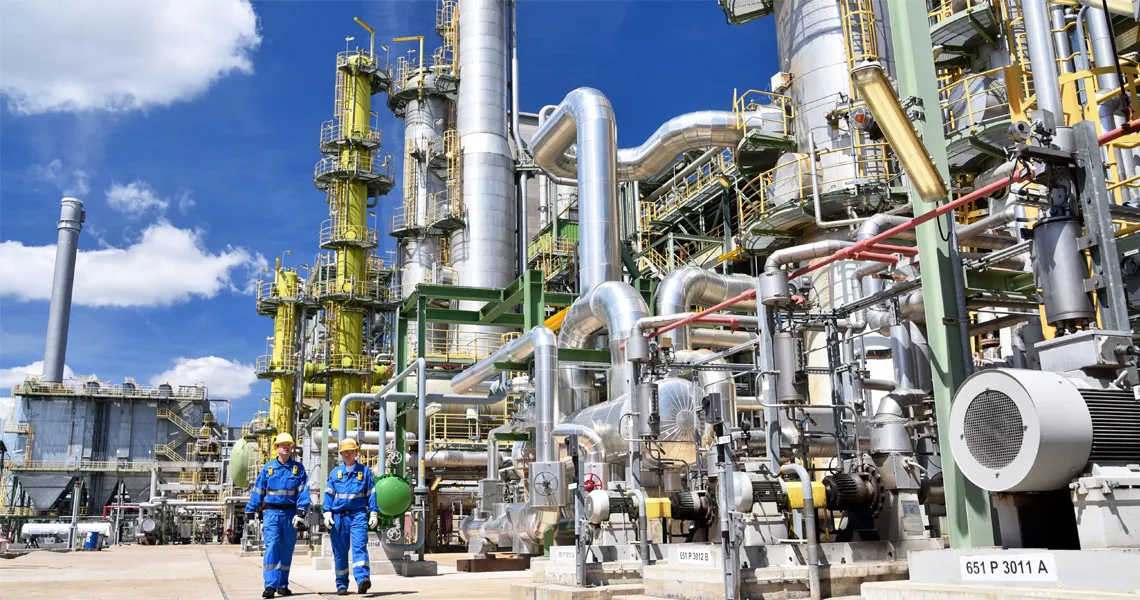
Chemistry is a network business: BHAVYA–Rasayan funds the shared spine — utilities, effluent treatment, storage, logistics — that lets an upstream plant and its downstream customers sit inside the same fence rather than a thousand kilometres apart.
A chemical park is really a set of pipes. What the scheme is buying is not a factory but the distance between two factories — reduced to nothing.
At a Glance
• Scheme: BHAVYA–Rasayan (Bharat Audyogik Vikas Yojana — Rasayan), approved by the Union Cabinet
• Outlay: ₹3,030 crore — ₹3,000 crore for common infrastructure and utilities, ₹30 crore administrative
• Period: five years, FY2026-27 to FY2030-31; three dedicated chemical parks
• Funding: up to ₹1,000 crore per park from the Centre, against a minimum ₹500 crore state contribution
• Land: minimum 8 sq km (2,000 acres) contiguous, encumbrance-free, per park
Why the geometry matters is worth spelling out, because it is the part that rarely survives a headline. Chemical manufacturing runs on integration. The output of one reactor is the feedstock of the next, and the economics collapse if that transfer requires a tanker, a highway and three days. A cluster in which upstream, downstream and ancillary units share a fence line also shares steam, power, effluent treatment, hazardous-waste handling, storage tankage and emergency response — each of which is ruinously expensive to build alone and merely expensive to build once for fifty units. That is precisely the layer the ₹3,000 crore is aimed at. It is the connective tissue, not the organs.
The honest challenge is that the binding constraint is the land, and land is a state subject. Assembling 2,000 contiguous, encumbrance-free acres near a port, a power line and a water source is difficult in any Indian state, and doing it well — with fair compensation, genuine consent and a credible environmental plan — is slower than doing it badly. The requirement that a state put in ₹500 crore of its own is a sensible filter, because a government that has committed capital tends to also commit administrative attention. The constructive way forward is to publish the site criteria and selection process early, involve host communities before acquisition rather than after, and hold the environmental standards inside these parks to a level that makes them a national demonstration rather than a national argument. India already imports a large share of the specialty chemicals its own pharmaceutical, agrochemical and electronics industries consume. Building three places where that chemistry can happen at scale is not industrial nostalgia. It is supply-chain sovereignty, laid out in acres.