Blitz Bureau
NEW DELHI: Energy powers every aspect of modern life – it fuels homes, farms, industries, transport, and the wider economy. As India continues its rapid growth, ensuring a reliable, affordable, and secure energy supply has become a national priority. While the country’s energy needs continue to rise, a significant share of its crude oil and natural gas requirements is met through imports. Expanding domestic production is therefore essential to strengthen energy security, reduce import dependence, and conserve valuable foreign exchange.
Among the country’s key energy resources are hydrocarbons, which occur deep below the land and the seabed. Crude oil and natural gas are the widely used hydrocarbons. That provide raw material for petrol, diesel, LPG, petrochemicals, fertilisers, and numerous industrial products.
India’s offshore basins hold vast untapped hydrocarbon potential. Unlocking these resources requires modern exploration, reliable geological data, advanced drilling capabilities, and a strong domestic supply chain. To accelerate this effort, Samudra Manthan – the National Offshore Exploration Scheme to boost the hydrocarbon exploration and production sector was approved recently.
Risk-sharing approach
Samudra Manthan marks the transition from policy reform to mission-mode implementation. The scheme adopts a risk-sharing approach to attract sustained investment into frontier waters. It seeks to de-risk offshore ventures and encourage private capital, building enduring national capability across the value chain. In doing so, it converts a decade of reform into concrete action at sea.
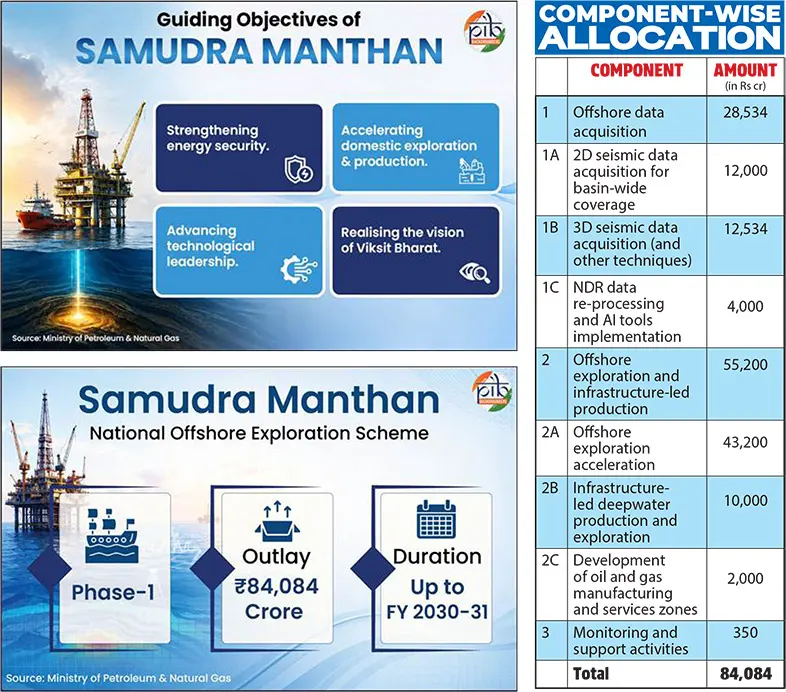
Offshore exploration depends on reliable data, advanced technology, modern infrastructure, and a resilient supply chain. Samudra Manthan brings these elements together through four components.
Seismic surveys: Limited offshore seismic coverage restricted the identification of drill-ready oil and gas prospects. The scheme funds large-scale 2D and 3D seismic surveys with an outlay of Rs 28,534 crore. Advanced technology and Artificial Intelligence will speed up processing and interpretation.
Accelerated exploration: High cost and long gestation make deepwater drilling a risky venture. To share this risk, the scheme allocates Rs 43,200 crore for drilling 60 deepwater and ultra-deepwater wells. Financial support covers up to 50 per cent of eligible drilling cost. The scheme is open to both public and private Exploration and Production (E&P) operators.
Common infrastructure: Many offshore discoveries remain unproduced due to costly infrastructure. The scheme provides Rs 10,000 crore for shared production and evacuation facilities in select basins.
Integrated zone: An integrated oil and gas manufacturing and services zone will be established that will build domestic capabilities in manufacturing, repair, warehousing, engineering, and services.
Enabling ecosystem
Beyond funding, the scheme creates a supportive environment for the entire value chain. Dedicated provisions cover digital programme management for transparent and efficient implementation; capacity building for professionals across the sector; adoption of cutting-edge technologies; continuous stakeholder engagement; and international outreach to attract global partners.
The scheme is designed to create value for the economy and future generations. Subject to exploration success, it is expected to bring wide-ranging gains:
Larger reserves: Increase of over 600 MMTOE of hydrocarbon reserves, expanding resource base from 1.6 billion to 2.2 billion tonnes of oil equivalent.
Higher output: Annual domestic production is targeted to rise from around 62 MMTOE to 80 MMTOE.
Lower import bill: Additional output can cut crude imports by nearly Rs 1 lakh crore every year, generating significant foreign exchange savings.
Investment and growth: The scheme will promote investments across the value chain and drive strong GDP expansion.
Job creation: Large-scale jobs will be created in exploration, production, and allied activities.
Indigenous strength: Domestic manufacturing will deepen under Make in India and Atmanirbhar Bharat.
A series of reforms
In recent years, India has steadily rebuilt its hydrocarbon exploration and production ecosystem. A series of structural reforms has made the sector open, transparent, and investor-friendly.
Opening acreage: More than 99 per cent of the earlier ‘No-Go’ areas have been removed. Over one million square kilometres of the exclusive economic zone is now available for exploration. This zone is the sea area where India holds rights over natural resources.
Licensing framework: The Hydrocarbon Exploration and Licensing Policy (HELP) was launched in 2016. Under it, the Open Acreage Licensing Programme (OALP) was launched which replaced the old nomination-based approach. HELP provides lower levies, uniform licencing, revenue sharing, and incentives to promote hydrocarbon exploration and early production.
Simpler contracts: India moved from Production Sharing Contracts (PSC) to Revenue Sharing Contracts (RSC) in 2016. In PSC, profits were shared between the Government and the contractor after recovery of cost. In RSC, the contractor bears all exploration risks, production and development costs in return for its stipulated share of revenue.
Modern law: The Oilfields (Regulation and Development) Amendment Act, 2025 provided contractual stability and stronger dispute resolution. It recognised integrated petroleum operations and created a contemporary regulatory architecture.
Streamlined process
Enabling rules: The Petroleum and Natural Gas Rules, 2025 operationalised these changes. They promote ease-of-doing business and streamline the administration of petroleum leases.
Level-playing field: The composition and mandate of the Empowered Committee of Secretaries were standardised across all contract regimes. Every operator now enjoys consistent treatment, whenever their contract was signed.
Sharper focus: The performance parameters of Oil and Natural Gas Corporation (ONGC) and Oil India were reoriented towards exploration. This reinforces the national commitment to expanding the domestic resource base.
Good exploration begins with good data. Seismic surveys send sound waves into the earth to map rock layers below the seabed. India has made sustained investments in such geoscientific knowledge through several national initiatives. These include Mission Anveshan, the National Seismic Programme, the Extended Continental Shelf Survey, the National Data Repository, and the Hydrocarbon Resource Assessment Study. Together, these have created one of the world’s most comprehensive geoscientific databases.
The reforms have inspired visible confidence. Nearly 81 per cent of active exploration acreage has been awarded after 2014. Under OALP, 172 blocks covering nearly 3.8 lakh square kilometres have been awarded. Committed investments in these blocks exceed $4.3 billion. Activity on the ground has gathered pace as well. During FY2025‑26 alone, around 674 wells were drilled. Five new discoveries were made and seven discoveries were monetised.
India’s offshore basins hold vast untapped hydrocarbon potential. Unlocking these resources requires modern exploration, reliable geological data, advanced drilling capabilities, and a strong domestic supply chain
Good exploration begins with good data. Seismic surveys send sound waves into the earth to map rock layers below the seabed. India has made sustained investments in such geoscientific knowledge through several national initiatives