Blitz India Business
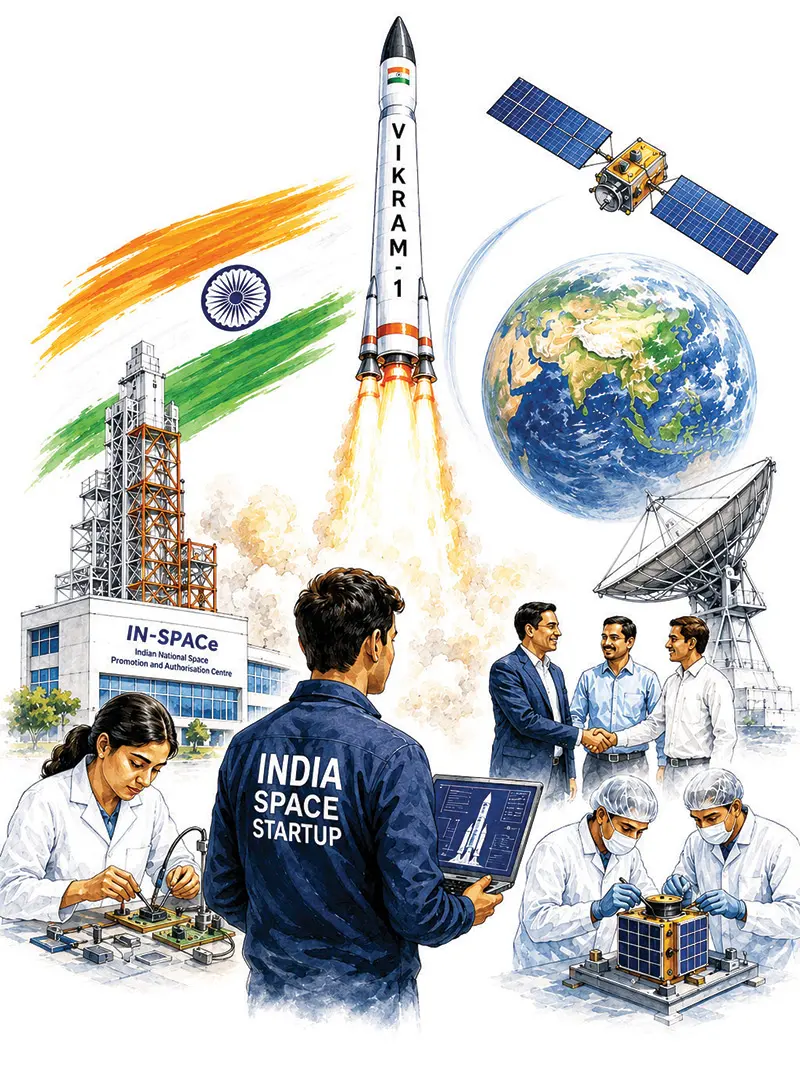
NEW DELHI: The space sector in India is undergoing a historic transformation through the Government’s forward-looking reforms. With the successful launch of Skyroot Aerospace’s Vikram-1, India’s first privately developed orbital rocket, the country’s growing private space ecosystem is demonstrating the impact of these reforms.
The Indian Space Policy 2023 opened the entire space value chain to private participation, fostering innovation, investment and enterprise across the space ecosystem. The domestic industry is now participating in satellite manufacturing, launch services, space applications and downstream services. The space startup ecosystem in the country has grown from one in 2014 to over 400 in 2026.
Reforms in the sector are also accelerating the growth of India’s space economy. Valued at approximately $8.4 billion today, the sector is projected to grow five-fold to $40–45 billion by 2030. It is further aimed to reach $100 billion by 2040. Sustained Government support, enabling regulations and strong public-private partnerships continue to drive this growth.
Profound steps
The Government has taken profound steps by introducing key reforms in the space sector to expand private sector participation and unlock new opportunities for innovation.
Policy notification: The Government notified the Indian Space Policy 2023, allowing non-Government entities (NGEs) to take part across the entire space value chain. The policy aims to drive innovation in technology, encouraging fresh ideas and advancements within the sector. Alongside, it also encourages international collaboration, fostering partnerships that support peaceful exploration of space.
Single-window regulator: The Indian National Space Promotion and Authorisation Centre (IN-SPACe) is acting as an autonomous single-window agency to authorise and promote space activities by Government entities and NGEs. It also provides a stable and predictable regulatory framework and facilitates end-to-end industry participation. Additionally, it enables access to ISRO facilities, technologies and technical expertise, and streamlines approvals through transparent guidelines.
| Sector / Activity | Sectoral Cap | Entry Route |
|---|---|---|
| Satellites – Manufacturing & Operation | 100% | Up to 74%: Automatic Beyond 74%: Government route |
| Satellite Data Products | 100% | Up to 74%: Automatic Beyond 74%: Government route |
| Ground Segment & User Segment | 100% | Up to 74%: Automatic Beyond 74%: Government route |
| Launch Vehicles and associated systems or subsystems | 100% | Up to 49%: Automatic Beyond 49%: Government route |
| Creation of Spaceports for launching and receiving Spacecraft | 100% | Up to 49%: Automatic Beyond 49%: Government route |
| Manufacturing of components and systems / sub-systems for satellites, ground segment and user segment | 100% | Up to 100%: Automatic |
As of June this year, IN-SPACe has registered over 4,500 organisations, issued 133 authorisations, and signed 106 Memoranda of Understanding. Additionally, as of February, it facilitated $150 million in investments into Indian space startups during CY 2025.
Catalysing investment
Seed Fund Scheme: This IN-SPACEe scheme provides early-stage financial assistance to space startups and micro and small enterprises. It supports them in developing innovative space technologies and practical applications for various uses. Moreover, the scheme offers grants of up to Rs 1 crore to eligible applicants working in this space. Along with funding, it also provides mentorship, training, and networking support to help startups grow.
Venture Capital Fund: A Rs 1,000-cr VC under IN-SPACe aims to accelerate private participation in the space sector. This fund provides early-stage capital to promising startups working in space technology and related fields. It also attracts private investment into the sector while supporting the production of domestic space startups. The Fund will be deployed over five years.
Technology Adoption Fund: IN-SPACe introduced a Rs 500-cr Technology Adoption Fund, aiming to accelerate the deployment of indigenous space technologies developed by NGEs. It also supports the transformation of early-stage technologies into commercially viable products for the market. The scheme offers funding of up to 60 per cent of project cost for startups and MSMEs.
Commercial arm
The Indian Space Policy 2023 defined the role of NewSpace India Limited (NSIL) as ISRO’s commercial arm. NSIL manufactures and procures space systems on commercial principles. It also delivers end-to-end space solutions to both Government entities and NGEs. NSIL further expands private participation through PSLV productionisation and small satellite technology transfer.
Over the years, NSIL has witnessed a tenfold increase in revenue, reflecting its expanding commercial footprint in the global space sector. As of December 2025, over 70 Technology Transfer Agreements had enabled the transfer of ISRO-developed technologies to industry.
As of July this year, NSIL has launched a total of 141 satellites, including 138 international/customer satellites and three Indian satellites, reinforcing India’s position as a trusted global launch service provider.
The Foreign Direct Investment (FDI) policy for the space sector was liberalised to make it more investor-friendly. The revised policy permits up to 74 per cent automatic FDI in satellite manufacturing and operations, 49 pc automatic FDI in launch vehicles and spaceports, and 100 per cent automatic FDI in the manufacturing of satellite components and subsystems.
Reforms in the sector are also accelerating the growth of India’s space economy. Valued at approximately $8.4 billion today, the sector is projected to grow five-fold to $40–45 billion by 2030. It is further aimed to reach $100 billion by 2040
These reforms reflect the Government’s commitment to building a stronger, more dynamic space ecosystem that encourages enterprise, accelerates growth, and strengthens India’s global standing.
Innovation unlocked
Government reforms have unlocked innovation, private participation and commercial opportunities across India’s space ecosystem. These reforms have translated into tangible outcomes in launch services, indigenous technology development, public-private partnerships and technology transfer.
NSIL strengthened India’s commercial launch capabilities by executing country’s first dedicated commercial LVM3 mission in October 2022, launching 36 OneWeb satellites into Low Earth Orbit and reinforcing India’s position in the global launch services market.
Vikram-S, launched under Mission Prarambh in November 2022, was India’s first privately developed rocket and the country’s first private launch authorised by IN-SPACe. The technology demonstration mission carried three customer payloads equipped with sensors to validate critical launch technologies for future orbital missions.
Agnikul Cosmos became the first NGE to launch a rocket from India’s first private launch pad (‘Dhanush’) at Sriharikota in May 2024. The mission also demonstrated the world’s first single-piece 3D-printed semi-cryogenic rocket engine.
IN-SPACe approved a Public-Private Partnership for an Earth Observation satellite constellation, led by Pixxel with Dhruva Space, SatSure Analytics India and Piersight Space, to strengthen applications such as agriculture, disaster management, climate monitoring and urban planning.
Technology commercialisation has also accelerated. In February, IN-SPACe facilitated the Rs 511-crore, 10-year transfer of SSLV technology to Hindustan Aeronautics Limited (HAL), enabling industry-led production and launch services.
The Road Ahead
India’s space sector stands at the threshold of a new era, driven by Government-led reforms and a vibrant private ecosystem. The Indian Space Policy 2023, liberalised FDI norms, and dedicated funding initiatives have opened the entire space value chain to any potential players. These reforms have fostered a dynamic ecosystem marked by growing startups, indigenous innovation, and expanding commercial activities.
Vikram-1 liftoff under Mission Aagaman represents more than a technological milestone. It reflects the growing confidence and capabilities of India’s private space industry. The journey from ISRO-led missions to a thriving space ecosystem demonstrates the success of the Government’s reform agenda.
With sustained policy support, public-private partnerships, and technological innovation, India is well positioned to emerge as a leading global space power and a key driver of the future space economy.
As of July this year, NSIL has launched a total of 141 satellites, including 138 international/customer satellites and three Indian satellites, reinforcing India’s position as a trusted global launch service provider