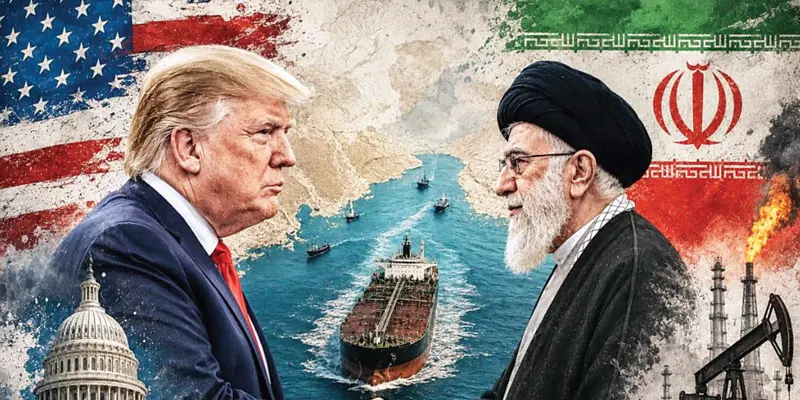
It has been nearly six months since the US war with Iran started. And there is no sign it is going to end anytime soon. The deal that the US President Donald Trump signed at Versailles in June set an ambitious 60-day deadline for ending the war with Iran and reaching an accord on its nuclear programme.
The deadline was August 17, and the two sides are further apart than they were then. US President Donald Trump said that Washington was not seeking an extension of the memorandum of understanding signed.
Talks, such as they are, have focused on reopening the Strait of Hormuz and lifting a US blockade on Iran, both of which were supposed to have happened under the interim deal. There has been no sign of any compromise on the strait, or that detailed nuclear talks have even begun.
For the US, acceding to Iran’s latest demands would mean giving it control over a critical international waterway that carried a ¿fth of the world’s traded oil and gas before the war — and would be tantamount to admitting defeat. Escalating the deeply unpopular war would further draw down US supplies of advanced missile interceptors, jolt the world economy, and drive up gas prices ahead of US congressional elections. So both sides have dug in, hoping the other will blink ¿rst. So far, neither has.
The June deal, known as the Memorandum of Understanding, called for a halt to all military operations and set a 60-day deadline for an agreement to permanently end the war and resolve the longstanding dispute over Iran’s nuclear activities.
Iran’s claim
It called for the Strait of Hormuz to be reopened but gave Iran a vaguely de¿ned role in facilitating traႈc, leaving open the possibility it could charge fees after the 60-day deadline. Iran has seized on that clause to claim control over the waterway.
A week after the deal was signed, Iran began ¿ring on vessels using a route along the coast of Oman, on the other side of the strait, that is overseen by the US military and intended to bypass Tehran’s control.
The US responded by striking Iran, which retaliated by attacking Arab countries hosting American forces, like Jordan, Kuwait and Bahrain. The US canceled waivers issued as part of the deal that had allowed Iran to sell its oil internationally and Trump restored a blockade of Iran’s ports. Each side accused the other of violating the June agreement, of which almost nothing remains.
Pakistan, which played a key role in brokering the June agreement, noted last week that the deadline was August17 while expressing hope it would be extended.
Earlier this month, Iran issued a list of demands for reopening the strait, including the lifting of the American blockade, the withdrawal of US forces from around Iran and the payment of reparations for damage inÀicted in the war started by the US and Israel on February 28.
Trump rejects demands Trump has rejected Iran’s demands — saying it’s Tehran that should pay war reparations and claiming the U.S. controls the strait.
Iran’s economy has been battered by the war and isolation, and inÀation has soared. Traႈc through the Strait of Hormuz, which rose immediately after the interim deal, is back to a small fraction of what it was before the war. Rising prices of fuel and other goods are expected to climb further.
Trump warns Oman
US President Donald Trump has threatened to bomb Oman if it “gets in the way” of US eႇorts to reopen the Strait of Hormuz, putting the traditionally neutral Gulf nation at the centre of Washington’s confrontation with Iran.
In a Fox News interview on August 17, Trump was asked about parallel talks between Iran and Oman on managing shipping through the Strait of Hormuz. “If Oman gets in the way, we’ll bomb…them,” he said. Trump also said Iran should “surrender” to end the war.
In May 2026, after reports that Muscat and Tehran were discussing fees or controls in the strait, he warned that Oman must “behave … or else we’ll have to blow them up.”