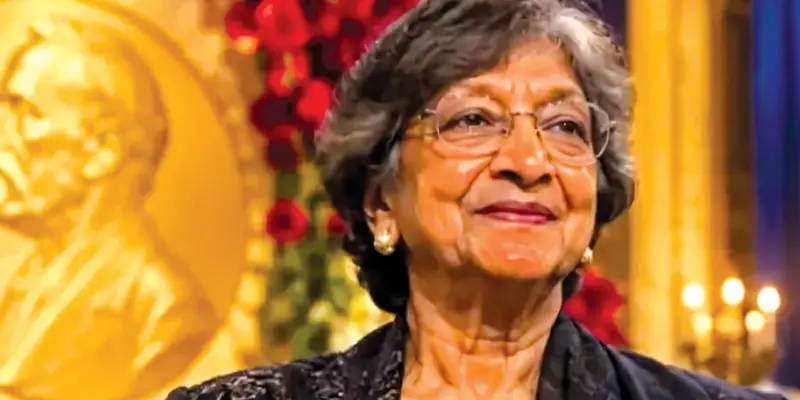
NEW DELHI: Navanethem “Navi” Pillay won the Nobel Peace Prize 2026 on October 9 “for her efforts to promote peace and international law,” the Norwegian Nobel Committee said. Venezuelan opposition leader Maria Corina Machado won in 2025.
Born in Durban on September 23, 1941, to Indian parents of Tamil descent, Navanethem “Navi” Pillay grew up under apartheid and went on to build a career defending anti-apartheid activists and advancing human rights and equality.
Pillay became the first Black woman appointed to South Africa’s High Court in 1995, following the end of apartheid.
In 1967, Pillay became the first woman to open a law practice in South Africa’s Natal province. She defended anti-apartheid activists and fought against the mistreatment of political detainees.
As a judge at the International Criminal Tribunal for Rwanda, she contributed to the landmark Akayesu case, which established that rape and sexual violence could constitute acts of genocide under certain circumstances. She served as the tribunal’s president from 1999 to 2003.
She also served as a judge and president of the International Criminal Tribunal for Rwanda, a judge at the International Criminal Court and the UN High Commissioner for Human Rights from 2008 to 2014.
Pillay earned a master’s degree in law in 1982 and a Doctor of Juridical Science degree in 1988 from Harvard University. She also co-founded Equality Now, an international organisation working to advance women’s rights.
Reacting to her Nobel win, Pillay, 85, said she would “dedicate this award to all of the survivors of international crimes”.
Praise for service
Advocates of human rights and international justice cheered, as Israel and its supporters expressed disappointment, after South African jurist and former UN human rights chief Navi Pillay won the Nobel Peace Prize.
The 85-year-old, who currently serves as an ad hoc judge at the UN’s International Court of Justice, drew huge applause and an outpouring of praise for her work over decades — including as an investigator of crimes in Rwanda, Israel and the occupied Palestinian territories, and as a lawyer who helped defend Nelson Mandela.
Pillay heard the news while attending a forum in Nuremberg, Germany, where the trials of Nazi war criminals helped lay the foundations of international law. She was in the same room where the trials were held when the prize was announced.
The 2026 Nobel Prize winners have been announced across all categories, each receiving a cash award of 12 million Swedish kronor (about $1.2 million). The formal prize-awarding ceremony will take place annually on December 10, 2026. The ceremonies will be held in Stockholm, Sweden and Oslo, Norway.
Recognition for excellence
Physiology or medicine
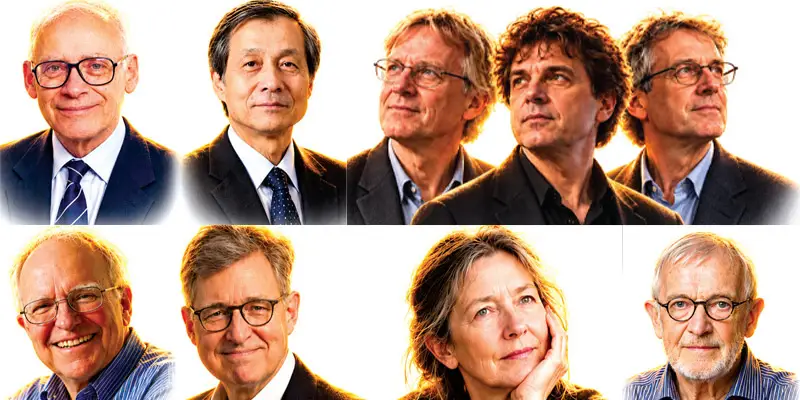
The Nobel Assembly at Karolinska Institutet has announced the 2026 Nobel Prize in Physiology or Medicine jointly for Karl Deisseroth, Peter Hegemann and Georg Nagel “for their discoveries concerning light-gated ion channels and optogenetics.”
Hegemann and Nagel discovered channelrhodopsin, a protein with unique properties.
Deisseroth introduced the gene for channelrhodopsin into nerve cells from rats.
By illuminating the cells with blue light, he was able to trigger a nerve signal.
Physics
The Nobel Prize in Physics 2026 was awarded to Francis Halzen “for decisive contributions to the IceCube Neutrino Observatory and the discovery of high-energy neutrinos of astrophysical origin.”
He has laid the foundation for an entirely new type of astronomy.
Economic Sciences
Robert E. Hall and Michael Woodford are awarded this year’s prize in economic sciences for demonstrating how economic models could be reconstructed to revitalise stabilisation policy. Rather than basing the models on statistical links between macroeconomic variables, such as inflation, production and consumption, they chose to build them on a microeconomic foundation. This encompasses an understanding for how the total mass of individual households and businesses affect the economy through their actions
Chemistry
The Nobel Prize in Chemistry 2026 was awarded to Henri B. Kagan and Kenso Soai “for the discovery of non-linear effects and autocatalysis in asymmetric organic synthesis.”
Their discoveries are hugely important for chemists who design reactions that are utilised in applications such as pharmaceutical manufacturing.
The Nobel Prize in Literature 2026 was awarded to Anne Carson “for her bold and inventive oeuvre that, in playful dialogue with the classical tradition, has created new forms for contemporary literature.”
Born in Toronto in 1950, Carson is known for work that moves freely between poetry, prose and translation, drawing heavily on the literature and mythology of the ancient Greek world.
Her best-known work is Autobiography of Red, a 1998 novel in verse inspired by the fragments of the ancient Greek poet Stesichorus.