Blitz Bureau
NEW DELHI: The list the Department of Defence Production notified on 18 August contains no weapons. It contains 405 items — line replaceable units, sub-assemblies, spares, components and raw materials — and the largest of them would fit in a crate. Sixteen belong to the Indian Coast Guard; 389 come from the defence public sector undertakings. They are drawn from the innards of the Light Combat Aircraft Tejas, the Su-30MKI, the Advanced Light Helicopter Dhruv, the Light Utility Helicopter, the T-72 and T-90 tanks, the BMP-II infantry combat vehicle, the Medium Range Surface-to-Air Missile system, and from warships, radars and sonars. The estimated business potential is ₹3,070 crore, which works out to about ₹7.58 crore an item. Each carries an indicative date after which it may be bought only from Indian industry. This is the sixth such list. The first five carried 5,012 items; with this one the running total reaches 5,417.
Read as a defence story, that is procurement housekeeping. Read as an industrial story, it is something more interesting: a government publishing, years in advance, a schedule of demand. A small firm in Coimbatore or Pune that can machine a particular Su-30 bracket now knows there will be an Indian buyer for it, and roughly when. That is the missing ingredient in most industrial policy — not capital, not tariffs, but visibility. The SRIJAN portal, where the lists live, had carried more than 33,000 items offered for indigenisation by the defence PSUs and service headquarters up to June 2026. The portal is the shop window; the Positive Indigenisation List is the part of the window with a price and a date on it.
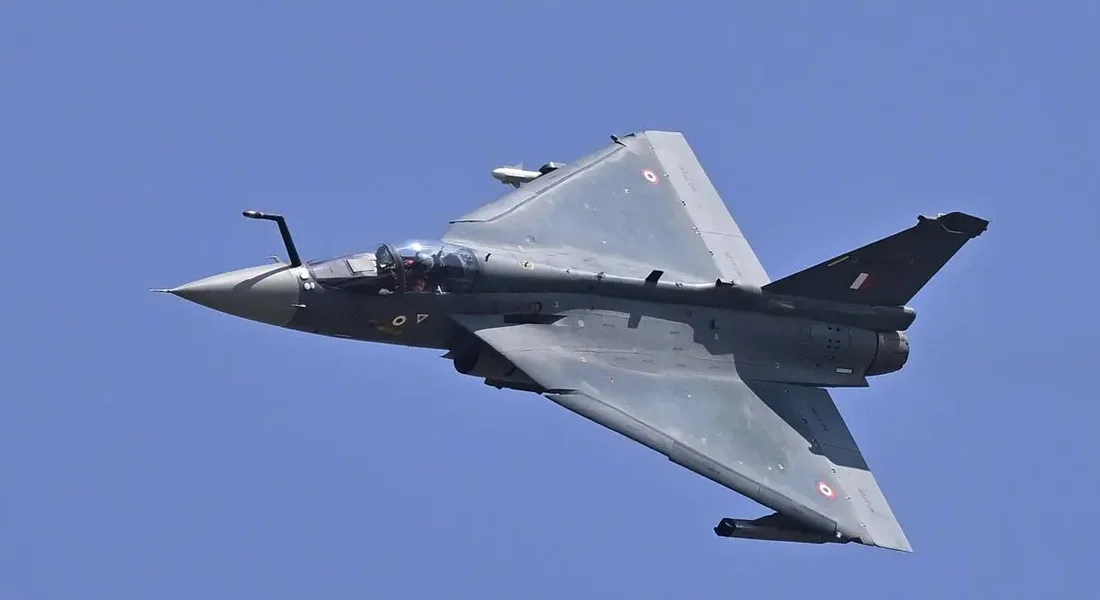
Where the list ends up: A Tejas trainer under construction. Components for the Light Combat Aircraft are among the 405 items added on 18 August 2026 to the sixth Positive Indigenisation List, which now takes the six lists to 5,417 items reserved for Indian industry. Photo: Wikimedia Commons (Creative Commons)
Industrial policy is usually argued about in terms of money. What a small manufacturer actually needs is a date, a specification and a buyer who will still be there when the tooling is paid for.
Why It Matters
• Sixth Positive Indigenisation List, 18 August 2026: 405 items, ₹3,070 crore of business potential — 16 Coast Guard, 389 DPSU
• Six lists together: 5,417 items; more than 33,000 items offered on the SRIJAN portal up to June 2026
• PLI schemes, as on 31 March 2026: over ₹2.40 lakh crore of realised investment and 14.15 lakh direct and indirect jobs across 14 sectors — about ₹17 lakh of investment per job
• Four sectors carry three-quarters of that investment: solar modules ₹64,873 crore, pharma ₹45,158 crore, autos ₹44,326 crore, specialty steel ₹23,896 crore
• Electronics output: ₹13.11 lakh crore in 2025-26, close to seven times the 2014-15 level; exports ₹4.24 lakh crore, about eleven times
• Mobile phones: ₹2.59 lakh crore exported in 2025-26, India’s single largest export line; about 99.2% of handsets used in India are made here
• Semiconductors: 12 approved projects, ₹1.64 lakh crore committed; three packaging plants in commercial production, all in Sanand, Gujarat
Set the indigenisation list beside the Production Linked Incentive schemes and the shape of the strategy becomes legible. As on 31 March 2026, the Minister of State for Commerce and Industry, Jitin Prasada, told the Lok Sabha in July, the fourteen PLI schemes had drawn realised investment of more than ₹2.40 lakh crore and supported 14.15 lakh direct and indirect jobs. Divide one by the other and each job carries roughly ₹17 lakh of invested capital — a reminder that this is capital-intensive manufacturing, not a jobs programme, and that the employment case rests on the suppliers who cluster around an anchor plant rather than on the anchor plant itself. The concentration is striking: high-efficiency solar modules at ₹64,873 crore, pharmaceuticals at ₹45,158 crore, automobiles and components at ₹44,326 crore and specialty steel at ₹23,896 crore account for about three-quarters of the total between them. Four sectors, most of the money.
Electronics is where the argument has already been settled. Production has gone from roughly ₹1.9 lakh crore in 2014-15 to ₹13.11 lakh crore in 2025-26, close to a sevenfold rise; exports from about ₹38,000 crore to ₹4.24 lakh crore, roughly eleven times. Mobile phone exports alone reached ₹2.59 lakh crore last financial year and are now India’s largest single export line, while imports of handsets have fallen by nearly 77% and about 99.2% of the phones Indians use are assembled in India. The word doing quiet work in that sentence is “assembled”. India has won the final stage of the chain and is now spending to move upstream: twelve semiconductor projects approved under the India Semiconductor Mission with ₹1.64 lakh crore of committed investment, of which three — all packaging and testing plants at Sanand in Gujarat — are in commercial production. A fabrication plant is a decade’s work. India is in year four.
The demand side of the story is easy to miss because it does not come with an announcement. The Annual Survey of Unincorporated Sector Enterprises counted 7.92 crore establishments in the twelve months to December 2025, up by about 54 lakh in a year, employing 12.81 crore people. That is roughly 1.62 workers to an establishment: India’s manufacturing base is overwhelmingly a base of very small workshops. Manufacturing units grew 6.48% over the year, and the share of these enterprises using the internet rose from 26.7% to 39.4%. When a defence list names 405 components with dates attached, or when a PLI anchor plant needs a gasket supplier within a day’s truck ride, these are the firms that either can respond or cannot. Their constraint has rarely been ambition. It has been the cost of tooling up for an order that might not repeat.
This week’s news gave the answer its clearest external endorsement. On 20 August, Defence Minister Rajnath Singh and his Japanese counterpart Shinjiro Koizumi signed a memorandum on maritime security in New Delhi covering maritime domain awareness, search and rescue and the protection of sea lines of communication — and, more consequentially for factories, agreed to explore joint development in naval shipbuilding and design, pairing Japanese technology with Indian production capacity. Tokyo revised its defence equipment transfer framework in April, which is what makes such a conversation possible at all. That is the international version of the same proposition the indigenisation list makes domestically: India is being offered the build stage of somebody else’s design.
The way forward is mostly a matter of publishing more, and sooner. Put out the fulfilment record of the five earlier lists — how many of the 5,012 items were actually indigenised by their indicative dates, by whom, and at what cost against the imported part — because a list that is never audited becomes a wish list. Shorten the distance between the SRIJAN portal and a first purchase order for a firm that has never supplied to a defence PSU before. Publish PLI outcomes sector by sector, with disbursement against target, so the gap between committed and realised investment can be read rather than inferred. And keep the small workshop in the frame: 7.92 crore establishments averaging 1.62 workers each is not a weakness to be consolidated away, it is the capillary system of Indian manufacturing, and the schemes that reach it are the ones that will decide whether the next decade looks like the last one in electronics or the last one in fertiliser. India has spent this decade proving it can assemble at world scale. The next test, which the week’s two lists both point at, is whether it can make the parts.