Blitz Bureau
NEW DELHI:A bacterium on the World Health Organization’s critical priority list survives antibiotics by hiding under a shield it builds itself. A laboratory in Bengaluru went looking for something that eats the shield, and found it in the gut of a cow.
Acinetobacter baumannii is a hospital organism. It settles on wounds, catheters, ventilator tubing and bed rails, and it is very hard to remove, because it does not live as loose cells. It builds a biofilm — a community of bacteria wrapped in a matrix of sugars, proteins, fats and loose DNA that works as physical armour. Antibiotics reach the outside of that matrix and struggle to get through it; so do the immune cells that would otherwise finish the job. The organism is on the WHO’s critical priority list for exactly this reason, and a great many wound treatments in ordinary use do nothing to its biofilms at all.
On 25 August 2026 the Indian Institute of Science announced a piece of work that attacks the armour rather than the organism. The study appears in npj Biofilms and Microbiomes under the title “A matrix-targeting enzyme and an engineered bioactive gauze enable resistance-agnostic antibiofilm wound care”, at DOI 10.1038/s41522-026-01115-3. The first author is Reshma Ramakrishnan, formerly a doctoral student in the Department of Inorganic and Physical Chemistry. The corresponding authors are Debasis Das, Associate Professor in that department, and Dipshikha Chakravortty, Professor in the Department of Microbiology and Cell Biology. Kirti Parmar, Velpandi Ramachandran, Debmitra Sen and Raju S Rajmani complete the team.
Why a cow
The reasoning is simpler than it sounds. Between forty-five and ninety-five per cent of a bacterial biofilm matrix is polysaccharide — long chains of sugar — and those chains cross-link with one another to give the matrix its strength. “Polysaccharides are one of the major components,” Das says of the matrix, “constituting between 45% and 95%.” Anything that could cut those chains would weaken the whole structure.
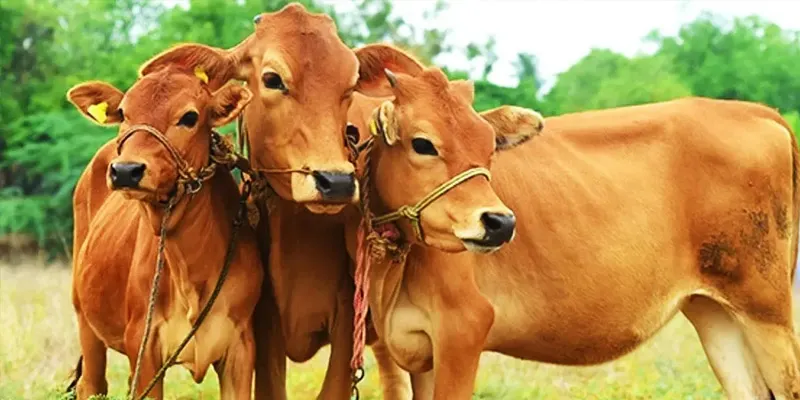
Nature already runs an industrial-scale polysaccharide-cutting operation, and it runs it inside a cow. The bovine rumen exists to break down cellulose, which is itself a polysaccharide, and the microbes living there carry an enormous library of enzymes evolved to do it. The team went to the genomic data from rumen microbes and searched it for enzymes capable of digesting cellulose, on the reasoning that a good cellulose-cutter might also cut the sugars in a biofilm.
One candidate worked. The team named it CRhAB — Cow rumen hydrolase against A. baumannii. It sharply reduced biofilm formation and substantially suppressed the expression of the bacterium’s biofilm-related genes. It then did the same to Klebsiella pneumoniae. “Both A. baumannii and K. pneumoniae are among the most notorious of the ESKAPE pathogen group,” Chakravortty says, “and thankfully, this enzyme acts against both. It’s a dual bacterial strategy with one enzyme.”
CRhAB — what the paper establishes, and what it does not
| Parameter / Aspect | Details |
|---|---|
| Institution | Indian Institute of Science, Bengaluru |
| Departments | Inorganic & Physical Chemistry; Microbiology & Cell Biology |
| Journal | npj Biofilms and Microbiomes (2026) |
| DOI | 10.1038/s41522-026-01115-3 |
| Announced | 25 August 2026 |
| Source of the enzyme | Bovine rumen microbial genomes |
| Targets | A. baumannii and K. pneumoniae biofilms |
| Polysaccharide share of a biofilm matrix | 45 to 95 per cent |
| Stage reached | Enzyme-immobilised gauze, mouse wound model |
| Stage NOT reached | Any human trial |
Source: IISc press release of 25 August 2026 and the cited paper. Compiled by Blitz India. Photograph note: the institute’s own images of the team and the gauze are credited to IISc photographers and are not copyright-free; under Circular BIMG/CIR/2026/02 no agency or uncleared picture runs, and this in-house data card takes its place.
What the study reached, stated exactly
The team immobilised the enzyme in a gauze and tested it on infected wounds in mice. That is the stage the work has reached, and it should be read as nothing more. There is no human trial. There is no clinical result. An enzyme that strips a biofilm off a mouse wound is a serious finding and an early one, and the distance between the two is measured in years and in money.
Ramakrishnan is candid about how ordinary the difficulties were. “Maintaining the enzyme-immobilised gauze over the wound throughout the study was particularly difficult because the mice naturally tried to remove the dressing,” she says. “We had to optimise the experimental setup to ensure that the gauze remained in place while minimising stress to the animals.” The team is now working on a patch-style dressing aimed at diabetic foot infection, on delivery systems for respiratory infection, and on combining enzymes to widen the range of biofilms addressed. The stated long-term goal is an inhalable or nebulisable formulation delivering CRhAB directly to the lungs.
Why it matters here, and not only here
The mechanism is the reason this deserves Indian attention beyond the usual. CRhAB does not kill the bacterium. It removes the bacterium’s defences, which is a different proposition altogether. As Ramakrishnan puts it: “Instead of directly killing the bacteria, it weakens their defenses, potentially restoring the effectiveness of existing antibiotics while reducing the selective pressure that drives antibiotic resistance.”
Antibiotics create the resistance that eventually defeats them, because every course kills the susceptible and leaves the resistant to multiply. An agent that does not kill applies no such pressure. The paper’s own word for this is resistance-agnostic, and in a country where diabetic foot infection, ventilator-associated pneumonia and chronic non-healing wounds are large and growing clinical burdens, an agent that makes the antibiotics we already own work again is worth more than another antibiotic would be.
Two things the announcement does not settle should be said plainly rather than assumed. It names no funding agency, and it states no patent or licensing position. Neither absence is remarkable at this stage of a piece of academic work, and neither should be filled in by inference. Both are questions for the institute’s intellectual property and technology transfer cell, and the answer to the second will decide whether an Indian manufacturer or a foreign one ends up making the dressing.
What would move it forward
The route from here is well trodden and unglamorous: enzyme stability and shelf life at Indian ambient temperatures, cost of production at scale, toxicology, and a regulatory path for what is legally a combination of a biological agent and a device rather than a drug. None of that is research; all of it is expensive, and it is the stage at which good Indian laboratory work has historically stalled.
The constructive step is a small one. A translational package covering stability, toxicology and pilot manufacture, funded through the Indian Council of Medical Research, the Department of Biotechnology or BIRAC and attached to a named tertiary-care partner for a first-in-human wound study, would carry CRhAB across precisely the gap where such work is usually lost. The science has been done in Bengaluru. The decision about whether it becomes a dressing an Indian nurse can open is an administrative one, and it can be taken now.