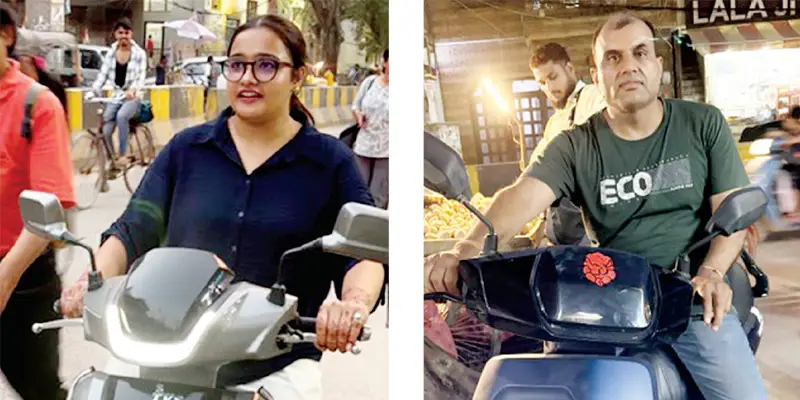
NEW DELHI: For Nishtha Dugan, 22, the Delhi-Gurugram journey is a daily reality. The dashboard on her electric scooter displays its range and other functions. But for her, the attraction is basic: getting to Gurugram and coming back home without waiting at a fuel station.
“It is eco-friendly, plus it is pocketwise very convenient. I really like it,” she says about her EV. In a single night’s charge, she can do around 80 kilometres and it costs her about Rs 12 on electricity, compared to around Rs 120 a day she used to spend on petrol.
Nishtha’s experience is personal, but it illustrates why the economics of electric mobility are becoming harder to ignore. Across India, electric twowheelers are becoming increasingly visible. In the financial year 2025-26 alone, around 1.4 million electric twowheelers were sold, more than half of the entire EV sales in the country. So, why are people making the switch? Is it about environment, Government incentives, new technology, or simply money? For many everyday riders, the answer may be more practical: how much it costs to run the vehicle every day, and how much to maintain.
The EV economics
Sharif Qamar, who leads the Transport and Urban Governance team at The Energy and Resources Institute, TERI, has been driving an EV for several years. He says consumers should not look only at the price they pay when buying the vehicle.
“EVs in terms of upfront cost are still slightly expensive. People are shifting to EVs not only because of the fuel cost, but there are multiple factors,” he adds. The initial price of an electric vehicle can still be higher than that of a conventional petrol vehicle. But the calculation changes if the vehicle is driven every day, particularly over long distances. For someone who drives only occasionally, the calculation may be different. But for a commuter covering tens of kilometres every day – or a taxi driver travelling hundreds of kilometres – the economics become much more compelling.
Fuel price volatility
Harbir Singh, 45, a real estate agent at Deoli on the outskirts of South Delhi, has reached a similar conclusion. He travels around 50 to 60 kilometres a day and charges the vehicle at home. For him, the attraction is simple: less money spent on fuel and no regular visits to a petrol station. His experience reflects another side of the EV transition – the attraction of avoiding petrol altogether and reducing the day-to-day cost of running a vehicle.
“The Iran war and the conflict in the Middle East has shifted people not only to EVs, but also CNG,” says Qamar. The point, he says, is not that every motorist will immediately switch to electric, but the fuel-price volatility can make the EV cost-advantage more attractive. He says the long-term objective is bigger than simply avoiding expensive petrol.
The Delhi Government is also trying to push the transition towards zero tailpipe emissions. The Delhi Electric Vehicle Policy 2026 came into effect on July 1, with incentives, tax-related measures and plans to expand charging infrastructure. EV registrations in the city rose to more than 10,700 during the month. But incentives alone cannot make people buy electric vehicles. The vehicle has to work for them. It has to be affordable, have sufficient range and, most importantly, be easy to charge.
The practical test
For Nishtha and Harbir, charging is not a major problem because they can charge their vehicles at home. That is actually the case for most private EV owners. Qamar says more than 90 per cent of private EV owners charge at home, making residential charging particularly important.
The priority of the Government, he says, should be to ensure that these private owners or prospective buyers of EVs have access to charging points at their own parking places.
That is a reminder that the economics of an EV depend not only on the vehicle itself, but also on the infrastructure around it. But people like Nishtha are least interested in the big policy debate. Her calculation is simple and straightforward – she has a daily commute, needs a reliable vehicle, wants something easy to ride and does not want to waste her time at a petrol pump.
For a country heavily dependent on imported oil, electric mobility also offers a way to reduce exposure to volatile global energy prices. But there are obstacles – the upfront cost of an EV remains higher, charging infra needs improvement, and battery technology and domestic manufacturing have to develop further.
IN A FIRST, alternative fuel vehicles outsell petrol cars
For the first time in the country’s history, alternative fuels – CNG, hybrid and electric combined – overtook petrol in the passenger vehicle market, at 41.95 per cent against petrol’s 40.85 per cent.
Passenger vehicle retails were 4,02,398 units, the best-ever August figure and the first time PVs crossed the four-lakh mark in this month.
Beyond the volume record, the fuel mix reached an inflexion point – alternative fuels (CNG 25.28 pc, hybrid 9.04 pc, EV 7.63 pc) together touched 41.95 per cent, edging past petrol/ethanol at 40.85 per cent for the first time, though petrol still remains the single largest individual fuel.
Dealers attribute the shift to running-cost economics and continuing consumer hesitation around the E20 transition, which is nudging petrol buyers towards CNG, hybrids and EVs.