
Blitz Bureau
An average of more than 1.50 lakh people die in road accidents in India every year.
With increasing number of highways, the death toll is still rising, leaving planners pondering over possible solutions. It is not that these frightening figures cannot be brought down; doing so will require a change in our thought process and an approach that treats driving as a serious responsibility.
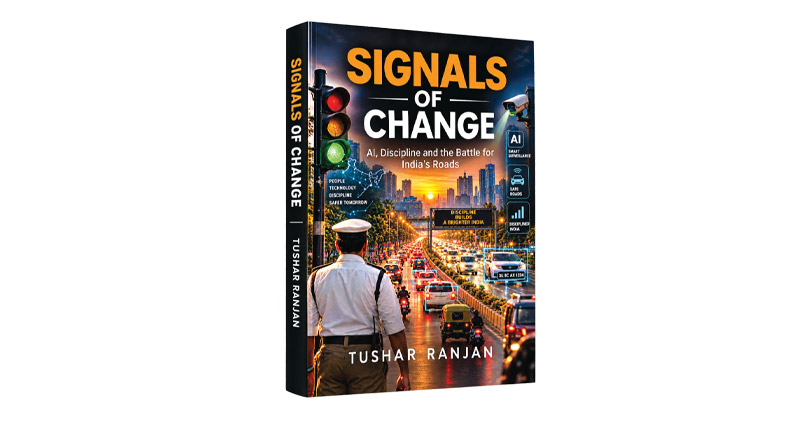
A recently published book, Signals of Change, by Tushar Ranjan discusses these aspects in a simple and logical manner. It explores not only traditional approaches to road safety but also the effective use of AI in trafÏc management. Ranjan is an experienced industry professional and his book, written in a distinctive style, offers a glimpse of his professional understanding of the subject.
“Road safety in India is a task which requires attention from people from every walk of life. From pedestrians and bike riders to vehicle drivers, everyone should be aware of their responsibility towards others and themselves.” He writes.
Specific problems
The book has 15 chapters, each dealing with specific problems and their possible solutions. It begins with trafÏc crisis, presenting the current trafÏc scenario and the technological shift that is taking place. The author raises an important question: Can India synchronise technology, governance and citizen behaviour? He answers this by pointing out that it is ultimately about people. A nation on the move must decide how safely it wants to travel. People often talk about technology, but technology alone cannot solve the problem. The solution lies elsewhere – trafÏc reform, synchronisation and behavioural change are the key.
The book also discusses accountability and governance. Government agencies and the administration must take responsibility because when accountability becomes collective, road safety becomes consistent. He suggests that road safety and safe driving practices should be included in school curriculum. He argues that technology, by itself, cannot solve the problem; proper synchronisation between human behaviour and technology is essential.
Distinctive style
Signals of Change has been written in a distinctive style, with separate lines and bold points that enable readers to grasp important observations easily. Subheadings have been used effectively to draw the readers’ attention to specific subjects. Discussing trafÏc management at length, the author rightly observes that it is not merely about signals and sensors; it is about people.
Through this book, Ranjan presents a practical perspective on how India can move beyond simply deploying smarter trafÏc technology to building a smarter trafÏc ecosystem, where technology, accountability, governance and disciplined behaviour work together