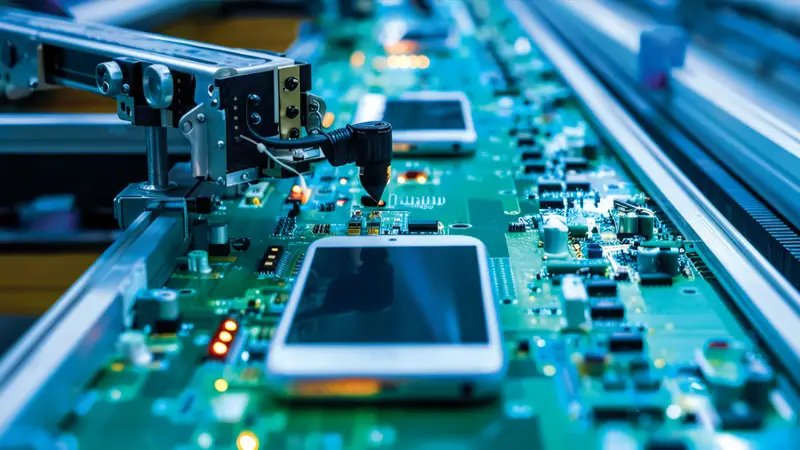
NEW DELHI: India’s electronics sector is undergoing a strategic shift — from being a final-assembly destination to building deep domestic value addition through component manufacturing. Over the past five years, total electronics production has more than doubled, rising from Rs 5.5 lakh crore in 2021 to Rs 12.1 lakh crore in 2026, while exports have surged nearly fivefold, according to a Financial Express analysis based on Jefferies report.
In 2026, electronic goods became India’s third-largest export category by value, with smartphones emerging as the single largest exported product.
Now, with new Government schemes targeting backward integration, the focus is on moving beyond assembly to making the parts inside devices — cameras, displays, batteries, and printed circuit boards (PCBs) — within India.
Mobile manufacturing
Nearly 99 per cent of mobile phones sold in India today are assembled domestically due to the success of the Mobile PLI (Production Linked Incentive) scheme launched in 2021. Companies like Foxconn, Tata Electronics and Samsung have scaled up local production, with India now accounting for over 25 per cent of global iPhone output, the Jefferies report added.
In 2025, India even surpassed China as the top exporter of smartphones to the United States which shows that global firms are also diversifying supply chains away from China.
However, despite high assembly volumes, domestic value addition remains below 15 per cent. Most critical components — such as display modules, camera sensors, and multi-layer PCBs — are still imported.
“99 per cent of phones sold in India are assembled locally; the next growth phase is deeper component localisation and higher domestic value addition,” notes a recent industry analysis.
ECMS: Push for backward integration
To address this gap, the Government launched the Electronics Components and Materials Scheme (ECMS) in April 2025, with an initial outlay of Rs 229,000 crore. Due to overwhelming investor interest, the allocation was raised to Rs 400,000 crore in the 2027 budget — a 75 per cent increase.
The six-year scheme (2026-2032) aims to boost local manufacturing of high-value components and reduce import dependence.
So far, 106 projects have been approved under ECMS, with committed capital expenditure of around Rs 695,000 crore — nearly double the initial target. The Government estimates these investments will produce components worth Rs 53,40,000 crore over the scheme’s lifetime.
Analysts project that ECMS could raise the share of locally made components in mobile phones from less than 20 per cent of the bill of materials today to around 50 per cent by 2032, the Jefferies report states.
Who’s investing in components?
Major global and Indian companies are stepping up. Foxconn, Motherson and Tata Electronics are investing in mobile and IT hardware enclosures. ATL India (part of Japan’s TDK Group) is building a lithium-ion battery plant with Rs 29,000 crore in capex. Wipro Engineering has received approval for a Rs 14,000 crore copper laminates unit.
Among domestic players are Dixon Technologies which has partnered with China’s HKC to set up a display modules unit and acquired a stake in QTech India for camera modules.
Syrma SGS is entering multi-layer and HDI PCB manufacturing in collaboration with South Korea’s Hinhyup, with total ECMS approvals worth Rs 18,000 crore.
Kaynes Technology has secured approvals for multi-layer PCBs, camera modules, and copper-clad laminates (CCL).
“Foreign partnerships (example: Dixon-HKC, QTech; Syrma-Shinhyup) have potential to bridge technology gaps,” the analysis notes, highlighting how joint ventures are helping Indian firms access advanced manufacturing know-how.
Investment outlook
Analysts remain bullish on component manufacturers over original equipment manufacturers (OEMs), as localisation drives the next phase of growth. Within covered stocks, Kaynes Technology is rated a “Buy” due to its shift toward core electronics manufacturing services, with new OSAT and PCB capacities coming online. Dixon and Syrma carry “Hold” ratings, citing valuation concerns and execution risks.
“We prefer component plays as localisation drives the next phase of electronics growth,” the report concludes.
Printed Circuit Boards — especially high-density interconnect (HDI) and multi-layer variants — are a key focus area. India’s PCB market is estimated at $5-7,000 crore, but 85-90 per cent of supply is imported. With an average import duty of around 30 per cent on boards up to six layers, local manufacturing offers significant cost and supply chain advantages.
The ECMS scheme specifically targets this gap, incentivising companies to set up PCB fabs and related material units. This is critical not just for mobiles, but also for automotive electronics, defence systems, and industrial equipment.
MPMS 2.0: Boosting Indian mobile brands
In July, the Government cleared the Mobile Phone Manufacturing Scheme (MPMS) 2.0, with a Rs 625,000 crore outlay over five years. While the first PLI scheme focused on assembly, MPMS 2.0 emphasises value addition, supply chain depth, and critically, building Indian mobile brands with domestic R&D and design patents. The scheme offers additional sales-based incentives for companies that develop and market home-grown smartphone brands.
This comes as iPhone exports from India have sharply risen between 2021 and 2026, reflecting Apple’s strategic shift to use India as a global export hub alongside China and Vietnam.
The ECMS and MPMS schemes align with the Ministry of Electronics and IT’s (MeitY) broader target of achieving $500,000 crore in electronics production by 2030-31 — up from approximately $140,000 crore in 2025. Of this, around $150,000 crore is expected to come from components, marking a decisive move toward self-reliance.
Major global and Indian companies are stepping up. Foxconn, Motherson and Tata Electronics are investing in mobile and IT hardware enclosures. ATL India (part of Japan’s TDK Group) is building a lithium-ion battery plant with Rs 29,000 crore in capex. Wipro Engineering has received approval for a Rs 14,000 crore copper laminates unit.
As NITI Aayog noted in a July 2024 report, while smartphone assembly has seen notable localisation, India remains dependent on imports for hi-tech components due to high capex requirements, long gestation periods, and limited technology transfer. The new schemes now aim to overcome these barriers through targeted incentives, foreign partnerships and scaling operations in India.