NEW DELHI: Fighter aircraft from across continents zipped over the skies of Jodhpur from September 26 to October 12 for Tarang Shakti, one of the largest-ever air exercises in the world. Many wondered what pushed India to undertake such a formidable exercise and put on a display reported around the globe.
No, it is not just aircraft or technology, and not just interoperability, which is the name of the game today. It is, in a sense, the esteem in which the Indian Air Force is held globally, and it also reflects the influence India carries across the globe.
Different measure
Quite often, military exercises are valued and judged by the number of aircraft participating, the complexity of the missions flown, and the sophistication of the weapon systems. But Tarang Shakti must be measured differently. The significance of this exercise involved not just the 40 countries that participated, but also India’s position in the evolving global security matrix.
Till a few years back, most multinational exercises involving India were largely about the country’s participation. Today, India is the organiser, and this has been the template for the last few years. This distinction matters hugely.
Till a few years back, most multinational exercises involving India were largely about the country’s participation. Today, India is the organiser, and this has been the template for the last few years. This distinction matters hugely
Let’s not forget that countries have finite resources and crowded calendars. Aircraft, crews, and the humongous effort that goes into planning logistics for an exercise of this nature cannot be expected of Air Forces around the world, and it reflects the confidence they have in the Indian Air Force to put together an exercise like Tarang Shakti. The scale of participation in Tarang Shakti is therefore a measure of the growing weight the IAF carries in international military circles.
The headline was F-35s flying in a multilateral exercise on Indian soil for the first time, but let us not forget that 40 participants, including a large number of countries, were sent as observer contingents to soak in the spirit of the exercise and what they can learn from it.
More interconnected
Air Chief Marshal AP Singh, during his annual press conference on October 3, spoke about the exercises: interoperability, learning from each other, and a shared communications language not limited to English. Coalition air operations succeed or fail on whether crews understand each other’s procedures in real time, and the exercise in Jodhpur will give Air Forces a chance to try and build that. That last phrase is absolutely critical. Coalition air operations, more often than not, succeed or fail on communication.
That evolution comes at a time when military power is becoming more interconnected than ever before. Future operations, whether combat missions, humanitarian deployments or crisis responses, will demand cooperation between countries that may never have trained together in the past. Understanding another Air Force’s procedures, communications protocols and operational culture is no longer a luxury. It is an operational necessity. Such familiarity cannot be improvised when a crisis erupts. It must be cultivated through exercises like Tarang Shakti.
Beyond the complex series of exercises, events like Tarang Shakti help create a template for cooperation. Learn how others approach missions. Round teams absorb each other’s maintenance practices and learn what they can from one another. Coordinating complex flight movements is an absolute art form, and such exercises give ground teams a huge learning opportunity. Relationships that appear routine during peacetime often become invaluable when emergencies emerge.
Indigenous Tejas
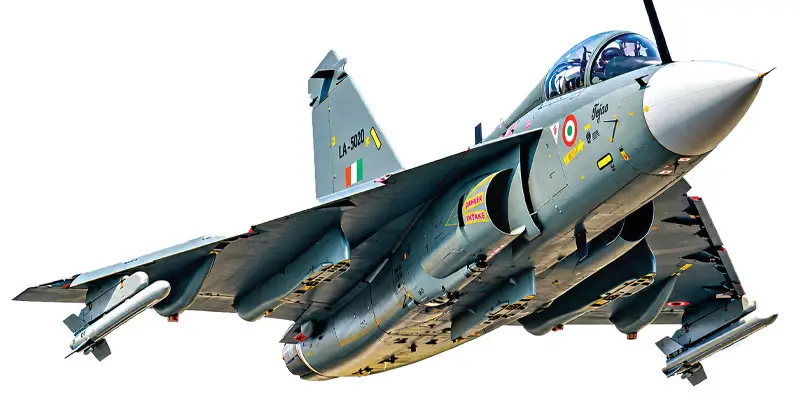
And let us not forget: there is a quiet satisfaction in watching a Tejas line up on the same runway as an F-35. For years, the indigenous fighter was discussed mostly in terms of its delays. At Jodhpur, it was judged the way every aircraft ought to be, by what it does in the air. Flying wingtip to wingtip with American stealth fighters, French Rafales and UAE F-16s, the Tejas was working the same composite air packages, the same beyond-visual-range problems and the same suppression-of-air-defence scenarios as its far more celebrated partners, in heat that punishes engines and airframes alike.
The Su-30MKI and the Rafale in IAF colours brought their own weight to the mix. What matters is that Indian crews and Indian machines were not mere participants. They were shaping it, and foreign pilots were seeing, at close range, an Air Force whose hardware has earned a place in the formation.