NEW DELHI: Any Indian who was at the Global Fintech Fest (GFF) at the Jio World Centre in the second week of September couldn’t have been prouder to see the razzmatazz and the open adulation of India’s absolute dominance in the fintech sector.
No, this admission was not simply for the UPI, but for India’s ability to scale up and say, “That’s done. Let’s move on to the next thing.” And what they have unveiled in terms of fintech, too, is what’s delighted and warmed the cockles of most of those present. For the record, in August 2026 there were 24.51 billion transactions, R 29.82 trillion in value, and the daily average was 791 million transactions/day (August 2026).
Engrossing, motivational
It is a hugely engrossing and motivational opening address. The Prime Minister, who inaugurated the fest, was widely quoted as challenging the industry to view current achievements as merely a starting point rather than a final destination. He drew upon his 25 years of experience in policy and governance to assert his philosophy of relentless progress.
“When one goal is achieved, I get busy preparing for an even bigger goal., he said and added, stop admiring what UPI has already done and start pushing fintech into the places it hasn’t gone yet – credit, insurance, savings, pensions. As he outlined, a street vendor who has a UPI QR code can now get a formal loan thanks to this same data trail. He said the ultimate proof of success would be India’s payments stack exported country by country, with Bengaluru the most successful corridor already running with Singapore.
The idea is that a rupee sent home from anywhere, be it Dubai or Toronto, moves at the same lightning speed and cost as a rupee sent across a Mumbai or a Delhi neighbourhood.
Speed of innovation
And it’s this speed of innovation that the PM was demanding. That was evident in many of the products that were on display. For example, an ATM built on Android software is completing assessment in real time and onboarding a rural borrower and printing a RuPay card before you can say ‘namaste’. In another corner, an AI agent is not just approving a flight booking and paying for it, but ensuring that all credits and debits are done seamlessly, without a human tapping a screen, without an OTP, and without a moment’s delay.
It’s also the extraordinary side of a merchant with just a smartphone, able to take contactless card payments that once required a bulky POS machine networked to a bank. Mind you, all this is in real time. This is not proof-of-concept work.
Nonetheless, the most significant part of the PM’s interest to the industry had nothing really to do with digital payments or expanding the stack globally. He outlined four conditions that are critical if the industry has to expand into the next level:
–Cybersecurity of global class, real-time, constantly updating, and not retrofitted into existing frameworks
–Data protection standards: The gold standard for public approval- that is written by the industry for the industry
–A regulator-industry relationship that moves not at bureaucratic speed, but at the speed of technology and, most importantly,
–Aa Fintech Consumer Protection Index that reflects the marketplace and ensures that trust in a fintech company, tangible and believable
Transformative acts
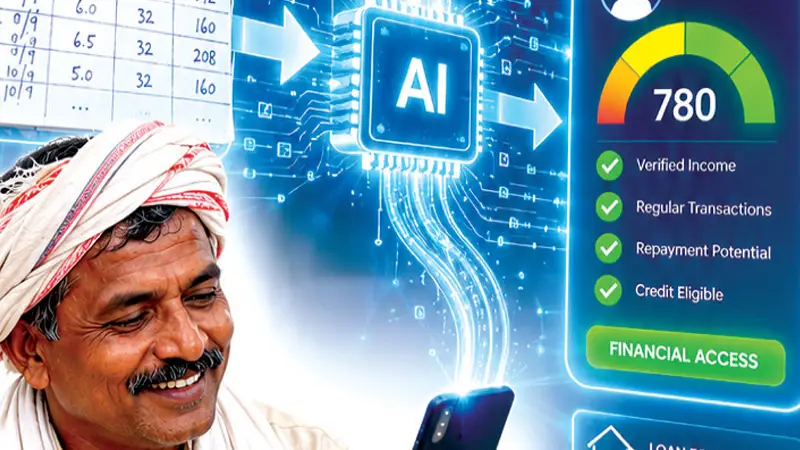
The Prime Minister’s vision was reflected perfectly by Perfios, which demonstrated their application to him. It showed an AI system reading a farmer’s daily milk-collection accounts to create a credit file from zero, all-ready inside of a minute – something that would take a financial identity, a salary slip, and a minimum of several years of banking history.
It is this sort of innovation that has caught the imagination of global financial pundits. Central bankers flew in from Seychelles and Zimbabwe and Georgia. The Bank of England sent its payments chief. Banque de France, the SEC, the Bank for International Settlements, JP Morgan, all sat in the same rooms.
Some years ago, such delegations would arrive in Mumbai not to learn, but to advise and benchmark India against systems already built elsewhere, suggesting they had figured it out and India could now have it. That era is now over. No more do they come to teach They now come to understand what has, for them, been one of the and most transformative developments of the last decade – that how a country of a billion-plus people built a financial identity system, a real-time payments rail, and now an agentic AI layer on top of both, running at volumes their own economies have never had to process, and doing it in production rather than in a lab.
The lesson used to travel from West to East. At GFF 2026, it was unmistakably flowing the other way – and every foreign badge in that hall knew it.
An ATM built on Android software is completing assessment in real time and onboarding a rural borrower and printing a RuPay card before you can say ‘namaste’