Indian Americans have moved from the margins of US politics to the centre of its electoral conversation, with immigration as a major point of discussion in bipartisan agendas.
At around 5.2 million in number, the community is America’s second-largest immigrant group and among its highest-earning and besteducated communities. US President Donald Trump faces the ¿rst major litmus test of his second term in the White House, according to a report by NDTV.
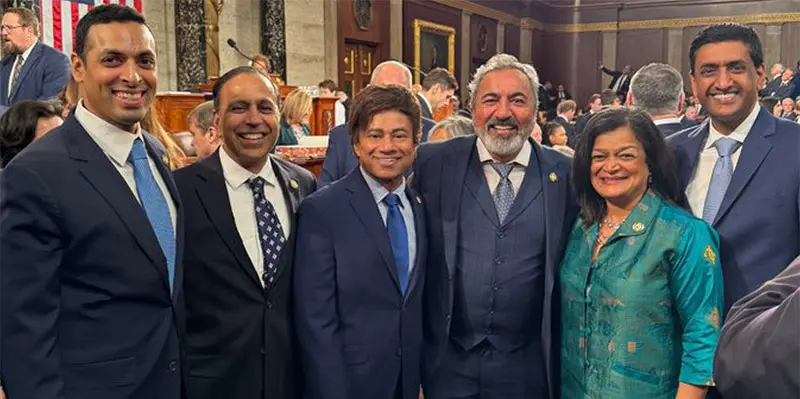
Before 2012, there were only two Indian Americans who had served in US Congress — Democrat Dalip Singh Saund of California, from 1957 to 1963, and Republican Bobby Jindal of Louisiana, from 2005 to 2008. Democrat Ami Bera’s election to California’s 3rd District in 2012 gave a boost to the steady rise of Indian Americans in the House. Ro Khanna, Pramila Jayapal, and Raja Krishnamoorthi arrived in 2017, followed by Shri Thanedar in 2023 and Suhas Subramanyam in 2025.
But this year, the pattern of rise may pause, as the number of Indian Americans in the US House of Representatives is likely to fall from six to four after the November 3 polls, unless Democrats Amish Shah in Arizona or Pia Dandiya in Florida win their closely fought races, with Congressmen Krishnamoorthi and Thanedar preparing to leave the chamber.
‘Samosa Caucus’
All six Indian-American members of the current House, informally known as the “Samosa Caucus”, are Democrats: Ami Bera, Ro Khanna, Pramila Jayapal, Krishnamoorthi, Thanedar and Suhas Subramanyam.
The US has around 2.6 million eligible Indian American voters, according to Washington-based think tank Carnegie Endowment for International Peace. In a midterm cycle where turnout in a handful of closely fought districts and states decides the outcome, even a modest shift in this electorate can matter.
Preference for independents
While Indian A m e r i c a n s continue to lean predominantly left of centre, latest data reveals an electorate that is increasingly nuanced, politically independent, and targetable by both major parties.
For decades, Indian Americans have been treated as a dependable pillar of the Democratic coalition, regularly delivering landslide margins of 70 per cent or more to Democratic presidential and congressional candidates.
However, data from the landmark 2026 Indian American Attitudes Survey (IAAS) — conducted by the Carnegie Endowment for International Peace in partnership with YouGov — con¿rms that the binding ties of party loyalty are loosening.
Party identi¿cation among Indian Americans identifying as Democrats has dropped from 52 per cent in 2020 down to 46 per cent, while the share of self-described political independents has expanded to nearly onethird of the community.