
A century after a Nagpur physician gathered a handful of boys on Vijayadashami, the Rashtriya Swayamsevak Sangh closes its centenary year claiming nearly 90,000 daily shakhas and doorstep contact with more than 10 crore homes.
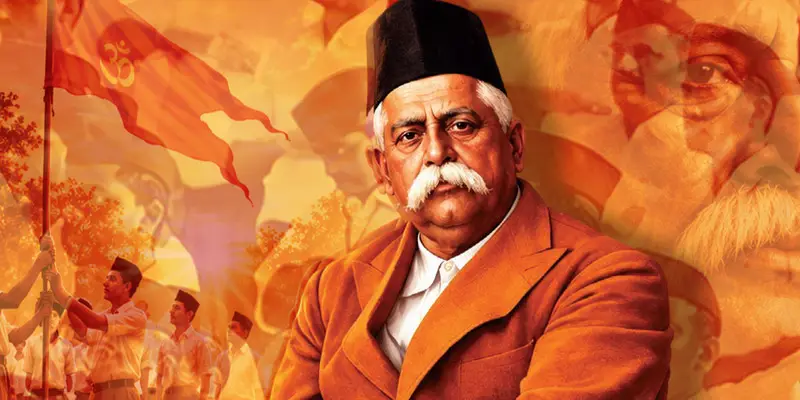
On October 20, at Reshimbagh ground in Nagpur, Sarsanghchalak Mohan Bhagwat performed the Shastra Puja, offered flowers before the image of founder Keshav Baliram Hedgewar and declared the centenary programmes complete. The figures he then read out are the largest the RSS has claimed for itself in a single year: 10,19,88,511 households contacted in 4,61,527 villages and 41,076 urban bastis.
The RSS’ centenary year opened on Vijayadashami 2025, with former President Ram Nath Kovind as Chief Guest, and closed on Vijayadashami this year with Dainik Jagran Editor-in-Chief Sanjay Gupta in that chair. In between, the Union Government released a Rs-100 coin carrying an image of Bharat Mata, which Prime Minister Narendra Modi described as the first such depiction on Indian currency.
Aims and objects
RSS’ stated objects, as set out in its prayer, its founding practice and its leaders’ public statements, run in five strands. The first is to organise Hindu society, which the Sangh defines as a shared civilisation rather than a single creed. The second is to build disciplined, selfless individuals through the daily shakha. The third is social harmony – samajik samarasata – across caste and region. The fourth is service, or seva, from disaster relief to schools in tribal districts. The fifth is to lead the nation to param vaibhav, the summit of its glory.
Bhagwat has restated these aims in terms meant to widen the circle. At Delhi’s Vigyan Bhawan in September 2018, he told an invited audience that Hindu Rashtra does not mean there is no place for Muslims, and that MS Golwalkar’s Bunch of Thoughts was written for its time rather than for all time. In his closing centenary address, he named three bonds that hold Indians together: devotion to Bharat as the motherland, pride in shared ancestors, and the universal values of Bharatiya culture.
The method has not changed in 100 years. A shakha is a gathering of about an hour on an open ground: physical drill and games, patriotic songs, a short discussion, and a prayer before the saffron flag, which the Sangh treats as its guru.
Two parallel tracks
The structure runs on two parallel tracks. Honorary heads, the Sanghchalaks, guide. Secretaries, the Karyavahs, and full-time pracharaks run the work.
At the top, the Sarsanghchalak is nominated by his predecessor and acts as guide rather than executive. The executive authority sits with the Sarkaryavah, the general secretary – at present Dattatreya Hosabale – who is elected every three years by the Akhil Bharatiya Pratinidhi Sabha (ABPS), the Sangh’s highest decision-making body.
Below the national level, the country is divided into kshetras (zones), prants (provinces), vibhags, districts, khands and mandals or bastis. At almost every rung three posts repeat – a Sanghchalak, a Karyavah and a Pracharak.
The pracharak is the hinge of the system: a full-time worker, traditionally unmarried, who can be moved across the country and into the Sangh’s affiliated organisations. Rising through the ranks depends on training camps, the Sangh Shiksha Vargs.
The RSS ran about 37 shakhas in 1929 and 125 by 1933. By April 2014 the figure stood at 44,000 in more than 29,000 locations. The rise since then has been steep.
The Sangh’s own annual reports show 73,117 shakhas in March 2024 and 83,129 a year later – 10,012 added in twelve months, an increase of about 14 per cent. By the close of the centenary year the count had reached nearly 90,000 daily shakhas at 56,000 locations, more than double the 2014 level.
The Centenary Year
The work ran on two tracks: organisational expansion, and contact with society. By the Sangh’s report of October 20, prominent-citizen meetings were held in 1,117 districts with 4,26,497 people attending. Social-harmony meetings took place in 5,036 khands. Hindu Sammelans were held in 34,187 mandals. Youth conferences drew 39,25,225 participants. Bhagwat addressed lecture series in Delhi, Mumbai, Kolkata and Bengaluru, which together drew nearly 10,000 questions from the public.
The message carried to every door was the Panch Parivartan, five changes the Sangh asks of society: social harmony, family values, care for the environment, self-awareness with Swadeshi, and civic discipline.
Beyond the shakhas
The RSS works far beyond its own shakhas, through organisations it describes as RSS-inspired. They span politics (Bharatiya Janata Party), students (Akhil Bharatiya Vidyarthi Parishad), labour (Bharatiya Mazdoor Sangh), farmers (Bharatiya Kisan Sangh), religion (Vishva Hindu Parishad), schools (Vidya Bharati), tribal welfare (Vanvasi Kalyan Ashram) and women (Rashtra Sevika Samiti).
Outside India, the Sangh works as the Hindu Swayamsevak Sangh (HSS); its coordinators explain that the word ‘Rashtriya’ cannot be used on foreign soil. The first overseas shakhas were started in Kenya and Myanmar in 1947 by swayamsevaks who had emigrated. By 2015 shakhas were running in 39 countries. Nepal has the most outside India, and the US counted 172 in 2016. In five Middle Eastern countries, where outdoor gatherings are not permitted, they meet indoors.
The centenary took the Sarsanghchalak abroad himself: a multi-faith meeting in New York on August 29, a conference in Toronto, and six days in London from September 2, where more than 115 UK organisations backed the programme. His message to British Hindus was that Hindutva never asks anyone to betray the country they live and work in.
The Sangh says the centenary was a beginning rather than a finish line. Its stated next phase is to keep contact with the families reached during the year, to push towards one lakh shakhas, and to turn the dialogues opened in India and abroad into a standing programme.
A shakha is a gathering of about an hour on an open ground: physical drill and games, patriotic songs, a short discussion, and a prayer before the saffron flag
AIMS AND OBJECTS
• Vyakti nirman: Building the character of the individual as the base of nation-building
• Sangathan: Organising Hindu society, defined by the Sangh as a shared civilisation rather than a single creed
• Samajik samarasata: Social harmony across caste and region
• Seva: Service, from disaster relief to schools in tribal districts
• Param Vaibhav: Leading the nation to the summit of its glory
• Panch Parivartan: Social harmony, family values, environment, self-awareness with Swadeshi, civic discipline
AT A GLANCE
• Founded: Vijayadashami, Sept 27, 1925, Nagpur, by Keshav Baliram Hedgewar
• Centenary year: October 2, 2025 to October 20, 2026
• Daily shakhas: 90,000 at 56,000 locations
• Homes contacted in the centenary year: 10.2 crore
• Highest body: Akhil Bharatiya Pratinidhi Sabha (ABPS)
• RSS-inspired bodies attending the ABPS: 32
• Abroad: Hindu Swayamsevak Sangh
THE CENTENARY YEAR (In numbers)
• Homes contacted: 10,19,88,511 in 4,61,527 villages and 41,076 urban bastis
• Prominent-citizen meetings: 1,117 districts, 4,26,497 attendees
• Social-harmony meetings: 5,036 khands
• Hindu Sammelans: 34,187 mandals
• Youth conferences: 39,25,225 participants
• Lecture series by the Sarsanghchalak: 4 metros, approx 10,000 public questions
• Daily shakhas added during the year: Around 6,700
(RSS’s own figures, reported on October 20, 2026)
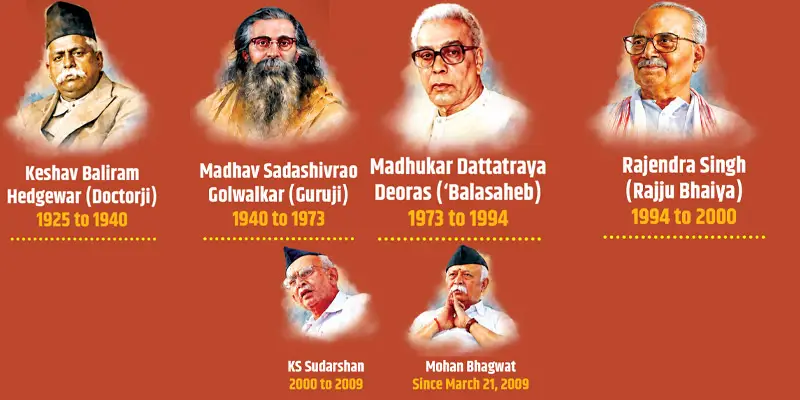
The six Sarsanghchalaks
Keshav Baliram Hedgewar (Doctorji) – 1925 to 1940
Madhav Sadashivrao Golwalkar (Guruji) – 1940 to 1973
Madhukar Dattatraya Deoras (‘Balasaheb) – 1973 to 1994
Rajendra Singh (Rajju Bhaiya) – 1994 to 2000
5KS Sudarshan – 2000 to 2009
Mohan Bhagwat – Since March 21, 2009
RSS arms
• Politics: Bharatiya Janata Party
• Women: Rashtra Sevika Samiti
• Students: Akhil Bharatiya Vidyarthi Parishad
• Labour: Bharatiya Mazdoor Sangh
• Farmers: Bharatiya Kisan Sangh
• Economy: Swadeshi Jagran Manch
• Education: Vidya Bharati
• Service: Sewa Bharati; Vanvasi Kalyan Ashram
• Religion and community: Vishva Hindu Parishad; Hindu Jagaran Manch; Muslim Rashtriya Manch; Rashtriya Sikh Sangat
• Culture and knowledge: Sanskar Bharati; Samskrita Bharati; Vijnana Bharati; Akhil Bharatiya Itihas Sankalan Yojana; Prajna Pravah; Kreeda Bharati
• Professional and borders: Akhil Bharatiya Adhivakta Parishad; Poorva Sainik Seva Parishad; Seema Jagran Manch
• Media: Organiser (English weekly); Panchjanya (Hindi weekly)
• Overseas: Hindu Swayamsevak Sangh (HSS); Sewa International