
While Brazil’s presidential c a n d i d a t e s have not made policy of the Amazon a major campaign topic, climate scientists and environmentalists say the winner of October 25 race could determine whether, and how soon, the world’s largest rainforest could reach a “tipping point,” according to a report in AP.
The key threshold, heavily debated among scientists, in simple terms would be when the dense, humid, moisturegenerating forest shifts to a drier ecosystem. That would come with irreversible consequences for biodiversity and the climate, as the forest absorbs massive amounts of carbon dioxide, a greenhouse gas that drives global temperature to rise. Brazil contains about 60 per cent of the Amazon, which is spread across several countries in South America.
President Luiz Inácio Lula da Silva, trying to win a fourth nonconsecutive term, has sought to curb deforestation and finance a sustainable economy through international donations and public and private funding.
Sen. Flávio Bolsonaro, son of former President Jair Bolsonaro, has said he doesn’t believe climate change is real while casting himself as an environmental defender. He has offered few details on his plans for forest protection or financing. He has called for a “modernization” of environmental laws and giving landowners in the Amazon more decision-making power, which environmentalists say would weaken safeguards and allow deforestation to accelerate.
Deforestation surged under Jair Bolsonaro, who governed from 2019 through 2022, as he dismantled enforcement agencies and loosened environmental norms. Meanwhile, under Lula’s current government, the lowest Amazon deforestation rate on record was announced last week.
Multiple threats
A 2024 study led by Bernardo Flores, a resilience expert, and published in Nature, estimated that 10 per cent to 47 per cent of the Amazon could face multiple threats by 2050, potentially turning parts of the forest into different ecosystems and worsening climate change in the region.
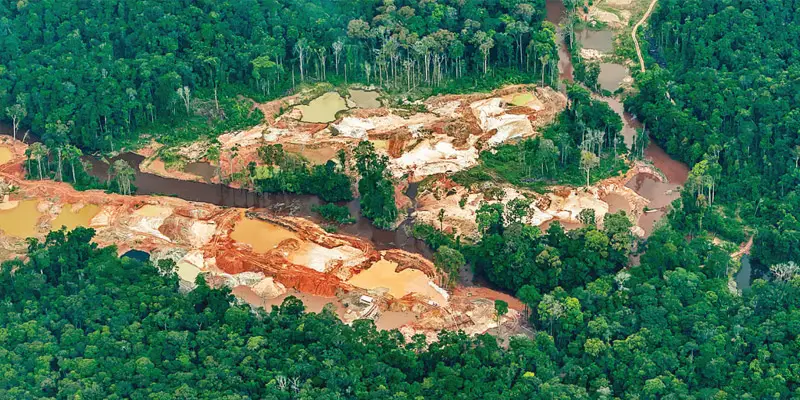
Still, Flores said that we cannot know precisely how close the Amazon is to a tipping point, and forest degradation could mean it is closer than models suggest. “I think the main sign would be the Amazon starting to become very dry and experiencing extensive burning,” he said. Forest degradation, driven by wildfires, logging and drought, affects about 40 per cent of the Amazon and has outpaced clear-cutting in recent years.
Rising temperatures and more frequent droughts are stressing trees and increasing mortality, weakening even intact forests’ ability to absorb more carbon than they release, Lapola, the UN report author, said. Those forests could cease to be a net carbon sink by the mid2030s if the decline continues, though the projection remains uncertain.
Climate scientist Carlos Nobre, among the first to warn that extensive deforestation could push the Amazon past a tipping point, said changes already underway show the forest is approaching that threshold. Parts of the Amazon already emit more carbon dioxide, a greenhouse gas that drives global warming, than they absorb, according to research by Luciana Gatti of Brazil’s National Institute for Space Research.
Her latest study, published recently in Nature, found that the Amazon released an annual average of 1.17 billion tonnes more carbon dioxide than it absorbed from 2010 through 2024. Fires, worsened by climate change, were the main source of emissions.
Drivers of deforestation
Nobre said preventing further damage requires sustained cuts in greenhouse gas emissions and economic alternatives to clearing forests for cattle ranching and farming, the leading drivers of deforestation. “We must achieve zero deforestation, forest degradation and fires,” he said.
At the UN climate talks in 2023, Brazil launched its “Arc of Restoration,” an initiative to replant and foster agroforestry practices to restore 24 million hectares in the southern Brazilian Amazon: 6 million by 2030 and another 18 million by 2050. But meeting such goals could depend on who Brazilians elect now.
The critical threshold
Atipping point is a critical threshold beyond which a small change can trigger a major shift in an ecosystem or climate system. Scientists study such risks in regions or systems like the Amazon, Antarctic ice sheets and circulation patterns of the Atlantic Ocean.
For the Amazon, some research suggests that losing more than 20 per cent of the forest, combined with global warming of around 2 degrees Celsius (3.6 degrees Fahrenheit) since the early 1800s, could trigger widespread changes. About 17 per cent of the Amazon has already been cleared and temperature rise is currently at about 1.4 C (2.5 F).
Crossing that threshold could set off a self-reinforcing cycle in which parts of the rainforest lose their ability to recover from drought, fire and other disturbances, giving way to a drier ecosystem.